Our Indelible Lives

First published June 3, 2010 in Mediapost’s Search Insider

It’s been a fascinating week for me. First, it was off to lovely Muncie, Ind. to meet with the group at the Center for Media Design at Ball State University. Then, it was to Chicago for the National Business Marketing Association Conference, where I was fortunate enough to be on a panel about what the B2B marketplace might look like in the near future. There was plenty of column fodder from both visits, but this week, I’ll give the nod to Ball State, simply because that visit came first.

Our Digital Footprints

Mike Bloxham, Michelle Prieb and Jen Milks (the last two joined us for our most recent Search Insider Summit) were gracious hosts, and, as with last week (when I was in Germany) I had the chance to participate in a truly fascinating conversation that I wanted to share with you. We talked about the fact that this generation will be the first to leave a permanent digital footprint. Mike Bloxham called it the Indelible Generation. That title is more than just a bon mot (being British, Mike is prone to pithy observations) — it’s a telling comment about a fundament aspect of our new society.

Imagine some far-in-the-future anthropologist recreating our culture. Up to this point in our history, the recorded narrative of any society came from a small sliver of the population. Only the wealthiest or most learned received the honor of being chronicled in any way. Average folks spent their time on this planet with nary a whisper of their lives recorded for posterity. They passed on without leaving a footprint.

Explicit and Implicit Content Creation

But today — or if not today, certainly tomorrow — all of us will leave behind a rather large digital footprint. We will leave in our wake emails, tweets, blog posts and Facebook pages. And that’s just the content we knowingly create. There’s a lot of data generated by each of us that’s simply a byproduct of our online activities and intentions. Consider, for example, our search history. Search is a unique online beast because it tends to be the thread we use to stitch together our digital lives. Each of us leaves a narrative written in search interactions that provides a frighteningly revealing glimpse into our fleeting interests, needs and passions.

 Of course, not all this data gets permanently recorded. Privacy concerns mean that search logs, for example, get scrubbed at regular intervals. But even with all that, we leave behind more data about who we were, what we cared about and what thoughts passed through our minds than any previous generation. Whether it’s personally identifiable or aggregated and anonymized, we will all leave behind footprints.

 Privacy? What Privacy?

Currently we’re struggling with this paradigm shift and its implications for our privacy. I believe in time — not that much time — we’ll simply grow to accept this archiving of our lives as the new normal, and won’t give it a second thought. We will trade personal information in return for new abilities, opportunities and entertainment. We will grow more comfortable with being the Indelible Generation.

Of course, I could be wrong. Perhaps we’ll trigger a revolt against the surrender of our secrets. Either way, we live in a new world, one where we’re always being watched. The story of how we deal with that fact is still to be written.

The Psychology of Entertainment: Our Need for Entertainment

Anytime we talk about human behavior thats triggered by the equipment we all ship with – namely our brains-we have to account for variations in how that equipment operates. We are not turned out by assembly line, with quality control measures insuring that all brains are identical. Each brain is distinct, formed both by our own genetic signature and by our environment. While variation across the human genome is remarkably minor, we are all products of bespoke design – handcrafted to make us uniquely us.

Distribution of Our Uniqueness

SnvThis variation typically plays out in a normal distribution curve, more commonly known as a bell curve. Most of us cluster towards the center – the norm. And as we move out from the center, venturing one or two standard deviations from the norm into outlier territory, our numbers drop dramatically.

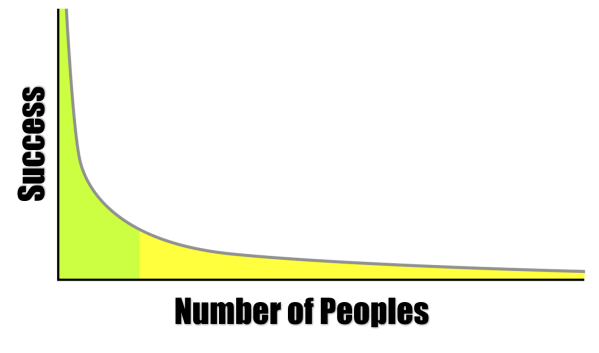
If we talk about the phenomenon of entertainment, we are definitely talking about how our brains operate. This means that we could expect to find a normal distribution in attitudes towards entertainment, with a peak in the middle and rapidly descending slopes on both sides. For example, one would expect such a distribution in the types of entertainment we prefer: the books we read, the shows we watch, the music we listen to. in fact, with a little statistical origami, we can do a quick check on this. Take a standard distribution curve and fold it in half along the “norm” line (shown as 0). The shape should look familiar. We have Chris Anderson’s Long Tail. The similarity of tastes close to the norm accounts for blockbusters and best sellers. These are the forms of entertainment that appeal to the greatest number of individuals. More esoteric entertainment tastes live well down the curve, in outlier territory.

Long_Tail

The Need for Entertainment Scale

I’ll come back to the types of entertainment we prefer and why in a later post. Today, I want to concentrate on another variable in the human psyche that also can impact our engagement with entertainment: how much do we need to be entertained? Why are some of us drawn more to fiction and others to non-fiction. Why do some of us like the escapism of a TV sitcom and others prefer to watch the news? Why do some of us have 5 TV’s in our house, with hundreds of digital channels, and others have none? What does the normal distribution curve of our need for entertainment look like. That was exactly the question that Timothy Brock and Stephen Livingston from Ohio State University tackled (The Psychology of Entertainment Media: Blurring the Lines between Entertainment and Persuasion. Publisher: Lawrence Erlbaum Associates. Place of Publication: Mahwah, NJ. Publication Year: 2004. p 255-268).

The need for entertainment seems to be almost addictive in some cases. In the study, Brock and Livingston restrict their definition of entertainment to passive consumption of some form of entertainment, either TV, radio, film, print, theatre or sport spectacles. Of these, television is the most common, so many of the measures revolved around our relationship with that specific entertainment medium. I’ve talked before about the impact of TV on society, but some of the empirical research on our reliance on the tube is astounding. In 2002, Robert Kubey and Mihaly Csikszentmihalyi found troubling evidence of a true biological addiction to TV:

“To track behavior and emotion in the normal course of life, as opposed to the artificial conditions of the lab, we have used the Experience Sampling Method (ESM). Participants carried a beeper, and we signaled them six to eight times a day, at random, over the period of a week; whenever they heard the beep, they wrote down what they were doing and how they were feeling using a standardized scorecard.

“As one might expect, people who were watching TV when we beeped them reported feeling relaxed and passive.

“What is more surprising is that the sense of relaxation ends when the set is turned off, but the feelings of passivity and lowered alertness continue. Survey participants commonly reflect that television has somehow absorbed or sucked out their energy, leaving them depleted. They say they have more difficulty concentrating after viewing than before. In contrast, they rarely indicate such difficulty after reading. After playing sports or engaging in hobbies, people report improvements in mood. After watching TV, people’s moods are about the same or worse than before.

“Thus, the irony of TV: people watch a great deal longer than they plan to, even though prolonged viewing is less rewarding. In our ESM studies the longer people sat in front of the set, the less satisfaction they said they derived from it. When signaled, heavy viewers (those who consistently watch more than four hours a day) tended to report on their ESM sheets that they enjoy TV less than light viewers did (less than two hours a day).

What value do we place on the ability to watch TV? Brock and Livingston gave 115 undergrads two scenarios. In the first, they could correct a hypothetical mix up in their official state citizenship in return for a one time cash gift. The undergrads were asked to put a value on changing their official allegiance from one state to another. 15% would do it for free and another 40% would do it for under $1000.

The next scenario asked the students what compensation they would require to give up TV for the rest of their lives. A permanent tracking implant in their ear would notify a monitoring service if they cheated and the entire gift would be forfeited. 8% were willing to do it for free, but over 60% would need at least a million dollars to give up TV forever.

Findings: Men Need More Entertainment & The More You Think , The Less You Need to Be Entertained

In their scale of the need for entertainment, Brock and Livingston assessed three factors: Drive (how actively do you pursue passive entertainment?), Utility (how useful is passive entertainment, both to you specifically and in general?) and Passivity (how active do you like your entertainment to be?).

So, how do we fare on our need to be entertained, based on Brock and Livingston’s scale? First of all, men seem to have a stronger drive to be entertained than women. Males scored higher on the amount they spend on entertainment, the daily need for entertainment and the inability to function without entertainment. One would assume that the “couch potato curve” would skew to the male side of the demographic split.

Also interestingly, Brock and Livingston found an inverse relationship between the need to be entertained and the “need for cognition” – a measure of how much people like active problem solving and critical thinking. Again, the more you think, the less reliant you are on TV.

In a follow up study, Brock and Livingston tried to draw a defining line between entertainment (in their definition, passive consumption) and sensation seeking. I’ll touch on this in tomorrow’s post.

How Our Brains “Google”

So far this week, I’ve covered how our brains find Waldo, scan a webpage and engage with online advertising. Today, I’m looking at how our brains help find the best result on a search engine.

Searching by Habit

First, let’s accept the fact that most of us have now had a fair amount of experience searching for things on the internet, to the point that we’ve now made Google a verb. What’s more important, from a neural perspective, is that searching is now driven by habit. And that has some significant implications for how our brain works.

Habits form when we do the same thing over and over again. In order for that to happen, we need what’s called a stable environment. Whatever we’re doing, habits only form when the path each time is similar enough that we don’t have to think about each individual junction and intersection. If you drive the same way home from work each day, your brain will start navigating by habit. If you take a different route every single day, you’ll be required to think through each and every trip. Parts of the brain called the basal ganglia seem to be essential in recording these habitual scripts, acting as sort of a control mechanism telling the brain when it’s okay to run on autopilot and when it needs to wake up and pay attention. Ann Graybiel from MIT has done extensive work exploring habitual behaviors and the role of the basal ganglia.

The Stability of the Search Page

A search results page, at least for now, provides such a stable environment. Earlier this week, I looked at how our brain navigates webpages. Even though each website is unique, there are some elements that are stable enough to allow for habitual conditioned routines to form. The main logo or brand identifier is usually in the upper left. The navigation bar typically runs horizontally below the logo. A secondary navigation bar is typically found running down the left side. The right side is usually reserved for a feature sidebar or, in the case of a portal, advertising. Given these commonalities, there is enough stability in most website’s designs that we navigate for the first few seconds on autopilot.

Compared to a website, a search engine results page is rigidly structured, providing the ideal stable environment for habits to form. This has meant a surprising degree of uniformity in people’s search behaviors. My company, Enquiro, has been looking at search behavior for almost a decade now and we’ve found that it’s remained remarkably consistent. We start in the upper left, break off a “chunk” of 3 to 5 results and scan it in an “F” shaped pattern. The following excerpts from The BuyerSphere Project give a more detailed walk through of the process.

searchheatmap11 – First, we orient ourselves to the page. This is something we do by habit, based on where we expect to see the most relevant result. We use a visual anchor point, typically the blue border that runs above the search results, and use this to start our scanning in the upper left, a conditioned response we’ve called the Google Effect. Google has taught us that the highest relevance is in the upper left corner

Searchheatmap22 – Then, we begin searching for information scent. This is a term from information foraging theory, which we’ve covered in our eye tracking white papers. In this particular case, we’ve asked our participants to look for thin, light laptops for their sales team. Notice how the eye tracking hot spots are over the words that offer the greatest “scent”, based on the intention of the user. Typically, this search for scent is a scanning of the first few words of the title of the top 3 or 4 listings.

Searchheatmap33 – Now the evaluation begins. Based on the initial scan of the beginnings of titles from the top 3 or 4 listings, users begin to compare the degree of relevance of some alternatives, typically by comparing two at a time. We tend to “chunk” the results page into sections of 3 or 4 listings at a time to compare, as this has been shown to be a typical limit of working memory9 when considering search listing alternatives

searchheatmap44 -It’s this scanning pattern, roughly in the shape of an “F”, that creates the distinct scan pattern that we first called the “Golden Triangle” in our first eye tracking study. Users generally scan vertically first, creating the upright of the “F”, then horizontally when they pick up a relevant visual cue, creating the arms of the F. Scanning tends to be top heavy, with more horizontal scanning on top entries, which over time creates the triangle shape.


searchheatmap5(2)5 – Often, especially if the results are relevant, this initial scan of the first 3 or 4 listings will result in a click. If two listings or more listings in the initial set look to be relevant, the user will click through to both and compare the information scent on the landing page. This back and forth clicking is referred to as “pogo sticking”. It’s this initial set of results that represents the prime real estate on the page.

searchheatmap66 – If the initial set doesn’t result in a successful click through, the user continues to “chunk” the page for future consideration. The next chunk could be the next set of organic results, or the ads on the right hand side of the page. There, the same F Shaped Scan patterns will be repeated. By the way, there’s one thing to note about the right hand ads. Users tend to glance at the first ad and make a quick evaluation of the relevance. If the first ad doesn’t appear relevant, the user will often not scan any further, passing judgement on the usefulness and relevance of all the ads on the right side based on their impression of the ad on top.

So, that explains how habits dictate our scanning pattern. What I want to talk more about today is how our attention focusing mechanism might impact our search for information scent on the page.

The Role of the Query in Information Scent

Remember the role of our neuronal chorus, firing in unison, in drawing our attention to potential targets in our total field of vision. Now, text based web pages don’t exactly offer a varied buffet of stimuli, but I suspect the role of key words in the text of listings might serve to help focus our attention.

In a previous post, I mentioned that words are basically abstract visual representations of ideas or concepts. The shape of the letters in a familiar word can draw our attention. It tends to “pop out” at us from the rest of the words on the page. I suspect this “pop out” effect could be the result of Dr. Desimone’s neural synchrony patterns. We may have groups of neurons tuned to pick certain words out of the sea of text we see on a search page.

The Query as a Picture

This treating of a word as a picture rather than text has interesting implications for the work our brain has to do. The interpretation of text actually calls a significant number of neural mechanisms into play. It’s fairly intensive processing. We have to visually intrepret the letters, run it through the language centres of our brain, translate into a concept and only then can we capture the meaning of the word. It happens quickly, but not nearly as quickly as the brain can absorb a picture. Pictures don’t have to be interpreted. Our understanding of a picture requires fewer mental “middle men” in our brain, so it takes a shorter path. Perhaps that’s why one picture is worth a thousand words.

But in the case of logos and very well known words, we may be able to skip some of the language processing we would normally have to do. The shape of the word might be so familiar, we treat it more like an icon or picture than a word. For example, if you see your name in print, it tends to immediately jump out at you. I suspect the shape of the word might be so familiar that our brain processes it through a quicker path than a typical word. We process it as a picture rather than language.

Now, if this is the case, the most obvious candidate for this “express processing” behavior would be the actual query we use. And we have a “picture” of what the word looks like already in our minds, because we just typed it into the query box. This would mean that this word would pop out of the rest of the text quicker than other text. And, through eye tracking, there are very strong indications that this is exactly what’s happening. The query used almost inevitably attracts foveal attention quicker than anything else. The search engines have learned to reinforce this “pop out” effect by using hit bolding to put the query words in bold type when ever they appear in the results set.

Do Other Words Act as Scent Pictures?

If this is true of the query, are there other words that trigger the same pop out effect? I suspect this to also be true. We’ve seen that certain word attract more than their fair share of attention, depending on the intent of the user. Well know brands typically attract foveal attention. So do prices and salient product features. Remember, we don’t read search listings, we scan them. We focus on a few key words and if there is a strong enough match of information scent to our intent, we click on the listing.

The Intrusion of Graphics

Until recently, the average search page was devoid of graphics. But all the engines are now introducing richer visuals into many results sets. A few years ago we did some eye tracking to see what the impact might be. The impact, as we found out, was that the introduction of a graphic significantly changed the conditioned scan patterns I described earlier in the post.

eshapedpatternThis seems to be a perfect illustration of Desimone’s attention focusing mechanism at work. If we’re searching for Harry Potter, or in the case of the example heat map shown below, an iPhone, we likely have a visual image already in mind. If a relevant image appears on the page, it hits our attention alarms with full force. First of all, it stands out from the text that surrounds it. Secondly, our pre-tuned neurons immediately pick it out in our peripheral vision as something worthy of foveal focus because it matches the picture we have in our mind. And thirdly, our brain interprets the relevancy of the image much faster than it can the surrounding text. It’s an easier path for the attention mechanisms of our brain to go down and our brains follow the same rules as my sister-in-law: no unnecessary trips.

The result? The F Shaped Scan pattern, which is the most efficient scan pattern for an ordered set of text results, suddenly becomes an E shaped pattern. The center of the E is on the image, which immediately draws our attention. We scan the title beside it to confirm relevancy, and then we have a choice to make. Do we scan the section above or below. Again, our peripheral vision helps make this decision by scanning for information scent above and below the image. Words that “pop out” could lure us up or down. Typically, we expect greater relevancy higher in the page, so we would move up more often than down.

Tomorrow, I’ll wrap up my series of posts on how our brains control what grabs our attention by looking at another study that indicates we might have a built in timer that governs our attention span and we’ll revisit the concept of the information patch, looking at how long we decide to spend “in the patch.”

Wrenching Changes in Ad Revenue Models

This week, I’ve talked about the importance of information foraging in understanding online behaviors and our interactions with content, the fact that we don’t really think our way through online interactions, but rather navigate through instinct and habit, and yesterday, how different intents lead to different levels of engagement with ads. All of this has been to show how Rupert Murdoch and other publishers are seriously off base in trying to put walls around their content to protect their obsolete business models.

The Planting of Intent

But, as comScore Chair Gian Fulgoni commented on yesterday’s post, does all this mean that display ads have no value? Yes, we agree, ads aligned with intent, such as search and relevant text ads, are the ideal, but something needs to plant that intent in the first place. Something needs to create awareness, which sparks need and kicks the brain into gear to go seek information. In Gian’s words:

there’s another issue that needs to be addressed: not all consumers search for information via an online search query. They’re just not all that rational. As a result, using display ads can get an advertiser a far higher reach against the target audience. And that higher reach can cause the total sales lift from a display campaign to rival that from search – even if the sales lift among those exposed is higher in the case of search.

There’s also another even more important point that we need to consider: brand building. That needs to occur even when the consumer isn’t foraging for information in support of an impending buying decision. Otherwise the value of an individual brand name isn’t going to be as meaningful to the consumer when he / she is in the shopping / buying mode. CPG manufacturers know this well. Every week, their special prices (“temporary price reductions”) are shown in the local newspaper feature ads. Placed by the retailer but funded by the manufacturer. The consumer can pick and choose the products they intend to buy and where they will buy them (and, incidentally, store loyalty is not the norm). This information – delivered by old media still, but, I would argue, aligned with consumers intent to shop and buy – determines, to a great extent, the store at which a consumer shops and the brands they buy in a particular week. But the important point is that the CPG manufacturers don’t just leave it with running these types of feature ads. They understand that they need to be supplemented with “branding” advertising that they run themselves because they need to make sure that their brand value has been firmly established in the mind of consumers before they compare prices across brands at the shopping / buying stage. This type of branding advertising is delivered via TV, print and radio – and increasingly today, via the Internet. It’s a critical part of brand marketing, and I think it should remain that way even in today’s Internet world, because — as one of our clients recently said to me — “God forbid that price becomes the only determinant of consumers’ brand choice!”

I voiced similar opinions in a previous post, No Search is an Island. Search itself has a naturally limited inventory. If no one is searching for a term, there is no inventory to buy. This lack of scale and reach has been the single biggest limiting factor in search marketing. If you suddenly cut out all awareness advertising, you’ll eventually find your available search inventory dwindling in lock step. Gian’s points are well taken, and indeed, one of the biggest questions for me is how much residual branding value is derived from an ad that is noticed but not clicked. As I said yesterday, I think it depends on how pressing the user’s intent is. If they’re browsing content, my suspicion is that the residual value would be higher than if they’re on a focused information finding mission.

Differing Shades of Gray

As is most transitions, the truth is there there is no absolute answer here. One is neither right or wrong, black or white. What is happening is a shift from one type of behavior to another. The answer is gray, and each day, that shade of gray is gradually shifting more from black to white. Murdoch won’t suddenly find his revenue model shutting off one day. But what will happen (and there are dozens of newspaper bankruptcies to support my case) is that the revenue model will gradually erode. In fact, it has been happening for some time. As we switch our behaviors from a destination information economy to a just-in-time information economy we’ll spend less time casually browsing content and more time taking brief forays through search to find specific pieces of information. And when we do so, all the challenges in ad engagement I addressed yesterday will have to be dealt with. Murdoch’s revenue model won’t shut off tomorrow, but it will gradually melt away to the point where it’s unable to support the business. That is why there’s more than a hint of desperation in his rantings. He knows the ship is sinking and he’s lashing out at what he thinks the cause is: Google. Unfortunately, he’s lashing out at the wrong cause. The real cause is his reader’s changing behaviour.

Brand Building = Fence Painting?

The other point I would make about brand building is this: Gian is right, we need some way to build brands in public consciousness. But even the options for building brand are rapidly shifting. It used to be that mass media was the most efficient choice. It offered reach and frequency. It was scalable and could be measured in GRPs. The market was treated like a fence to be painted. What was the most efficient way to apply as much paint to as much area as possible? The answer, the biggest possible spray gun. It was a pretty simple equation: Area of fence X density of paint = complete saturation. The spray gun didn’t even need to be that efficient at painting, we just had to keep pouring in more paint. Which was fine, as long as the fence was all in one place. But now, the fence is scattered over an impossibly large area. There are fragments spread everywhere. Suddenly, the spray gun isn’t working so well anymore. We need a new approach to brand building, and we’re beginning to explore new techniques, such as tapping into social networks and word-of-mouth. It seems in today’s world, Tom Sawyer had it right..the best way to paint a fence is to enlist an army of recruits to do it for you.

You Can’t Put a Wall Around News

The challenge advertisers face now is trying to find a way to reach an increasingly fragmented market who is spending less time with traditional media and are increasingly seeking information in bite-sized pieces, rather than sitting down to a full meal. And that’s a challenge that traditional media, represented by Rupert Murdoch, seem unable and unwilling to face. Their answer seems to be to rant, rave and hope the whole mess will go away. If people are increasingly seeking information through Google and not looking at my ads, fine, I’ll just lock out Google and lock in my audience by forcing them to pay. Murdoch is skiing down the wrong side of the adoption curve. And, as Danny Sullivan pointed out in his Search Engine Land post, you can no longer put a fence around information and keep it proprietary, especially in the news industry. Breaking stories will break in hundreds of ways online – through Twitter, networks, blogs and news aggregators. Even if the Wall Street Journal breaks a new story, they can’t control it. People don’t care about the source anymore, all they care about is the information. Even if Google is locked out of Murdoch’s content, it will find it somewhere else and will index it. And people will go where ever Google lets them go. For this reason, I disagree with Danny about the viability of a mutually exclusive relationship. Google doesn’t need the Wall Street Journal, but I do believe that the Wall Street Journal needs Google.

So what about the deal with Bing? Is that the answer to Murdoch’s woes? After all, you still get search visitors and you control your content. Again, for all the reasons I’ve stated over the past week, I don’t think this is any answer at all. It may look good on paper to two companies that are entrenched in command and control thinking, but it doesn’t reflect the real world at all. And if Murdoch would take a few minutes to glance at the latest search market share numbers, even he might see why it doesn’t make sense to kick the elephant out of bed to make way for the mouse (okay..perhaps a small dog).

In the final analysis, we have people changing their information consumption habits, which is giving advertising a wrenching kick right in its revenue model. The dramatic success of search was indicative of the power and speed of this behavioral change. The successful model of the future will understand and embrace the reality of information foraging and will leverage the changing habits of people. The search part, aligning with consumers when intent is present, is the easy part to work out. The challenging bit will be to swim upstream and figure out the pieces that have to be in place to spark intent and put the mental train in motion. My suspicion is that mass solutions will no longer work. We’ll have to figure out how to brand build one prospect at a time, one relationship at a time. None of this is good news for traditional publishers, but hey, if everyone won in evolution, the world would be a much more crowded place.

Mindless Online Behavior: Web Navigation on Autopilot

One of the biggest problems with Rupert Murdoch’s view of the world is that he’s assuming people are making conscious decisions about where they go to get their news and information. He somehow believes that people are consciously deciding to get their information from Google rather than one of his properties, and Google is encouraging this behavior by indexing content and providing free “back doors” into the WSJ and other sites. In other words, Murdoch has a conspiracy theory, and Google and online users are co-conspirators. The truth isn’t quite so evil or intentional.

Our Stomach’s Autopilot

I talked yesterday about the importance of information foraging and how we use the same strategies we use to find food to find online information. But tell me, how conscious are your decisions about where and what to eat? How long do you deliberate over eating a piece of toast in the morning, a sandwich at lunch or a plate of pasta at night? If you’re hungry, how often do you find yourself standing in front of the fridge, staring inside for a quick snack? It wasn’t as if you had a detailed series of decisions here: Hmmm..I’m hungry. Where would be the best place in the house to find food? The bathroom? No, that didn’t work. How about the bedroom? No, no food there. Hey, this kitchen place seems to be promising! Now..where in the kitchen might there be food? In this cupboard? No, that’s dishes. Down under the sink? Ooops..no, I don’t know what the hell’s under there, but it’s definitely not food. Hey..what’s in this big steel box here? Ah…Bingo!

Okay..it’s a ridiculous scenario, but that’s my point. It only seems ridiculous because we’ve found a more efficient way of doing it. We don’t have to go through these decisions every time because we’ve done it before and we know where to find food. Even if we went into someone else’s house, we would know that the kitchen is the best place to find food, and the fridge is probably the surest bet in the kitchen. We don’t have to think, because we’ve done the thinking before and know we can navigate by habit and instinct.

Where Do You Keep the Cockatoo Chichild Fillets?

But what if you visited the Jivaro tribe of South America, where the culture is so different that we have no cognitive short cuts to follow? Much of the food they eat we’ve never even seen before. And, as one of the most primitive cultures in the world, there are not a lot of kitchens or fridges to act as hints about where we might find something to eat. If we were suddenly dropped into the middle of a Jivaro settlement with no guide, we would have to do a lot of thinking about what to eat and where to find it. And how would we feel about that? Anxious? Frustrated? Uncertain? We don’t like it when we have to think. We much prefer relying on past experience and habits. The brain heavily discourages thought if there’s a more efficient short cut. It’s the brain’s way of saving fuel, because mobilizing our prefrontal cortex, the “reasoning” part of our brain, comes with a big efficiency hit. The PFC is powerful in a “single minded” way, but it’s also an energy hog. The way the brain discourages unnecessary thought is through stimulating unpleasant emotions. If you’ve spent much time in foreign cultures, you know the constant stress of finding something to eat can quickly go from being exciting to being a complete pain.

Here’s the other thing about our brain, it isn’t discriminating about when to kick in and when not to kick in. It usually takes the path of least resistance first, relying on past experience rather than thinking. The more familiar the environment, the more the brain feels safe in relying on past experience and habit. What does this mean? Well, when you’re hungry, it will mean you suddenly find yourself standing in front of the fridge with the door open without even knowing what you’re looking for. When you realize you actually want some crackers (i.e. when your brain finally kicks in), you swing the door shut and go to where the crackers are kept. Online, it means you go to Google and launch a search without thinking through what your actual destination might be.

Google, The Information “Fridge”?

So, I’ve gone fairly far down the path of this analogy to make a point. According to Pirolli, we use exactly the same mechanisms to find online information. We go first to the fridge, or, in this case, Google, because nine times out of ten, or even 99 times out of a hundred, we find what we’re looking for there. And, if we don’t, we start to get frustrated because our brain is suddenly called into service and it isn’t at all happy about it. There’s no conscious conspiracy to screw Rupert Murdoch, there’s just us following our own mental grooves. And these grooves dictate a huge percentage of our online activity. There’s been little neuro-scanning research done on how our brains work during online activity, but the little that’s been done seems to indicate a regular shifting of activity from the “reasoning” to the “autopilot” sections of the brain. I suspect strongly that this is especially true when we use search engines. If we can navigate on autopilot, we will.

This principle holds true for almost all online interaction. I keep hearing about the “joy” of discovery online. I believe that’s largely crap. As online becomes a bigger part of our lives, we depend on it to do more and more and we don’t have the time for “discovery”. We don’t have the time to set aside 2 hours to browse through WSJ.com, meandering through the content and providing a willing set of eyeballs for all those ads. We want to find what we’re looking for, get in and get out. There are occasions when we’re willing to invest the time for a long voyage of discovery, just as there are times when we will go out and graze our way through a smorgasbord buffet, but it’s not the norm. As I said in the last post, Google and search has given us a “just in time” information economy and we have forever shifted our concept of information retrieval. How the providers of the information make money from that remains to be figured out, something I’ll spend some more time talking about tomorrow.

Nicotine and Memory: Things Seemed Better with Smoke

iStock_000003125082XSmall“My God,” you think, as you swirl your drink in front of you, “I could use a smoke right now.” The urge is all the stronger because of all those memories of past times with friends and a cigarette. Your life just seemed more fun when you were smoking. Was life more exciting before you kicked the habit? It sure seems so.

It’s not all your imagination. A recent study at Baylor College of Medicine says nicotine actually tricks the brain into linking cigarettes and the environment you’re in when you smoke them. The brain is wired to reward you with a shot of dopamine when you do things that ultimately end up in your living longer. The problem is that this mechanism was built to reward us in an environment where scarcity was the norm. So, we get a reward when we eat, for example. Move this forward into our age of excess and the result is rampant obesity.

This mechanism also fires when we’re in an environment that typically prompts these reward releases of dopamine. We’re driven to spend more time there. If we typically get rewarded in one location (i.e. great dinners at our parent’s house) and not another we develop a subconscious affinity for the rewarding environment.

So, what do cigarettes do to this hard wired reward mechanism? They short circuit it in a couple ways. Nicotine not only hijacks the dopamine reward system, but it also alters the way our memories are laid down, drawing us back to environments where we smoke. Nicotine supercharges the hippocampus, a part of the brain that lays down new memories. The Baylor study, which was done on mice, found that mice “on nicotine” recorded twice the neuronal activity as the control group. Nicotine tricks the brain into believing that smoking is a beneficial activity and laying down memories to reinforce this belief. It’s a double whammy for those trying to kick the habit.

The Ebbs and Flows of Market Share

First published July 16, 2009 in Mediapost’s Search Insider

It’s been just over six weeks since the birth of Bing. While I didn’t actually say Microsoft’s new search baby was ugly, I was less than optimistic about its chances of unseating Google in a popularity contest. So, with every measurement panel carefully following Bing’s debut, I think it’s time to see just how the little engine is doing in the search (oops, make that “decision”) sandbox.

Let the Record Show

First of all, much acrimonious commentary has been attributed to me about Bing. I just want to say I never said Bing was a failure, a bad search engine or a step backwards on Microsoft’s part.

I simply said Bing would not break the Google habit, despite 100 million dollars of advertising.

In fact, here’s exactly what I said would happen. Driven by the advertising, people would temporarily disrupt the playing out of their habitual Google script, try Bing and find that it wasn’t all that different from using Google: better in some ways, worse in others. Without having a compelling reason to consciously break the Google habit (which is hard cognitive work) they would just go back on autopilot and continue to use Google. A temporary blip upwards for Bing would soon disappear, at roughly the same time as Microsoft’s $100 million ad budget, and we would all go back to mindlessly Googling what we’re looking for.

Survey Says...

So, what’s happening in terms of market share? Well, the various numbers seem to show that Bing has gained a small uptick in market share (the exact amount is difficult to determine, but Compete puts it at a 0.3% gain in share), Google’s up as well, by about half a percentage point, and Yahoo and Ask are both losing ground in what seems to be an irreversible death spiral.

If you just look at the Google and Bing numbers, the words “I told you so” naturally spring to mind. And this is still with the $100 million tap fully open. Google could come out of this with the biggest net gain, paid for by Microsoft’s ad budget.

But the story gets much more interesting, and more compelling for Microsoft, if you look at what’s happening with Yahoo and Ask. This is something I didn’t think about in my original forecast, but the logic seems clear in hindsight.

26% Still Up for Grabs

When Bing debuted, there was a 26.7% percent of the U.S. search market not owned by Google, again according to Compete. At the end of June, that shrunk to 26.1%. And that’s the share that Microsoft should be paying close attention to. Don’t worry about breaking the Google habit. Concentrate on picking off the weaker contenders. And right now, when it comes to search, Yahoo and Ask are lying limp and lifeless on the side of the road, easy pickins for a Bing drive-by. In the past year, Yahoo is down in market share by almost 3 and a half points, and Ask is off by a full point. All of this has gone to Google, plus some. They’re up almost 10 full share points in the past year.

Is Google Domination Inevitable?

If these are the trends, is it inevitable that Google will eventually own the entire search market? No, because we always like alternatives. We get nervous when there is a de facto monopoly, so we’ll keep even a weak contender on life support just to give us an alternative. At the height of the Window’s OS dynasty, Mac still managed to hold onto 4.5% of the market and Linux 0.5%. Since then, Mac has come back to take almost 9% of the market and Linux almost a full point (according to Net Applications).

That’s the other thing to remember about humans. If we have a viable underdog, we’ll throw it more than its fair share of support. Case in point: the browser wars. In 2004, Explore owned 91.35% of the market. The fledgling Firefox was its biggest competitor, at 3.66%. But over the past five years, the balance had shifted decidedly in Firefox’s favor: 65.85% for Explore vs. 22.39% for Firefox. The fact that Firefox improved its product at a much more aggressive rate than Microsoft didn’t hurt either.

I believe Google is getting very close to its natural market share cap. And the stronger the alternatives, the lower that cap will be. Yahoo and Ask have lost their appetite for competing in the search arena, but Microsoft has a viable contender in Bing. I still don’t expect it to break a Google habit, but it could well become our No. 1 alternative when we’re ready for an occasional break from our habitual search rut.

How ironic! Microsoft’s Bing playing the White Knight to Google’s Evil Empire!

Entertainment vs Usefulness – Which Builds More Loyalty?

On Wednesday, I talked about how digital marketers always tend to jump on fads, assuming they’ll become trends. I called it digital fluff. My position was that something has to become useful before it will have staying power. And our judgement of usefulness takes time. We have to get beyond the initial obsession with novelty. Marketers jump on channels when they’re still a novelty, which creates churn when the majority of these channels die away because they’re just not useful to the average person.

Lance Loveday posted a great comment and in it he brought up another potential factor of audience longevity and loyalty: entertainment value:

I’d add “entertaining” to usefulness as a requirement for achieving sustained behavior. TV and video games aren’t very useful, but they’ve definitely made sustained behavior status. I can only assume it’s because they’re entertaining.

Hmmm…the Psychology of Entertainment. Sounds like a good topic for a further post. In fact, I’m thinking a series of posts: How Our Brain responds to Entertainment.

After Lance’s post, I started doing some digging. In short time, I dug up a fairly rich vein of research into how our brain responds to entertainment. My goal is to find out why some types of entertainment have more staying power than other types. And then, once we discover the psychological underpinnings of entertainment, lets look at how that applies to some of the digital trends I disparaged: things like social networks, microblogging, mobile apps and online video. What role does entertainment play in online loyalty? How does it overlap with usefulness? How can digital entertainment fads survive the novelty curse and jump the chasm to a mainstream trends with legs? Why are we continually attracted to bright shiny objects to begin with? And is that trait universal or is it just a function of the early adopter tendencies of the current online audience?

I haven’t had a lot of opportunity to go through the research, but already, some interesting titbits have come to the top that present some compelling questions:

Why Does Fiction Typically Outsell Non Fiction?

If you look at the best selling books of 2009, or any year for that matter, you’ll almost always find that fiction tops the list. And, when you do get down to the fiction books, you’ll probably find that close to the top is a book by Malcolm Gladwell. Why? Well, in both instances, we’re suckers for the appeal of a story. We enjoy narratives much more so than rhetoric. Gladwell is a master of this. He wraps his points (and he always has a point) in a rich tapestry of anecdotes and stories.

Why do humans love stories? Well, it appears it’s a hardwired trait. Research seems to indicate our brains process narrative differently than rhetoric. This is one area I’ll be diving deeper into.

What Makes some TV Shows Great and Some Flashes in the Pan?

Lance brought up the example of TV as a bed for sustained behaviour. There is probably no source of sociological data richer in the past half century than our TV viewing habits. I’ll be taking a look at what separates a one season wonder from a multi season success story.

What is the Appeal of a Video Game anyway?

Lance’s other example was video games. Here there’s a psychological buffet of hardwired enticements. In fact, some psychologists are worried that the jolt received from video games may be addictive – a mainline hit of dopamine producing stimuli wired directly to our pleasure centres.

Why Do Boys play Video Games Much more often than Girls?

Video games may be addictive, but the danger seems to be much greater with males than females. We’ll explore why.

What is the Entertainment Value of Social Networks?

Of all the trends playing out currently online, that of social networks seems to be the most prevalent. Are social networks useful, or simply entertaining? Are they in transition from entertainment to usefulness? What is the future of social networking?

Can Online Compete with TV for Entertainment Value?

When we look at where our entertainment comes from, we’re definitely a culture in transition. Increasingly, more and more of our video consumption is online. So, if we find that entertainment and usefulness are both factors in online audience loyalty, what does this mean for future marketing?

The Difference Between Entertainment and Usefulness in Targeting Strategies?

At some point, I’ll have to address the fundamental question raised by Lance: If entertainment is also important, what are the implications for marketers? What mental modes are in place in both instances? This gets to some of the fundamental questions I’ve been wrestling with in marketing – the nature of engagement, the role of intent, the question of attribution. What is the difference in a strategy for search (usefulness) vs a strategy for Hulu (entertainment). And, does online bring about a significant paradigm shift as the worlds of usefulness and entertainment come closer to merging?

Lance..you got me thinking. Stay tuned!

Chasing Digital Fluff – Who Cares about What’s Hot?

Marketers are falling over themselves in their rush to the digital landscape. Social media is SO hot! But not as hot as behavioral targeting. And if you think that’s hot, wait till you see what you can do with mobile!

The Digital Dogpile

blow-dandelionMarketers desperately scramble over each other, grasping for a tenuous handhold on some emerging tactic that gives them, however briefly, a fraction of an inch advantage over the competition. New digital marketing directors prove their worth through their savvy of online technology. They cut their teeth on Facebook advertising and put Powerpoints (or, because they’re uber-cool – Keynote presentations) together on the immense potential of the social graph.

Churn is the norm in digital marketing. And marketers are the worst, whipping the industry into a froth because they get all breathless about the latest thing. My inbox gets a hundred emails every single day talking about how freaking cool everything is and how we’re stumbling to figure out the importance of everything. If you’re not an early adopter…scratch that…if you’re not a bleeding edge pioneer, you’re a hopeless loser. The pace of marketing testing and adoptions just keeps spinning faster and faster.

Step Away from the iPhone

Stop! Take a breath. Relax for a few minutes. Get outside and breath some honest to God fresh air. And don’t take your iPhone with you. Because here’s the scoop Kemosabe, all the technology in the world is useless until your audience figures out how to use it. And here’s the nasty little secret. Humans love bright shiny objects but we’re pretty slow when it comes to figuring out how to jam it into our already busy lives. Until that happens, your nifty online strategies will never be anymore than a pointless treadmill jammed on overdrive. You can run as fast as you want, but you’ll never get anywhere.

I do financial analyst calls every quarter and the last question on the call is always the same: anything else we should be looking at? Apparently, technologiosis (or technitis, or technophilia, take your pick) is contagious. My answer is usually the same..wait till people figure out how to use it.

Think about the buzz that’s been devoted to social networks and, more recently, real time search, in the last 2 years. That’s 2 years of foaming-at-the-mouth marketing buzz about how this channel is:

A) the savior of marketing
B) most effective connection with consumers
C) coolest technology without an identifiable purpose
D) biggest waste of time on God’s green earth
E) all of the above

The Geekiest Guy on my Block

Now, I’ll be the first to admit I don’t have a clue how to use social media in a meaningful way in my life. I have a Facebook page, I tweet, I have a Linked In profile, a Trip-It network, just to name a few, making me the geekiest guy I know. Maybe not at an online marketing show, but if you ever visit Kelowna, take a walk with me down my block and I’ll prove my techno-geek status is several Trekkie parsecs ahead of anyone else. I suspect the same is true for you. And you know what? I have no frigging idea why Facebook is important or why I should log into my profile today. It’s cool, but it’s not useful in an every day kind of way. And if I, who spend over 10 hours a day online and have a network of friends and colleagues that span the globe, can’t jam Facebook into my life in a useful way, how is the average techno-pleb going to?

As far as I can see, most of things marketers salivate over fall into the same category..digital candy that tweaks our dopamine supplying pleasure centre but serves no real, sustainable purpose in our lives. This puts it in the same category as 95% of my iPhone apps, 99% of the computer games on my laptop and the Wii my nephew got last Christmas – an obsession for approximately 27 hours, an occasional pastime for another 36 hours, then something we ignore for the rest of our lives.

The one difference, at least in my experience, seems to be teenagers. Most of things that seem to be passing fancies to us do seem to become useful in the lives of the average 15 – 23 year old. But, as I said in a previous post, when you look at what the live of a high school or university student looks like and what they want to do, a Facebook suddenly makes sense. For me, not so much.

An Eyeball is an Eyeball, Right?

So, even given this notorious degree of fickleness, why should marketer’s care? Eyeballs are still eyeballs, right? Even if the eyeballs we’re capturing this week will be completely different than the eyeballs we capture next week. This approach only works if you consider your market a faceless blob of unleashed consumer potential. If you actually want to get relevant messages to real people with real needs, the logic starts to break down immediately.

Effective marketing depends on reliable targeting. And reliable targeting depends on established patterns. And established patterns depend on sustained behaviors. And sustained behaviors depend on things we find useful. Otherwise, we’re marketing via fad, condemning ourselves to spending our professional lives and our client’s ad dollars chasing fluff in a hurricane. Our audience will always be “just passing through” on the way to the next thing.

I Miss Frank Cannon, PI

movies_070708_cannonMarkets have to stabilize in order for us to understand the individuals that make up that market. Also, brand relationships need a stable environment, allowing them to germinate and flourish.

When I was a kid, Kraft always sponsored Cannon. When you tuned in to see William Conrad somehow roll his fat old carcass out of his Lincoln Continental and pick off a sniper 3 miles away on a mountain top with his trusty .38 revolver, you could depend on Kraft telling you how to cook Mac & Cheese in every commercial break. Much as the entertainment value may have sucked (beggars with 2 channels in the Canadian prairies can’t be choosers) you knew Kraft would be there and Kraft knew who they were talking to. The audience had stabilized.

Until things pass through the temporary obsession phase to something that adds real value to our lives, we can’t consider advertising on these channels as anything more than an experiment. The trick in picking the right digital channels is not to look at the eyeballs they’re attracting today, but in how these things might be used in real, practical ways. That will give you an idea of how real people might be using these things next week or next month, when the technoratti have moved on to the latest bright shiny object.

Chrome’s Shiny, but is it enough to Break a Habit?

How ironic!

After going on at length about how Google’s competition is the victim of the search juggernaut’s ability to make searching Google a habit, now they’re running up against the same brick wall with the introduction of Chrome.

With the introduction of a new product that’s vital to future strategies, one has to account for cognitive lock in and habitual behavior. Let’s do a walk through of two examples.

Searching by habit

First of all, my Google analogy. Using Google as a search engine isn’t a conscious choice, it’s habit. We don’t think about it, we just do it. And because we don’t think about it, you can’t take a rational approach to convincing us to do otherwise. You have to disrupt the playing out of the habitual script. And you can’t just disrupt it once. You have to destroy the script completely and permanently.

So Microsoft’s Cashback scheme was doomed to failure from the beginning. It was a rational appeal based on Microsoft’s offering to pay you an incentive for using their search engine. It’s a fundamental human appeal and, on paper, appears to make sense. The problem is, sense isn’t really enough to change habits. Here’s what will happen. Someone will hear about the Cashback offer and may actually rationally suspend habitual behavior in order to try Live Search. Their autopilot will be switched off and they’ll consciously take over the controls. But we’re programmed to revert to autopilot in order to save energy. So unless the experience offered such a tremendous benefit that it’s worth our while to continue to rationally keep our hand on the controls, we’ll turn our attention (remember, attention is a one task at a time proposition, so we have to be very judicious about where we choose to spend it) to other things and go back to autopilot behavior. Cashback would have to blow away our previous search experiences, giving us a benefit worthy of investing the time to create a new habit. Cashback simply didn’t raise the bar enough.

What Goes Up will probably Come Down

So, with that psychological foundation, one could predict with a fair degree of confidence what would happen with the introduction of Cashback. There would be a temporary blip upwards in marketshare as the least loyal of Google’s habitual users consciously decided to give it a try, and then because the experience wasn’t a revolution in search, habitual behavior would take over and they would go back to Google. Marketshare would quickly return to previous levels. In fact, because there are a number of subtle psychological scripts built to help us maintain our habits (habits are a evolutionary advantage because they allow us to function with less cognitive effort) we might even become more frequent Google users and less frequent Live users. The bounceback could actually cause Live to lose marketshare.

Now, let’s look at what actually happened. The early summer introduction of Cashback seemed to be the answer to Live’s woes, as Compete’s Jeremy Crane was quick to point out.  Marketshare took a quick jump upwards. But two months later, Cashback’s initial glow is quickly fading. Search users are switching their auto pilots back on, and the default setting is Google.

Chrome Plated Strategies

Now, with the introduction of Chrome, Google is facing exactly the same challenge. They’re calculating that Chrome will have what it takes to break the Explorer or Firefox habit. And exactly the same pattern is emerging, as people take Chrome for a spin to decide whether it’s breaking-habit-worthy. And at this point, the answer seems to be no.

There’s one potential difference here. Chrome is much more than a browser. Google has a shiny future planned for the web app interface. If they raise the bar enough, people may make the investment required to break their existing habit and reform a new one around Google’s browser. But don’t expect any big marketshare shifts until that bar is raised.