Evolutionary Hotspots in Marketing

First published November 21, 2013 in Mediapost’s Search Insider

paramoscene1_7in

The Páramos Ecosystem

The Páramos are remarkable places: grasslands that sit above the tree lines in the Andes, some 10,000 feet above sea level. What makes them remarkable are the things that grow and live there — like Espeletia uribei,which looks like a huge palm tree, but is actually an overgrown member of the daisy family.

The Páramos just happen to be the place on earth where evolution happens the fastest.  There are other places where species evolve quickly, including Darwin’s Galápagos Islands, but scientists believe the Páramos are the hottest of the evolutionary hot spots.

The reason for this supercharged speciation is the climate, which makes them a very tough place to call home.  They’re located at the equator, so they get sunshine year round. But the elevation introduces harsh temperatures and extreme ultraviolet exposure. Also, the weather can change in a heartbeat. A few minutes can mark the difference between sunshine, mist and full-on storms.  This constant adaptive stress has resulted in biodiversity not seen anywhere else on the planet.

In biology, evolution is measured by the rate of mutation. In the business world, mutation equates to innovation. A new idea introduces a wild card into the competitive environment, just as a genetic mutation introduces a wild card into nature. It disrupts the status quo, either positively or negatively. That’s why it’s important for organizations to embrace failure. Openness to error encourages innovation, driving the competitive evolution of the company. Successful innovations can be game-changers, as long as you create a framework to identify unsuccessful innovations before they do irreparable damage.

So if we accept that corporate evolution is a good thing, and we want to increase our mutation/innovation rate, then it makes sense to seek our own organizational “Páramos.” These will be departments or divisions where volatility is the norm, rather than the exception. Stability is the enemy of innovation. Typically, these will be areas that require rapid reaction to external forces and adaption to new environmental factors. Much as we like to mythologize the lone genius toiling away in an ivory tower or R&D lab, the history of innovation shows that it most often comes from far messier, more organic sources.

In the Páramos, it’s the harsh, unpredictable climate that drives evolution. In a company, it’s the instability of the competitive marketplace that drives the forces of innovation. So it makes sense that the hotspots will be those areas of the organization that have the most exposure to that marketplace. Front-line touch points with customers, head to head contact with competitors and real world usage of your products or services are the externalities you’ll be looking for. That makes sales, marketing and customer service prime candidates for becoming your own Páramos.

The challenge is to enable innovation at this level. Typically, innovation in an organization is constrained (and unfortunately, often choked to death) by bureaucratic frameworks that build in “top-down” governance from executives who are traditionally miles away from the “Páramos” in the org chart. This is exactly the wrong approach. Mechanisms should be developed to encourage “bottom-up” innovation in these identified hotspots, with appropriate guidelines for identifying successful opportunities as quickly as possible, allowing organizations to fast-track the winners and cut their losses on the losers. These hotspots can become the strategic radar of the organization.

Darwin’s “dangerous idea” has completely changed biology. Currently, it’s causing everyone from psychologists to economists to rethink their respective fields. In the future, don’t be surprised if it has a similar impact on marketing and corporate strategy.
Google’s Etymological Dream Come True

First published November 14, 2013 in Mediapost’s Search Insider

Yesterday’s Search Insider column caught my eye. Aaron Goldman explained how search ads were the original native ads. He also explained why native ads work. This is backed up by research we did about 5 years ago, showing how contextual relevance substantially boosted ad effectiveness (but not, ironically, ad awareness). I did a fairly long blog post on the concept of “aligned” intent, if you really want to roll up your sleeves and dive in.

The funny thing was, I was struck by the use of the word “native” itself. For some reason, the use of the term in today’s more politically charged world struck a note of immediate uneasiness. On a gut level, it reminded me of the insensitivity of Daniel Snyder, owner of the Washington Redskins. There’s nothing immoral about the term itself, but it is currently tied to an emotionally charged issue.

As I often do, I decided to check the etymological roots of “native” and immediately noticed something different on the Google search page.  There, at the top, was an etymological time line, showing the root of “native” is the Latin “nasci” – meaning born. So, it was entirely appropriate, given Aaron’s assertion that “native” advertising was “born” on the search page. But it was at the bottom, where a downwards arrow promised “more,” that I hit etymological pay dirt.

Google showed me the typical dictionary entries, but at the bottom, it gave me a chart from it’s nGram viewer showing usage of “native” in books and publications over the past 200 years. Interestingly, the term has been in slow decline over the past 200 hundred years, with a bit of a resurgence over the last 25 years. When I clicked on the graph it broke it down further, showing that small-n “native” has been used less and less, but big-N “Native” took a jump in popularity in the mid-80’s, accounting for the mild bump.

Google’s nGram isn’t new, but its capabilities have been recently beefed up, providing a fascinating visual tool for us “wordies” out there. With it, you can plot the popularity of words over 500 years in a body of over 5 million books. For example, a blog post at Informationisbeautiful.net shows several fascinating word trend charts in the English corpus, including drug trends (cocaine was a popular topic in Victorian times, slowed down in the 20’s and exploded again in the 80’s), the battle of religion vs science (the popularity cross over was in 1930, but the trend has reversed and we’re heading for another one) and interest in sex vs. marriage (sex was barely mentioned prior to 1800, stayed relatively constant until 1910 and grew dramatically in the 70s, but lately it’s dropped off a cliff. Marriage has had a spikier history but has remained fairly constant in the last 200 years.)

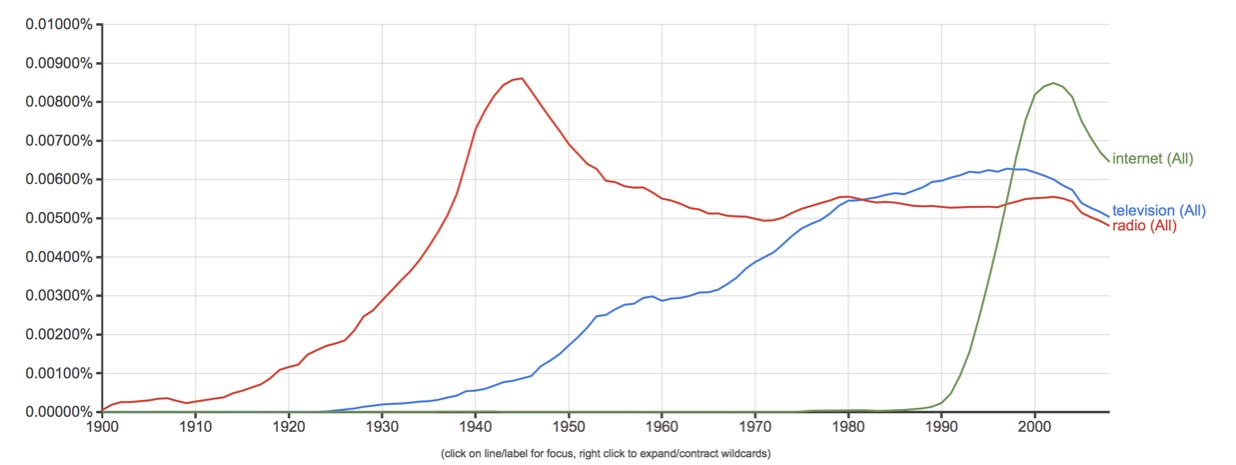
I tried a few charts of my own. Since 1885, “Evolution” has beaten “Creation,” but it took a noticeable drop during the 30’s. Since 1960 both have been on the rise.  In1980, Apple got off to an initial head start, but Microsoft passed it in 1992, never to look back (although it’s had a precipitous decline since 2000.)  Perhaps the most interesting chart is comparing “radio”, “television” and “internet” since 1900. Radio started growing in the 20’s and hit its popularity peak around 1945, but the cross-over with television would take another 40 years (about 1982.) Television would only enjoy a brief period of dominance. In 1990, the meteoric rise of the Internet started and it surpassed both radio and television around 1997.

tvradiointernet

My final chart was to see how Google fared in it’s own tool. Not surprisingly, Google has dominated the search space since 2001, and done so quite handily. Currently, it’s 6 times more popular than its rivals, Yahoo and Bing.  One caveat here though – Bing’s popularity started to climb in 1830, so I think they’re talking about either the cherry, Chinese people named Bing or a German company that used to make kitchen utensils.  Either that, or Microsoft has had their search engine in development a lot longer than anyone guessed.

googleyahoobing

Yahoo Under the Mayer Regime

First published November 7, 2013 in Mediapost’s Search Insider

marissa-mayer-7882_cnet100_620x433OK, it has a new logo. The mail interface has been redesigned. But according to a recent New York Timespiece, Yahoo still doesn’t know what it wants to be when it grows up. Marissa Mayer seems to be busy, with a robust hiring spree, eight new acquisitions, 15 new product updates, a nice 20% bump in traffic and a stock price that’s been consistently heading north. But all this activity hasn’t seemed to coalesce into a discernible strategy — from the outside, anyway.

It’s probably because Mayer is busy rebuilding the guts of the organization. Cultures are notoriously difficult things to change. In any organization where a major change in direction is required, you will have to deal with several layers of inertia — and, even more challenging, momentum heading the wrong way.  In the blog post, design guru Don Norman agrees, ““The major changes she has made are not what the logo looks like or a new Yahoo Mail. The major changes are what the company looks like internally. She’s revitalizing the inside of the company, and what everyone sees on the surface are just little ripples.”

To be fair, Yahoo has been an organization lacking a clear direction for a long, long time. I remember speaking at the Sunnyvale campus years ago, when Yahoo was still being remade into a media property, under the direction of Terry Semel. There were entire departments (including the core search team) that felt cut adrift. Since then, the strategic direction of Yahoo has resembled that of a Roomba vacuum, plowing forward until it senses an obstacle, then heading off in an entirely new direction.

What was interesting about the recent Times post was the marked contrast to the rumors and kvetching coming from Mayer’s old digs: Google. There, the big news seems to be the ultra-secret party barge anchored in San Francisco bay. And a Quora thread entitled “What’s the Worst Part about Working at Google?” paints a picture of a frat house that has yet to wake up and realize the party’s over:

  • Overqualified people working at menial jobs.
  • Frustration at not being able to contribute anything meaningful in an increasingly bureaucratic environment.
  • Engineers with egos outstripping their skills.
  • Bottlenecks preventing promotion,
  • A permanent “party” atmosphere that makes it difficult to get any actual work done.

But perhaps the most telling comment came from someone who spent seven years at Google, who said that all the meaningful innovation comes from an exceedingly small group, headed by Larry and Sergey. The rest of the Googlers are just along for the ride:

Here’s something to ponder.  The only meaningful organic products to come out of Google were Search and then AdSense.  (Android — awesome, purchased.  YouTube — awesome, purchased, etc. Larry and/or Sergey were obviously intimately involved in both.  Maps – awesome, purchased. Google Plus is a flop for all non-Googlers globally, Chrome browser is great, but no direct monetization (indirectly protects search), the world has passed the Chrome OS by… etc. ) Fast-forward 14 years, and the next big thing from Google, I bet, will be Google Glass, and guess who PMd it.  Sergey Brin.  Tiny number of wave creators, huge number of surfers.

So we have Google, still surfing a wave that started 15 years ago, and Yahoo struggling to get in position to catch the next one. For both, the challenge is a fundamental one: How do you effect change in a massive organization and get thousands of employees contributing in a meaningful way? Ironically, it may turn out that Marissa Mayer has significant advantage here. If you’re bright, ambitious and looking to do something meaningful with your career, what would be more appealing: trying to shoehorn your way into an already overcrowded house party, or the opportunity to roll up your sleeves and resurrect one of the Web’s great brands?