The Bleeding Obvious File: Advertising Leads to Increased Search Volumes

Holy crap, it’s official! There is a link between advertising and the volume of searches. We now have research to prove it. A recent analysis for the Retail Advertising and Marketing Association found a direct link between consumers exposure to advertising and their likelihood to begin an online search.

Consumers said they were most motivated to begin an online search after viewing:

  • Advertising in magazines (47.2%)
  • Newspapers (42.3%)
  • Ads on TV (42.8%)
  • From reading articles (43.7%)

In a particularly insightful quote, Mike Gatti, Executive Director of RAMA, said, “… while search engine marketing continues to be a popular strategy, retailers should not lose sight of traditional advertising channels to promote products and services.”

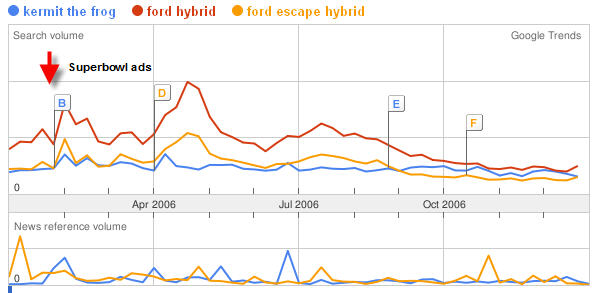
Huh? We’re now worried about search taking too much of the advertising budget away from TV, magazines and newspaper? Has Mr. Gatti seen how that particular pie is sliced up lately? If anything, we should flip this and tell all those advertisers dumping millions on television that they should back up those campaigns with a few bucks spent on relevant search terms. Here’s just one example. In 2006, Ford spent mega bucks to promote their new Green line of Hybrid Ford Escapes on the Super Bowl in television ads. They had Kermit the Frog as their spokesperson..er…spokesfrog. But what Ford didn’t remember is that all that media attention would probably drive a resulting spike in search activity. And sure enough, as we can see from the Google trends graph below, there was a spike:

ford campaign

Unfortunately, Ford forgot to bolster their keyword buy by including all related phrases, leaving the door open for General Motors to bid higher for a number of generic relevant phrases, including Ford’s own spokesperson, Kermit the Frog, and intercept search users with pinpointed messaging. The total cost for Ford to close the loop on this particular campaign? Probably less than the cost of Kermit’s personal assistant during the filming of the ad.

Shari Thurow Talking Smack about Eye Tracking

You know, if I didn’t know better I’d say that Shari Thurow had issues with me and eye tracking. I ran across a column a couple of weeks ago where she was talking about the niches that SEO’s are carving out for themselves and she mentioned eye tracking specifically. In fact she devoted a whole section to eye tracking. Now, it’s pretty hard not to take it personally when Enquiro is the only search marketing company I know that does extensive eye tracking. We’re the only ones I’m aware of that have eye tracking equipment in-house. So when Shari singles out eye tracking and warns about using the results in isolation…

That brings me to my favorite group of SEO specialists: search usability professionals. As much as I read and admire their research, they, too, often don’t focus on the big picture.

…I’m not sure who else she might be talking about.

I’ve been meaning to post on this for awhile but I just didn’t get around to it. I’m on the road today and feeling a little cranky so what the heck. It’s time to respond in kind. First, here’s Shari’s take on on eye tracking and SEO.

Eye-tracking data is always fascinating to observe on a wide variety of Web pages, including SERPs (define). As a Web developer, I love eye-tracking data to let me know how well I’m drawing visitors’ attention to the appropriate calls to action for each page type.

Nonetheless, eye-tracking data can be deceiving. Most search marketers understand the SERP’s prime viewing area, which is in the shape of an “F.” Organic or natural search results are viewed far more often than search engine ads are, and (as expected) top, above-the-fold results are viewed more often than the lower, below-the-fold results. Viewing a top listing in a SERP isn’t the same as clicking that link and taking the Web site owner’s desired call to action.

Remember, usability testing isn’t the same as focus groups and eye tracking. Focus groups measure peoples’ opinions about a product or service. Eye-tracking data provide information about where people focus their visual attention. Usability testing is task-oriented. It measures whether participants complete a desired task. If the desired task isn’t completed, the tests often reveal the many roadblocks to task completion.

Eye-tracking tests used in conjunction with usability tests and Web analytics analysis can reveal a plethora of accurate information about search behavior. But eye-tracking tests used in isolation yield limited information, just as Web analytics and Web positioning data yield limited (and often erroneous) information.

Okay Shari, you didn’t mention me or Enquiro by name but again, who else would you be talking about?

Actually, Shari and I agree more than we disagree here. I agree that no single data source or research or testing approach provides all the answers, including eye tracking. However, eye tracking data adds an extraordinarily rich layer of data to common usability testing. When Shari says eye tracking is not the same as usability testing, she’s only half right. As Shari points out, eye tracking combines very well with usability testing but in many cases, can be overkill. Usability testing is task oriented. There’s no reason why eye tracking studies can’t be task oriented as well (most of ours are). The eye tracking equipment we use is very unobtrusive. It virtually like interacting with any computer in a usability lab. In usability testing you put someone in front of the computer with the task and asked them to complete the task. Typically you record the entire interaction with software such as TechSmith’s Morae. After you can replay the session and watch where the cursor goes. Eye tracking can capture all that, plus capture where the eyes went. It’s like taking a two dimensional test and suddenly making it three-dimensional. Everything you do in usability can also be done with eye tracking.

The fact is, the understanding we currently have of interaction with the search results would be impossible to know without eye tracking. I’d like to think that a lot of our current understanding of interaction with search results comes from the extensive eye tracking testing we’ve done on the search results page. The facts that Shari says are common knowledge among search marketers comes, in large part, from our work with eye tracking. And we’re not the only ones. Cornell and Microsoft have done their own eye tracking studies, as has Jakob Nielsen, and findings have been remarkably similar. I’ve actually talked to the groups responsible for these other eye tracking tests and we’ve all learned from each other.

When Enquiro produced our studies we took a deep dive into the data that we collected. I think we did an excellent job at not presenting just the top level findings but really tried to create an understanding of what the interaction with the search results page looks like. Over the course of the last two years I’ve talked to Google, Microsoft and Yahoo. I’ve shared the findings of our research and learned a little bit more about the findings of their own internal research. I think, on the whole, we know a lot more about how people interact with search than we did two years ago, thanks in large part to eye tracking technology. The big picture Shari keeps alluding to has broadened and been colored much more extensively thanks to those studies. And Enquiro has tried to share that information as much as possible. I don’t know of anyone else in the search marketing world who’s done more to help marketers understand how people interact with search. When we released our first study, Shari wrote a previous column that basically said, “Duh, who didn’t know this before?” Well, based on my discussions with hundreds, actually, thousands of people, almost everyone, save for a few usability people at each of the main engines.

There are some dangers with eye tracking. Perhaps the biggest danger is that heat maps are so compelling visually. People tend not to go any further. The Golden Triangle image has been displayed hundreds, if not thousands of times, since we first released it. It’s one aggregate snapshot of search activity. And perhaps this is what Shari’s referring to. If so, I agree with her completely. This one snapshot can be deceiving. You need to do a really deep dive into the data to understand all the variations that can take place. But it’s not the methodology of eye tracking that’s at fault here. It’s people’s unwillingness to roll up their sleeves and weed through the amount of data that comes with eye tracking, preferring instead to stop at those colorful heat maps and not go any further. Conclusions on limited data can be dangerous, no matter the methodology behind them. I actually said the same for an eye tracking study Microsoft did that had a few people drawing overly simplified conclusions. The same is true for usability testing, focus groups, quantitative analysis, you name it. I really don’t believe Enquiro is guilty of doing this. That’s why we released reports that are a couple hundred pages in length, trying to do justice to the data we collected.

Look, eye tracking is a tool, a very powerful one. And I don’t think there’s any other tool I’ve run across that can provide more insight into search experience, when it’s used with a well designed study. Personally, if you want to learn more about how people interact with engines, I don’t think there’s any better place to start than our reports. And it’s not just me saying so. I’ve heard as much from hundreds of people who have bought them, including representatives at every major search engine (they all have corporate licenses, as well as a few companies you might have heard of, IBM, HP, Xerox..to name a few). I know the results pages you see at each of the major engines look the way they do in part because of our studies.

Shari says we don’t focus on the big picture. Shari, you should know that you can’t see the big picture until you fill in the individual pieces of the puzzle. That’s what we’ve been trying to do. I only wish more people out there followed our example.

User-centricity is More than Just a Word

Ever since Time Magazine made you and I the person of the year, user experience has been the two words on the tip of everyone’s tongue. We’re all saying that the user is king and that we’re building everything around them. But I fear that user-centricity is quickly becoming one of those corporate clichés that’s easy to say, but much, much harder to do. All too often I see internal fighting in a lot of companies between those that truly get user centricity and have become the internal user champions and those that are continuing to push the corporate agenda, at the expense of the user experience. The tough part of user centricity is seeing things through the users eyes. We can do user testing but if we truly put the user first, it requires tremendous courage and fortitude to make the user the primary stakeholder. All too often, I see user considerations being one of several factors that are being balanced in the overall design. And often, it takes a backseat to other considerations, such as monetization. This is the trap that Yahoo currently finds themselves in. They talk about user experience all the time. But the fact is, over the last two years it’s really been the advertiser whose’s owned their search results page. I’ve recently seen signs of the balance tipping more towards the user’s favor with the rollout of Panama and a more judicious presentation of top sponsored ads. But I’m still not sure the user is winning the battle at Yahoo!

It’s not easy to step inside your user’s head when it comes to designing interfaces. It’s very tought to toggle the user perspective on and off when you’re going through a design cycle. The feedback we get from usability testing tends to be too far removed from the actual implementation of the design. By that time the meat of the findings has been watered down and diluted to the point where the user’s voice is barely heard. That’s why I like personas as a design vehicle. A well formulated persona keeps you on track. It keeps you in the mindset of the user. It gives you a mental framework you can step into quickly and readjust your perspective to that of the user, not the designer.

If you’re truly going to be user centric, be prepared to take a lot of flack from a lot of people. This is not a promise to be made lightly. You have to commit to it and not let anything dissuade you from delivering the best possible end-user experience, defined in the user’s own terms. This can’t be a corporate feel good thing. It has to be a corporate commitment that requires balls the size of Texas. And if you’re going to make a commitment, you better be damn sure that the entire company is also willing to make the same commitment. The user experience group can’t be a lone bastion for the user, fighting a huge sea of corporate momentum going in the opposite direction. This isn’t about balancing the user in the grand scheme of things, it’s about committing wholeheartedly to them and getting everyone else in the organization to make the same commitment. If you can do so, I think the potential wins are huge. There’s a lot of people talking about user centricity but there’s not a lot of people delivering on it consistently and wholeheartedly.

The Personalized Results are Coming, The Personalized Results are Coming!

Okay, sometimes the temptation to say I told you so is overwhelming. Danny has a nice long post in Searchengineland about Google’s changes to Personalized Search, making it more of a default and less of an option for millions of users. Danny details it more than I intend to, so please check it out.

As Danny says, he’s been talking about personalization for years, but up to now, it never materialized. After interviews with head user experience people at all three engines, I felt the time was right for personalized search to roll out (check The Future of SEO in a Personalized Search Interface and The SEO Debate Continues). And it appears my sense of timing was bang on. Much as I’d like to claim to be prescient, it’s really just common sense. You could see all the engines inching towards it. Now, Google has just upped the ante a little.

There are two major implications to this: what it means for search marketers, especially organic optimizers, and what it means to users. I’ll deal with each in turn.

What it Means for Search Marketers

The “Is SEO Dead? Rocket Science? A Scam?” Debate has been winding it’s weary way through several blogs in the past few weeks. My take was that SEO is, and will continue to be, vitally important as long as organic search results continue to be important to the user. Based on what I’m seeing, that continues to be very much the case. But, organic optimization now has a completely new rule set, which will irritate the hell out of many organic optimizers. The disgruntlement is already beginning to show. Michael Gray, better known as Graywolf, was the first to post a comment on Danny’s story:

Just because I ordered my coke with extra ice last time doesn’t mean I want it that way this time. I hate personalized SERP’s, I despise it even more that they don’t tell me they are personalized, and I loathe not being able to turn it off. I also have extreme antipathy for not being able to keep my search history on and not be part of personalized search.

Let me have it the way I want, not the way you think I do. I don’t want SERP’s that work like Microsoft programs that try to anticipate what I want to do, because more often than not it’s wrong. Bring back truth, purity, and clarity to the SERP’s.

Graywolf is complaining as a user, but I can’t help thinking that the more significant pain he’s feeling is as an organic optimizer who’s world suddenly just became a lot more complicated. “Truth, purity and clarity to the SERP’s”? In whose eyes? Come on. Personalization is being implemented because it enhances the user experience. It doesn’t take a “Rocket Scientist” (sorry, couldn’t resist) to see that one set of search results is not the best way to serve millions of users.

As Danny said, there’s now an explosion of new fronts for the organic optimizer to consider. Right now, Google is only injecting a few personalized results into the search page, but expect that threshold to gradually creep up as Google gains confidence in the targeting of the results to the person. The days of the universal results page are numbered. Which means that the days of the reverse engineering approach to SEO are equally numbered. I’m sure people will try to figure out ways to spam personalized search, but as I’ve said before, reverse engineering requires a fixed constant to test against. Up to now, the results page and the other sites that appeared on it represented that fixed constant. That’s gone now.

So where does that leave SEO? Well, it’s certainly not dead, but it has dramatically changed. You can’t optimize against a results set, but you can optimize against a user. Let’s use an analogy that’s often been used before to describe SEO. Think of it as Public Relations on the Web. If you launch a PR campaign, you don’t target a particular position on the front page of the NY Times, you target a type of audience. You plan your release distribution and messaging accordingly. And you give reporters what you think will catch their attention. Most of all, you have to wrap your campaign around something that’s genuinely interesting. Then, you hope for the best.

Now, SEO becomes the same thing. You don’t target the first page of results on Google for a particular term. You target an end user. You wrap your site messaging in terms that resonate with that user. You write in their language, you give them a reason to seek you out, and you sure as hell don’t disappoint them when they click through to your site. You do all this, and you remove all the technical barriers between your content and the indexes you need to be in. Then, you hope for the best.

The problem with SEO has always been that it’s been treated like some magical voodoo that can be applied after the fact, like some “secret sauce”. And yes, that was what the infamous Dave Pasternack has been trying to say. He just went several steps too far. The fact is, with universal search results, you could actually do this. Thousands of affiliates have made millions of dollars doing it. Link spamming, cloaking, doorway sites..the fact is, up to now, this bag of tricks has worked. It’s gotten harder, but it’s worked. Site owners looked to SEO to help them hi jack traffic that wasn’t rightfully theirs. They hadn’t done the heavy lifting to create a site that justified a place in the top rankings, and they tried to take an easy short cut.

But now, organic optimization means that you have to do the heavy lifting. It has to be integrated into the entire online presence. What Marshall Simmonds has done with About.com and the NY Times is a perfect example of the new definition of SEO. Get to the front lines, to the people who are churning out the content, and teach them about what search engines are looking for. Make sure SEO best practices are baked right into the overall process flow. Work with the IT team to create a platform that entices the spider to crawl deeper. Work with the marketing team to crawl inside the head of your target audience and figure out the who, the when and the why. Don’t worry so much about the where, because you can’t really control that any more. It’s a tough paradigm to break. We’ve been struggling with our clients for the past year or so. They’re still fixated on “being number one” for a particular term. We’ve been trying to ease them into the new reality, but it’s not easy.

I guarantee this will create an identity crisis for the SEO industry. As recently as a few months ago I was moderating a panel that was talking about analytics, and in the Q&A someone asked the panel, who had a few very well known SEM’s on it, about what they used for ranking reporting. The names of various options were thrown out and people started scribbling them down. I saw this and thought I had to comment.

“You know, the whole concept of ranking is quickly becoming irrelevant”

Nobody lifted their head, they were still busy writing down tool names. Maybe they hadn’t heard.

“As search engines move to personalized results, there will be no such thing as ranking. It will all be relative to the user.”

That should get their attention. Nope, nothing.

One of the search marketers said, “Yes, but knowing how they rank is still important to people.”

Huh? Am I speaking a different language here? I shook my head and gave up.

So, does this mean SEO is dead? Absolutely not. It becomes more vital than ever. Here are a few things that remain to be true. Preliminary results from the new SEMPO survey say SEO continues to be the number one tactic in search marketing. Yes, people want to bring it in house, but they recognize it’s importance.

Why do they think it’s important? Because it kicks ass in ROI. Here are the results from another recent study by Ad:Tech and MarketingSherpa, asking advertisers about the return they get from various marketing channels.
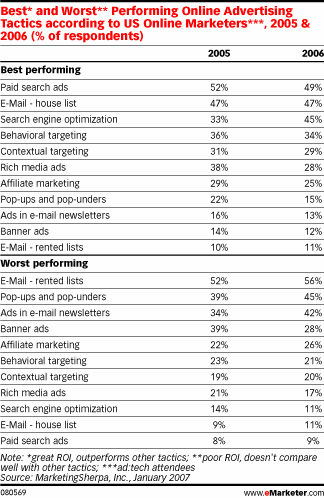
080569

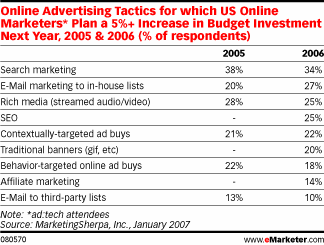
The biggest jump from year to year? SEO. Now, let’s look at where marketers plan to spend more money in the next year.

080570

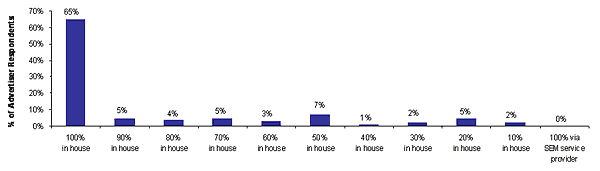
SEO, from flatlined last year to looking to spend 25% more this year. So SEO definitely isn’t dead. But it is moving to a new home. Here’s some early results from the SEMPO State of the Market Study (by the way, final results should be available next week. Look for them):

SEMPO2a

It’s true that most companies would far rather bring SEO in house, if they could. And when we consider the new definition of SEO, it probably makes sense for SEO to be integrated into the internal work flow. But the problem is that there’s not a lot of SEO expertise out there. If SEO was so easy, why don’t more companies do it, or do it well? Contrary to Pasternack’s argument, it’s not a “set and forget” type of tactic. It requires a champion, buy in and diligence.

I think the future is bright for SEO as a skill set, but we’re talking a modified set of skills. I talked about this in a recent SearchInsider column and a follow up online debate with Andrew Goodman. My view of the future for the really good SEO’s out there fall into three categories:

Get a (Really Good) Job

As companies bring this in house, there will be a firestorm of demand for skilled SEO Directors, but ideally as employees, not consultants.

Broaden Your View

Become an expert in how consumers navigate online and help your customers with the big picture, including the new reality of SEO.

Adapt and Survive

Find a new online niche where your search honed skills give you an advantage.

User’s View

Okay, this is already a much longer post than I intended, so I should probably talk about personalized search from the user’s perspective now.

Personalized search is a big win for the user. Don’t judge by the first few tentative steps Google is taking. Personalization is a much bigger deal than that. Google is easing us in so the experience isn’t too jarring. By the end of 2007, all 3 of the major engine’s results pages will look significantly different than they do today. Personalization will be like a breached dam. Right now we’re seeing the first few trickles, but there will be a wave of much deeper personalization options over the next several months. Search will become your personalized assistant, tailored to your tastes. As you search more, your results will draw more and more away from the universal default and closer and closer to your unique intent. Immediately after your query, you’ll be dropped into a much richer search experience. Disambiguation will become much more accurate, and you’ll find that you will pretty much always find just what you’re looking for right at the top of your page, without having to dig deeper. Here’s how I see it playing out at each of the big three:

Google

Google has a religious devotion to relevance, and as they gain confidence with personalized search and their ability to disambiguate, this will manifest itself with a laser focus on relevance above the fold. They will continue to maintain a good balance of organic results, but these results will not just be the current web search results. They could be local, image, news or a mix of each. And ads. Yes, you won’t escape ads, but Google will be the most judicious in what they show. Expect more stringent quality scoring, down to the landing page level and a high degree of relevancy in the ads that do show. Google will be the most concerned of the three in disambiguating intent.

Yahoo

Yahoo will put their own spin on personalization by wrapping in Social Search. They will continue to leverage their community, as they currently do in Yahoo! Answers so when you’re logged into Yahoo, you’ll be plugged into their community and that will impact the search results you see. Relevancy will be determined more by what the community finds interesting than what you find interesting, although it will be a mix between the two. Yahoo will target two types of searches, serendipitous search, where you’re looking to discover new sites, and what I call “frustrated” search, where your own efforts to unearth the data online have come up empty and you want the help of the community. When it comes to monetization, Yahoo will be the most aggressive, pushing more ads above the fold into Golden Triangle real estate. These ads will trail Google’s in terms of relevance

Microsoft

Microsoft will use their targeting capabilities and probably tie in some behavioral targeting to personalize their search results. Also expect personalization in the Microsoft product to be integrated at a deeper, more ubiquitous level, into apps and OS. This probably won’t happen in 07, but it will be a long term goal. When it comes to ad presentation, Microsoft will fall somewhere between Google and Yahoo in both the number and relevance of the ads being presented. The heaviest investment will be in building out the platform to manage and model the ad program, rather than in policing the quality of the ads themselves.

It promises to be a very interesting year in the Search Marketing biz!

BusinessWeek Dissing Paid Search (Again)

Okay, BusinessWeek is beginning to get a little obvious in its campaign against paid search. In my books, they just received their third strike.

Strike One

An “expose” on the SEM Sweat Shop floor that showed a remarkable ignorance for the diversity of the industry. I responded to this little journalistic gem in a SearchInsider column last May. In it, search marketers were called “digital bricklayers”. Here was one quote:

“The work ranges from the slightly creative, such as … crafting sentences for ads to snag search traffic, to the rote — typing in descriptions of hamburgers for online menus.”

It was not wrong so much as one dimensional. BusinessWeek shows a tendency to paint the entire industry with a single brush.

Strike Two

This time BusinessWeek took on click fraud, with a similarly one sided perspective. They approached it focusing on the most egregious cases of click fraud, with examples of both perpetrators and victims. This is fine to draw attention, but they should also provide an accurate assessment of the overall problem. They used numbers that came from faulty research, like Outsell’s much quoted study and passed it off as an accurate assessment of the scope of click fraud with the slippery qualifier, “most experts believe”. They virtually ignored the balancing viewpoint of the engines themselves. Again, I dealt with this in another SearchInsider column and a follow up post. This is just one of many articles from BusinessWeek pumping up concern about click fraud. And most imply that the majority of the problem lies with Google and Yahoo.

Strike Three

The latest one indicates that advertisers are souring on search ads because of rising click costs and decreasing ROI. Again, they’ve taken a few cases and given the impression that it represents the entire industry. So, let me dive in again. Yes, PPC costs are rising. And yes, if you’re not tweaking your campaigns, you could find your ROI dropping. But here’s the thing. The advertisers finding this are the direct marketers. And as I’ve said over and over, there’s an inherent disconnect here. Direct marketers are looking at selling something..now. And their ads say as much. One of the advertisers quoted as complaining about the ineffectiveness of paid search in the articles was eBags.com

Okay, let’s say I search for “best luggage” on Yahoo. Here are the ads that come up:

luggageexample

Hmm..apparently eBags isn’t that turned off sponsored. But let’s get to the disconnect. What are the chances that if I search for “best luggage”, I’m looking to buy right now? How interested am I in saving 60%? I’ll tell you, based on past research. Less than 1 in 10.  In fact, it’s probably less than 1 in 20. I’m looking to see what the best luggage is. I’m researching. And where will I click? Well, let me show you the number one organic result for the same search in Yahoo.

luggageorganic

This is where I’m going to click, because it’s a much better match to my intent.

So, for those advertisers hell bent on jamming a purchase down a consumer’s throat, I have three pieces of advice:

  • Get to know how search works better
  • Get to know your consumers better
  • Get to know how your consumers use search better

If you do those 3 things, you’ll get a much better return than you will from desperately steering budget into different channels without putting some solid strategy and understanding behind your campaigns. The problem is not that search is getting less effective, it’s that marketers using it aren’t getting any smarter.

From the “Living in Glass Houses” Category

And finally, when I went to try to read this article on BusinessWeek, I had to click through an interstitial. When the hell will online publishers learn that these are incredibly annoying and detract significantly from the user experience? Give me a bushel of paid search ads, aligned with my intent, any day over one interstitial.

Over 50% of CMOs aren’t looking for Big Agencies for Online

A new study has reaffirmed something I’m hearing more and more. Big agencies don’t get online.

Sapient, through Evalueserve, surveyed a number of CMO’s, and just over half of them believe that traditional, large ad agencies are “ill-suited to meet online marketing needs”. They believe that there’s too much invested in traditional models, and that agencies can’t think beyond these constraints.

The upshot? Fewer than 10% of those polled seek to partner with large agencies for online marketing. They instead look for partners with roots in technology, a high degree of creativity and traditional print expertise, or, even more common, to use multiple agencies.

It’s not that large agencies don’t have people capable of getting online. In many cases, they do. But they’re trapped in a rigid and bureaucratic structure that sucks the lifeblood out of the bold thinking and initiative essential for online. They spend more time fighting turf wars than they do providing value to clients, and it seems that the clients are getting tired of it.

Increasingly, large agencies are struggling to understand the shifting marketplace. They are fighting the idea of a participatory approach to branding, with a community of consumers at least as important in the process as the actual brand itself. They are far more comfortable with the more traditional, and much more profitable, command and controlled channel form of marketing that has been built over the last several decades. They’re struggling to win in a new game where they don’t know the rules, largely because they haven’t been written yet.

The big agencies are out there shopping right now. They’re looking to buy expertise needed. I wonder how successful this will be. It’s not just the expertise they’re lacking. It’s the environment needed to let their experts do their job. You can buy all the roses you want, but if you lock them in a dark basement, you’re not going to see much blooming.

A Day in the Life

First published January 4, 2007 in Mediapost’s Search Insider

The U.S. Census Bureau has just released its new statistical abstract. According to the study, here’s how the average adult or teen will spend his or her time in 2007:

  • 65 days in front of the TV;
  • 41 days listening to the radio;
  • A little over a week on the Internet;
  • A week reading a daily newspaper; and
  • Another week listening to recorded music.

I have just one question: Who the hell are these people? Nobody I know.

The Census Bureau was unavailable for comment on the findings, so I have to make some assumptions. I’m assuming that the Internet time includes any work-related activity. So I tallied up my time on the Internet, actively using it, and found I averaged about 4 hours a day. Granted, I’m not a normal user (in oh-so-many ways) but bear with me. That means I spend almost 2 months on the Internet in a year.

Okay, I represent an extreme, and I realize that. So how about my wife, Jill? She is above average in nearly every regard, but when it comes to Internet use, is probably a closer approximation of your garden-variety user. Jill spends about an hour-and-a-half online a day. That puts her at just over 3 weeks of surfing in a year. My kids? About two-and-a-half hours a day, the majority of that chatting with umpteen zillion friends simultaneously on Messenger and butchering the English language I love, but I digress. That’s about five-and-a-half weeks in a year.

Perhaps the whole Hotchkiss family is abnormal when it comes to using the Net. Who are the least Net-savvy people I know? My Mom and Dad. Even they spend a half hour a day online, which puts even them slightly higher than the U.S. average.

Let’s attack the question in a different way. Let’s put together a day in the life of this mythical average American. According to the statistical abstract, here’s how his or her day is spent:

4.27 hours watching TV

2.7 hours listening to the radio

And roughly a half hour each surfing the Net, reading a newspaper and listening to music

Let’s assume that this person gets an average of 7.5 hours sleep and spends another 1.5 hours eating. That leaves fewer than 7 hours a day to do everything else, including being gainfully employed (unless their job is actually watching TV). Into that basket would fall things like reading a book, going for a walk with your family, hitting the gym, cleaning up the house, going on a vacation and talking with friends. Something seems askew here.

So I’m left with two possibilities. Either I have a warped view of the world because everyone I know represents the extreme end of the spectrum, or the U.S. Census Bureau has its facts wrong. If it’s the former, that means there are people, somewhere, that are really dragging down our collective average by remaining comatose in front of the TV for the better part of a day. I knew they existed, I just didn’t know there were so many of them. And it can’t really be the second possibility, can it? I mean, when’s the last time you remember the government getting its facts wrong?


Stepping into the Did It/Web Guerrilla/Searchengineland Fray

I came in this morning, and what did I find? Another tempest stirring up in the blogosphere! Danny Sullivan, Kevin Lee and Greg Boyser have all waded in, so what the hell, I’ll dive in too.

First, a little history. Did It President David Pasternack started the whole deal sometime ago when he took a swipe at SEO, calling for it’s imminent death. I’m not going to elaborate, but for those of you interested, here are links to the original article, and a follow up article.

Now, Kevin Lee from Did It has written a ClickZ column, adding some clarity, but also predicting organic results being pushed below the fold because sponsored ads are more relevant. I’m going to set aside for a moment the SEO spamming question that Kevin raises. Greg and Danny do a pretty passionate job of defending SEO.

I’d like to speak from another perspective, the search user. There are a couple things that should be considered here.

First of all, contrary to Kevin’s point, just paying for an ad doesn’t make it relevant. That’s because the vast majority of marketers don’t consider the intent of the search user. They assume that everyone is ready to buy right now. That assumption is at least 85% wrong. Go ahead, do a search for any popular consumer product. I’ll bet the ads you see are talking about lowest prices, free shipping, guarantees and other hot button items that are aimed at a purchaser. But study after study shows that search engines are used primarily for product research, not purchase. The problem is that marketers have a very biased set of metrics they use to measure return. They measure ROI based on purchase, so when they test, these types of ads tend to pull the numbers they’re looking for. But the metrics aren’t capturing the full story. The 85% of users that are researching are basically ignored. No value is assigned to them. Until PPC marketers figure this out, they’re not doing the user any favors.

Our research shows that a very interesting interaction takes place with the researcher versus the purchaser in that Golden Triangle real estate. Both users look at the top sponsored ads when they appear. They both look at the organic listings. Frankly, there’s not a lot of difference between the scan patterns. But it’s where they click that makes the difference. When they’re ready to buy, based on a recent eye tracking study, about 45% click on top sponsored, and about 55% clicked on the top 1 or 2 organic links. Almost a 50/50 split, FOR THOSE THAT ARE READY TO PURCHASE. But when we look at the other 85%, the ones doing research, EVERYONE OF THEM clicked on the organic link. And in the test, the same site appeared in both spots, so relevancy of the destination was equal. As long as users want organic links, organic optimization continues to be important.

Look, David Pasternack can ring the funeral bell for organic all he wants, but the fact is, it’s not his call. It’s the user’s. Yahoo has actually done exactly what he and Kevin are predicting. They’ve moved organic down the page, jamming more sponsored on the top. Based on Did It’s comments, this should be good for the user, right? It should be more relevant, pushing the “spam” down below the fold. Wrong. Google kicked Yahoo’s ass in user experience in our latest study by every metric we looked at. And they’re definitely winning in the big picture, including stock prices. The difference. About 14% of Yahoo’s screen real estate (at 1024 by 768 pixels) was reserved for top organic. 33% of Google’s real estate went for top organic. You want more proof? Ask, back in the Ask Jeeves days, pushed organic totally off the page, doing exactly what Kevin and David call for and filling the top with sponsored. Take a look at Ask now. Organic is back above the fold. Spend some time talking to Ask usability lead Michael Ferguson about how the absence of organic worked out for them.

And it’s not that sponsored links provide a bad experience. Our study proves Kevin somewhat right. Top sponsored links, for commercial queries, delivered the highest success rates. But those were in highly structured and commercially oriented scenarios. That doesn’t represent all searches. It’s not that we avoid sponsored links, but we do want a choice and we want relevance, ALIGNED TO OUR CURRENT INTENT. Google has recognized that to a much greater extent than their competitors, and they’re eating their lunch.

There’s a reason why 70% of users choose organic. We’ve done a number of studies over the past 3 years, and that number has remained fairly constant.  It can’t be because those results are filled with spam. I actually just chatted with Marissa Mayer at Google, and she continually emphasized the importance of organic on the page. It’s a cardinal rule there that at least one organic result will always appear at 800 by 600. It’s mandated by Larry and Sergey. And that’s because they know it’s important to the user. We want alternatives. And we will be the judge of relevancy. That’s why Google has stringent click through measures on their top sponsored ads. If they don’t get clicked, they don’t show. The top of the Golden Triangle is reserved for the most relevant results, period, and in more than 50% of the cases, those are organic (either through OneBox or traditional organic).

So we in this industry can debate sponsored versus organic. We can make predictions. We can post in blogs til the cows (or frogs) come home. But it’s not our call. It’s not even the engine’s call. It’s the user’s.

Thou Shalt Not Google (unless it’s on Google)

First published November 2, 2006 in Mediapost’s Search Insider

goo-gle: Function: transitive verb: to use the Google search engine to obtain information about (as a person) on the World Wide Web
Merriam-Webster Online Dictionary.
Of all the things that Google’s lawyers have in their basket, apparently stamping out inappropriate use of “Google” as a verb is right on top of the stack. It apparently irks them no end.Now, I can really sympathize here. It’s a little known fact that my last name has actually suffered the same fate as Google. In Japan, of all places, Hotchkiss has become the generic name for the office stapler. Each time a worker lost in the maze of cubicles at Mitsui and Co. says, “Pass me the Hotchkiss” I die a little inside. I kid you not! Check out Wikipedia.Mind your Ps and GooglesNow, according to a post on Google’s official blog, it’s not the fact that we Google on Google that causes the Google legal department to have hissy fits. It’s if we try Googling on Yahoo and MSN. It can’t be done. Not all tissue papers are Kleenex, not all copy machines are Xeroxes. To quote the post:

You can only “Google” on the Google search engine. If you absolutely must use one of our competitors, please feel free to “search” on Yahoo or any other search engine.

Hmmm..people are using the word “Google” to refer to Google’s competitors, and it’s Google that’s upset? Unless I’m missing something here, shouldn’t it be Yahoo and MSN that should be miffed?

I Google, therefore I am…

The inclusion of Google in the English lexicon is “faintly unsettling,” according to the folks at Google. They fear that Google will lose its identity as a trademark once it slips into common usage. They explain:

A trademark is a word, name, symbol or device that identifies a particular company’s products or services. Google is a trademark identifying Google Inc. and our search technology and services. While we’re pleased that so many people think of us when they think of searching the web, let’s face it, we do have a brand to protect, so we’d like to make clear that you should please only use “Google” when you’re actually referring to Google Inc. and our services.

Now, I know that Google has way too much money, and they have a team of very bright 12-year-old lawyers (or at least, they look 12) trying to reinvent the law. But in this case, I would suggest slipping down to the Google cafeteria for a double decaf low fat cappuccino and relaxing. There are better windmills to tilt at than this one.

Once again, who’s in control?

The irony here is that the very entity that has probably done more than any other to put control in the hands of the consumer is now fretting because consumers are exercising that control. We associate search with Google. We endorse the brand by using it as a verb. It’s just this critical mass that makes Google such a formidable competitor in the highly promising search market. Frankly, it’s not the fact that their brands became generic terms that hurt many of the companies that Google uses as examples. It’s because the companies became complacent and let the competition catch up, losing the distinction that their brand once afforded them. The consumers didn’t take the brand away from the company, the company surrendered the brand to the competition.

In the corporate culture that says “don’t be evil,” apparently improper use of “Googling” is now defined as evil. Just to make it clear, Merriam-Webster defines evil as “morally reprehensible.”.  Perhaps someday “google” will also mean “to spend one’s time unproductively fighting frivolous legal battles.” At this point, it’s a toss-up with “disney.”

A final word to Google’s legal team: As you’re putting together those multi-page lawsuits, go ahead and feel free to use the Hotchkiss. I don’t mind.

The SEM Hierarchy of the E-mail Inbox

First published September 14, 2006 in Mediapost’s Search Insider

Into each social structure, a little stratification must fall. As our society takes a decidedly virtual turn, I’m finding that my Outlook inbox is the latest place where a class structure is taking shape.

Of course, you have the standard spam vs. non-spam sorting, but this doesn’t really count. That happens pretty much transparently in the background, and every day or so I wade through the muck in my deleted spam folder just to make sure a vital piece of communication didn’t get waylaid. For instance, today an e-mail from my lawyer went there. On second thought, perhaps the filter knew better than I what should be deleted.

No, it’s the e-mail that survives the cut that is subject to endless classification and sorting, as I haplessly try to wrap my priorities around an ever-expanding inbox. At first, I thought the six different flags supplied by Outlook would do the trick, but I quickly realized my complicated world needs much more than six classifications.

So in an attempt to ease the daily burden of countless search marketers, I offer the following suggestions for an SEM Custom Rules plug that would automatically take the following actions in Outlook’s inbox.

The “Anything from Google” Rule

It doesn’t really matter what comes in with an “@google.com” on the back end, you’d better open it right away. These go on the top of the list. If it’s from Matt Cutts or Tim Armstrong, perhaps a siren and flashing red light to draw further attention. I don’t get e-mails from Eric, Sergey or Larry, and I suspect the same is true for most SEMs, but if I ever did, I would like a heavenly ray of light to shine gently on me as a choir of angels sing the “Hallelujah Chorus.”

The MSN Beta Invitation Rule

This could dramatically reduce the manual sorting required by automatically signing up for beta test groups for MSN’s new adCenter products, including the Targeting by Presence of Facial Hair Platform, the Visitors You Wish You Got Report feature and the Integrated adCenter/Xbox 360 Console, which drops you into a virtual 3-D world where you can walk up to leads that didn’t convert and slap them for being stupid.

The “Hey, I Got a Speaking Gig” Rule

This would (until recently anyway) include e-mails from Danny Sullivan, Chris Sherman and Brett Tabke, indicating which panel you’d be speaking on at the next big show. These e-mails have to be referred to quickly so you have time to book hotels and flights, and then start e-mailing to see who else will be at the show, who was going to what after- hours function, if you could catch a ride with them, who else was on your panel, and when is the deadline for getting the presentation done (no, not the official deadline–the “real” deadline).

The “Why the Hell Did I Sign Up for This?” Rule

The average search marketer signs up for approximately 6,428,943 newsletters, 194,597 Google news alerts, 963,693 forum post notifications–and that doesn’t include RSS subscriptions. This is all done in the hopes of gaining some vital piece of information that would give them the leg-up on the competition, who are of course all subscribing to the same things. This rule would scan everything for the 1 in 159,975 chance that there’s a useful tidbit in there somewhere. The one exception is the Search Insider–naturally.

The SEMPO Board Communication Rule

Admittedly for a very small market, this would be nonetheless essential for those who serve on SEMPO’s board. It would be able to detect the difference between the 9,543 e-mails a day you get just because you were part of the e-mail alias, a 12-page-long cc list, and the messages requesting you to get off your butt and do something.

The “Rocket to the Top of the Search Engines” Rule

Although these e-mails are technically spam, I like to read them every so often and feel smug about how superior and morally pure I am, and how far my company has come since the days when everyone tried this marketing tactic.

The “Arrange a Meeting/Teleconference” Rule

Why don’t we just accept the fact that it takes 3.6 months and 112 e-mails back and forth to arrange any type of call or meeting, so we should just automate the process? That way we can still feel good that we’re trying to facilitate the phantom meeting by generating reams of e-mails and invitations, while saving us some time. In the end, it will automatically revert to the original time and date proposed, as it turned out that it was really the best for everyone, anyway.

The “Loved Your Column” Rule

Okay, seriously, these e-mails, when they come in (and yes, I have got a few), are the highlight of my day, and they’re the first I respond to. Of course, don’t take this as a hint or anything.