
I just spent 15 minutes wrestling with the internal search tool on AdWeek trying to track down an article. I had the title, what the article was about and the month it ran and still I was unable to track it down. I was getting hundreds of results, supposedly ranked by relevance, and I was unable to filter it down. Then, I searched on Google, with just the name of the article and of the publication and bang, got it in 0.03 seconds. I don’t know how much AdWeek spent for their enterprise search tool but it was too much.
Category Archives: Rants
Every so often I have to blow off steam. These are the results
Search Engines Innovate, Why Not SEMs?
First published July 26, 2007 in Mediapost’s Search Insider
The future of search has been on my mind a lot lately. I’ve just done a series of interviews with some of the top influencers and observers in the space — Marissa Mayer, Danny Sullivan, Greg Sterling, Michael Ferguson, Steven Marder, Jakob Nielsen and others — talking about what the search results page may look like in 2010. I’ll try to corral this into a white paper this fall. I’ve also chatted with a few people about the future of search marketing. And here’s the sum of it all. “Hang on, because you ain’t seen nothing yet!”
Change is the Constant
I have remarked to a number of people in the last week or two that I’ve seen more change in the past six months in the search results page than I have in the last 10 years. And all my interviewees seem to agree: We’re just at the beginning of that change. Whether its personalization, universal results, Web 2.0 functionality or mobile, our search experience is about to change drastically. Search will become more relevant, more functional, more ubiquitous and more integrated. It will come with us (via our mobile devices) more often and in more useful ways. It will expand our entertainment options. It will change forever our local shopping trips. And it will all happen quickly.
As Search Goes, So Goes SEM
The question is, what does this do for search marketing? In a recent conversation, I was asked where the major innovation in the search marketing space was coming from. This was prefaced by the remark that when a well-known industry analyst was asked the same question, they (I’ll keep the gender neutral, as there really aren’t that many industry analysts out there) said there was almost no innovation coming from search marketers. They were “living off the fat.” My first inclination was to jump to the defense of the industry, but this proved harder than I thought.
I realized I haven’t seen a lot of innovation lately. Certainly, the engines themselves are innovating. And I’m seeing innovation in adjacent areas (Web analytics, competitive intelligence). But I’m not seeing a lot happen in the search-marketing space. After a raft of proprietary bid management tools hit a few years ago, there’s been little happening to move the industry forward. In fact, I’ve noticed a lot of SEM heads buried in the sand. We are not encouraging change; we are actively fighting it.
There are probably a lot of reasons why. First and foremost, I think a number of companies that have been in the space for a while are tired. I’ve touched on this in a previous three-part series in Search Insider. Secondly, it’s tough to develop new tools or technologies when you’re completely dependent on APIs or (worse still) scraping information from the search engines.
It’s a very risky call to spend time and resources developing new tools or technologies that can be rendered useless by an arbitrary change at Google or Yahoo — or made obsolete by the rapidly increasing pace of innovation.
Either Help Push Or Get Off!
Whatever the reason (and I’m sure the Search Insider blog will be getting a number of posts refuting my observation), the fact is that if search marketers are, in fact, riding the wave, it’s coming to a crashing halt very soon. The need for innovation and changing your strategic paradigm is greater than ever. As the search engines change rules, those search marketers that want to survive must change. Innovation will become a necessity.
And, in the end, this will be a good thing.
The change that’s happening in the search space is reflective of the change that is happening throughout marketing and advertising. It’s the continuing evolution of a much more efficient marketplace, where connections between customers and vendors are made tremendously more effective through access to information on both sides.
The traditional uncertainty of advertising is being leeched out of the system, due, in large part, to the tremendous effectiveness of search. And as search becomes more relevant and useful, it will make those connections more reliable, less intrusive and more successful for both parties. The opportunity is there for search marketers to help advertisers successfully negotiate this more efficient marketplace. It remains to be seen if we’re up for the challenge.
So You Really Want to Integrate Search?
The Ontario tourism board and I have been butting heads a little bit in the blogosphere as of late. It all came about from an article I wrote a few weeks ago saying that perhaps Canadian advertisers have their “heads up their ass” with search marketing. I used the Ontario Tourism Board as an example of a major organization that was not doing search and was quickly corrected by Nick Pedota from the board, who indicated that they were in fact doing a search campaign. My problem was that I couldn’t find them for any of the keywords I thought they would typically appear for. It seemed to me that there was a disconnect here. This week I published a follow-up column indicating that perhaps there was a mismatch between the objectives and the allocation of budget in the Ontario Tourism strategy. In a follow-up comment to the column, Nick graciously complemented me on my research and admitted that perhaps there was room for improvement in their integrated search strategy. My suspicion is that the cracks in the strategy don’t lie exclusively with either the Ontario Tourism board or their agency but likely fall somewhere in between. And it’s not uncommon to find these cracks when major advertisers move into trying to integrate search in their overall campaign strategies. Kudos are in order for Ontario Tourism’s recognition of search at all.
In the spirit of improvement, I’d like to offer Nick and other marketers a few tips for successfully integrating search into an overall marketing campaign.
Search should be your first dollars in
Typically, search is added as an afterthought in most marketing campaigns. In fact, search should be the foundation of the campaign. This should be the first allocation of funds. Searchers are often your best prospects. They’re the ones that are actively involved in trying to find you. In the case of the Ontario Tourism Board the entire campaign objective was to drive people to their website. Therefore, it didn’t make much sense to not fully utilize search as a channel and to steer dollars instead to less efficient branding channels such as print and television.
In this case, the first thing that should have been done was to accurately assess the size of the potential search market. This would’ve been done during the keyword analysis, when the prime keywords were identified and the corresponding search volumes were discovered. A smart search marketer would be able to determine the key phrases most likely to convert and would start with these, but would then work outwards to determine the total size of the keyword basket. Going hand in hand with this is the determination of the average click cost for these keywords. The search marketer has to make the determination if the cost per click is justified, given the likelihood to convert.
Once the total available search inventory that meets the quality threshold is established, this should form the core of your marketing budget. These are prospects are raising their hand, indicating that they’re looking to find you. They should be the first ones captured in your marketing strategy. Then you can extend the campaign with other branding intiatives.
Realize that branding dollars will drive search volume
Even after you extend your budget into areas other than search, quite often the dollars spent here will translate into search activity. In the case of Ontario Tourism, they ran their website address in all their ads. But much of this activity would have translated into searches on the primary search engines. Therefore, you need top of page presence to capture these navigational searches. Ontario Tourism also did some national advertising, primarily on television, and in this case in particular there is a high likelihood that search would be used to find the site. Unfortunately with Ontario Tourism’s geo targeting and other limits on maximizing their search presence, it’s unlikely that searchers would be able to find a site to click through to. So, in effect, you lose two ways here. You’re spending the money on branding to drive traffic and then you’re not capturing that traffic by ensuring you have an adequate search presence.
Bid on the head words if budget allows
A common mistake with many first-time search marketers is to compare click costs on different keywords against each other, rather than against other lead generation channels. Head words, the high traffic key phrases that generally form the bulk of the potential traffic, typically cost much more than the long tail phrases. The neophyte search marketer, in an attempt to be price conscious, often deletes the head words from consideration because of the expense, relative to more niche phrases. But this is often the wrong comparison. What the marketer should do is compare the cost per acquisition against the typical cost per acquisition of other channels. In the case of Ontario Tourism, even their most expensive potential phrases would’ve cost under two dollars per click. Even under the most optimistic of conversion scenarios, much of their print advertising would have been costing 15 times that. It was a false economy to delete the head words from the budget consideration, as it would’ve closed the loop on their search strategy and ended up bringing highly qualified prospects at a much lower cost per conversion than their other channels. If you’ve truly allocated as much as possible to your search budget and the head words are still not within reach, then bidding on long tail phrases is really your only option. But until you’ve made sure that you’re putting your first dollars in the search, don’t eliminate the head words from consideration.
Remember, if it isn’t clicked you don’t pay
It’s typical to use targeting extensively to make sure that traditional marketing is aimed at the right prospects. You would pick your media channels based on their target demographics. Often, this thinking is transferred into search but again this could prove to be a false economy. Ontario Tourism decided to use geo targeting to target their primary markets, which was the province of Ontario and the neighboring US border states. They also put budget caps in place and put time parameters on their campaign. All of these moves would have made sense if budget were extremely limited. It always makes sense to buy your best clicks first. But as I mentioned above, in this case search should have been the first dollars in and this would’ve allowed Ontario Tourism to extend their search campaign to capture all of the potential traffic. One of the beauties of search is that you can gain visibility with relatively little risk. Unlike television or newspaper advertising, you only pay in search if the ad is clicked. This eliminates much of the risk and allows you to relax your targeting to ensure that you’re capturing all the potential search traffic.
Understand the visibility dynamics of the search results page
Another source of false economy is the position you choose to occupy on the search results page. There is generally five times the interaction with ads in the top sponsored position as opposed to ads on the right rail. And in the case of Ontario Tourism, the official tourism site for the province of Ontario, this would be a site you would expect to see in the top sponsored ads for searches like Ontario vacations. By reinforcing this inherent trust with eye catchers like “official site” the Ontario tourism board would have been able to take advantage of quality scoring to reduce their bid price and maintain their top position. They would also have to use a close variation of the actual key phrase in the title to reinforce information scent. This relevance should, of course, carry through to the landing pages well. This was an area that could lead to substantially increased conversions for the Ontario Tourism Board as well.
I embarked down this path in order to wake up Canadian advertisers and hopefully make them smarter about integrating search into their strategies. It’s in that spirit that I offer these suggestions for those that are looking to seriously tap into the potential of search.
“Doing Search” Online Counts If You’re Seen
First published June 28, 2007 in Mediapost’s Search Insider
I’m not making any friends with Ontario Tourism. Two weeks ago I said in this column they weren’t using search. I was quickly corrected by the tourist bureau’s Nick Pedota, who told me my claim was “wildly inaccurate” and that Ontario Tourism in fact has “an extensive search program.” But based on the following searches I did while in Toronto, Ontario Tourism didn’t show for: Ontario vacations, Ontario resorts, Toronto vacations, Ontario getaways and Ontario holidays. According to Google Trends’ keyword research tool, these are the most common searches for Ontario, by a substantial margin.
If You’re Not Seen, You’re Not Doing Search
Here’s the reality of search marketing. It’s one thing to say “we’re doing search” internally — and it’s a totally different thing to have the searcher realize that yes, you’re doing search. The smart thing to do here would be to give Pedota and Ontario Tourism the retraction they’re looking for and say I made a mistake (which I did). But this proves too good an example of the disconnect I see all the time; managing a search campaign to budgets, not objectives. I stand by my original claim: Canadian advertisers aren’t clueing into the power of search.
Nick wasn’t really in a mood to share many details of the bureau’s campaign, but he did share that they’re were bidding on thousands of “targeted keyphrases” and were using heavy geo-targeting to focus on their prime markets (Ontario and the border states). He said that’s simply “smart marketing”. I can’t disagree. It makes sense to target in on your best clicks first, especially if budgets are limited.
Where’s the Money Going?
But in this case, are budgets really limited? Let me share some things I was able to dig up on Ontario Tourism’s site. First of all, the tourist bureau is doing print (lots of print) and TV (lots of TV). The goal? To drive people to its Web site. Full-page 4-color ads are running multiple times in over 70 dailies and weekly newspapers and 9 magazines. One 4-color full-page ad in the Toronto Star would run about $54,000 (there’s a certain amount of guessing here, as print rate cards are really a mathematical exercise in confusion and frustration). Circulation of the Toronto Star is 350,000 (on an average day). An excellent conversion rate for a newspaper ad would be 0.5% That means, ideally, 1,750 people would actually visit the Ontario Tourism website. Now, I have never in my life seen a newspaper ad convert this well, but even if it did, that would be a cost per visitor of $30.85. If the ad doesn’t work that well, the average cost climbs dramatically. And you pay whether or not the ad works.
What People Actually Use
Now, courtesy Yahoo Canada and a recent survey, let’s look at what actual travelers cite as the most important influencers in making travel plans. Search and Web sites are tied for number one and two, used by 51% of respondents in a recent survey. Newspapers and print? Only used by 7%. But yet, only 2.1% of Canadian ad budgets get spent on search, and 42% gets spent on newspapers and magazines. I couldn’t get any specific percentages for Ontario Tourism, but one only has to look at their campaign page to see that search is very likely getting only a fraction of what’s going to newspapers and magazines. And don’t even get me started on the TV buys.
The Search Story
So, where is Ontario Tourism in the search results? As Pedota shared, they’re only geo-targeting the prime markets, and then only for a 3-month period (April through June). Only 1 of the 7 highest traffic key phrases I found (using an Ontario IP) returned an ad or an organic listing for Ontario Travel (the site also hasn’t been organically optimized). More specific phrases, like Ontario Summer Vacations or Ontario Wine Getaways, did return more ads.
But by bidding on specific phrases (even thousand of “long tail” ones) and not on the more popular ones, Ontario Tourism is catching less than 10% of all the people using search to plan a vacation in Ontario. And unless you’re in the top-sponsored ad locations (which few of the ads I saw were) you’re actually only being seen by a small percentage of those searchers (usually 10% to 30% of them) on the results pages you do appear on. So, according to 97 out of 100 people who are using search to find the official site for Ontario Tourism, the tourism bureau is not “doing search.” By the way, you could maintain top spot in Google and Yahoo for all the top traffic phrases for less than $2 per visitor. Remember, that ad in the Toronto Star cost, at a minimum, 15 times that!
Again, let’s recap. What’s the purpose of the campaign? To drive people to the Web site. And not just any one — THE official Web site of Ontario Tourism, the site most people are looking for on these key phrases.
And You’re Spending Your Money Where?
Is it really “smarter” to ignore 97% of the people who are actively searching online to find you, so you can spend more money running ads in newspapers for the 99.5% of people who have no interest in your site at all? And the real irony here is that if people don’t click on a search ad, you don’t pay! Take a fraction of that budget from the Toronto Star and blow out the geo-targeting and time parameters and go for the high-traffic phrases. After all, there might be people in Saskatchewan or Nova Scotia that are planning a trip to Ontario. Or, perhaps they’re planning their trip in September, or February. If not, it’s not costing you anything. Try getting the Toronto Star to offer the same pricing model!
Is this really smarter marketing? You decide. The readership of this column includes some of the smartest marketers on the planet. Blog about this and give me your opinion. Maybe I’m missing something, but I’ve decided I shouldn’t apologize for trying to get advertisers to spend money more effectively. After all, in this case, it’s really our money they’re spending. At least, it would be if I were an Ontario taxpayer. Something tells me after this column, it might be a good thing I live 2000 miles away. As I said, I’m not making any friends in Ontario.
The Cranky Canadian is Back from Toronto
Apparently I stirred the pot a little bit when I was in Toronto. Yahoo invited me to give a breakfast talk to the handful of Canadian advertisers and I managed to hijack the session for 10 to 15 minute rant about how Canadians don’t get search. I quickly followed this up with a column in the SearchInsider to the same effect. I did make one mistake. I did mention that the Ontario government doesn’t do search for their official tourism information site. I was quickly corrected in that. There is in fact the search campaign going on. It just wasn’t registering for any of the searches I did. I think I’ll follow up on this a little more for next week’s SearchInsider column.
I apologize to show chair Andrew Goodman for breaking the cardinal Canadian rule of politeness. Andrew is shipping a case of generic cola with a Canadian politeness serum cleverly mixed in to try to return me to the accepted norms for Canadian behavior. I noticed another blogger who picked up on my rant indicated that as a Canadian living in the US, I would be well advised to escape back south of the border. I don’t know if this is good news for Canadian advertisers or not, but I actually am a resident Canadian. I call Kelowna, B.C. home.
You know, the funny thing is, other than poor Nick at the Ontario Tourism Board who I mistakenly said had his head up his ass, most everyone else has agreed with me. Perhaps being a cranky Canadian pays off. To my knowledge there’s nobody who really is filling this role currently, although Canadians have a long tradition of being cranky. Notable cranky Canadians in the past included Gordon Sinclair, Pierre Berton and Jack Webster.
If it makes you feel any better, Canadian advertisers weren’t the only ones I turn my sights on in the past week. I also took a few shots at Yahoo during an interview on Bloomberg TV. Maybe it’s the fact that I’ve been traveling for past 2 1/2 months and I think the last time I actually got seven hours of uninterrupted sleep was back in March. This weekend I think I’ll have a stiff shot of Canadian whiskey (we call it rye up here), have a good night’s sleep and maybe I’ll come back next week kinder, gentler and more polite. Or not.
Canada, It’s Time to Clue into Search!
First published June 14, 2007 in Mediapost’s Search Insider
I’ve never hid the fact that I’m Canadian. I’m fervently proud of that fact, and more than willing to take the good-natured ribbing I often get on the road from my American friends. I usually bear the brunt of some Canadian joke on a panel (often, I’m the one telling it) and I’m more than happy to act as a one-person tourism bureau. But this week, at SES Toronto, I’ve got to say that when it comes to search marketing, Canadian advertisers have their heads up their ass.
Being a Canadian, I’ve pondered long and hard about whether to soften that comment. After all, heaven forbid it comes off sounding rude. Saying someone, anyone, especially your fellow countrymen, have their heads up their ass sounds so, well, American. It’s unequivocal, to the point, in your face, aggressive: everything that Canadians generally aren’t. We’ve had it bred and/or frozen out of us.
But after looking at the facts, I couldn’t come to any other conclusion. The irony is that Canadians (I hope myself included) have played a major role in shaping the North American search industry. People like Barbara Coll, Todd Friesen, Andrew Goodman, Ian McAnerin, Ken Jurina and Jim Hedger are considered world-class in the game. But most of us are shaping the industry working with American clients. It’s because Canadian advertisers haven’t woken up to search yet, and there’s just no excuse for that, because Canadian customers are light years ahead of them.
Canada’s wired!
Canadians use the Internet more than anyone else in the world. According to comScore (responsible for all the stats in this paragraph), we spend more time online, have more wired households, are more sophisticated in our online behavior, do more searches. Pick your metric, Canada is ahead of the pack when it comes to online usage. For example, when we look at average hours spent online per month, Canadians are top with 40 hours, followed by Israel with 37.4 and South Korea with 34. The U.S. is in 8th place with 29.4. Canada also leads the pack in online reach, with 70% of households wired. This time, the U.S. comes in second with 59%. Average pages viewed per visitor? Canada comes in tops with 3800. The U.K. is second with 3300 and the U.S. clicks in with 2500.
See a pattern emerging? We spend a hell of a lot of time online up here. And much of that time is looking for something to buy. Canadians are the world’s best shoppers. We research every purchase down to the nitty-gritty detail. The Internet was created for shoppers just like us.
But what about the advertisers?
I’m writing this at SES Toronto. By common consensus with most Canadian search marketers I’ve talked to, Toronto seems to be the epicenter of the orifice that Canadian advertisers have lodged their collective heads in. The city doesn’t get it, the province doesn’t get it, the country doesn’t get it. When it comes to search, Canada (with a few exceptions) is clueless.
I remember my first SES in Toronto. I had been attending the U.S. shows for a few years previously, and it was with more than a hint of nationalistic pride that I attended the first Canadian show. But my jaw soon dropped at the questions I was fielding from the audience. This group was at least three years behind the U.S. market. That was four years ago. Since then, the U.S. has dramatically outpaced Canadian growth in search savviness. And if you look elsewhere, almost every market I’m familiar with, including the U.K, France, Italy, Germany and even China is rapidly gaining on the U.S. But Canada still seems to be blundering its way forward, overlooking the fact that Canadians spend a huge amount of time online using search engines. It’s to the point where it’s unforgivable.
Show us the money!
Here are just a few of the stats I pulled from comScore, Yahoo Canada and other sources:
- Canadians spend $28.05 in online advertising per Internet user. The US spends $71.43.
- 21% of Canadians media usage is online, but it gets 6% of the budget.
- In contrast, newspapers and magazines get a 7% share of total media usage, but capture 42% of Canadian ad budgets,
- The U.S. spends almost twice as Canada per capita on search marketing.
I did a few searches from my hotel in Toronto to see if the big brands show for common searches. They don’t. The quality of sponsored ads up here is abysmal. If you were planning a vacation in Ontario, don’t expect to see the official tourism site for the Ontario government in the top sponsored ads. They don’t do search. If there’s anything our research has shown, it’s that you need relevance in top sponsored to encourage interaction with this real estate. Until you get quality advertisers, sponsored is No Man’s Land.
So, in an atypical move for a Canadian, I’m railing against the cluelessness of our advertising community. Next time I come to Toronto, you’d better have your act together. Canadian shoppers get it, why don’t you?
By the way, sorry if this sounds harsh. Must be all the time I’m spending out of the country. Hopefully my passport won’t get revoked.
Planning for Personalization
First published June 7, 2007 in Mediapost’s Search Insider
I should have known as soon as I saw the speaker roster. Google’s Matt Cutts, Yahoo’s Tim Mayer, Atlas Web Service’s Michael Gray and myself on the same panel. Guess who got the lion’s share of attention in the Q&A and after-session scrum? Michael and I might as well have checked out early and hit the Google Dance before the crowds.
The title of the panel at the inaugural SMX in Seattle was “Search Personalization: Fear or Fear Not.” (Discussed from an attendee’s point-of-view in yesterday’s Search Insider.) As moderator Danny Sullivan often does, he set the panel up to generate a little debate: Michael Gray vs. Google, Yahoo vs. Google. I was like Switzerland, in neutral territory. Danny did get his conflict, with Michael taking a few shots at Google and Tim Mayer throwing down the gauntlet about the lack of transparency on Google’s personalized search results.
Guess What? SEOs are not your Average Search User!
To be honest, I was a little taken aback that the audience didn’t jump all over how personalization was going to change SEO. Most of the questions from the crowd centered on how you opt out of personalized search and why personalization wasn’t good for them. I have some issues with that, which of course I’ll share in this column:
- First, this crowd was trying to argue from a user’s point of view. Okay, they’re SEOs (this was the organic track) and most of them have been using search since Lycos was a little baby spider. Just how typical do you think these users are?
- Second, I question their motives. Do they hate personalization as a user, or as an organic optimizer? My guess is the latter, but it doesn’t seem very noble to joust with Google because the company is making your job harder. Far better to cry foul as a user than as a PO’d organic optimizer. As somebody said to me after the session, do you really think Marissa Mayer is losing sleep because the Google user experience for SEOs isn’t all the SEOs want it to be?
- This was a perfect opportunity to start planning for the new world of SEO, post-personalization. There’s a ton of value we can add, as smart, proactive practitioners, but I didn’t see anyone take the opportunity to delve into this. Perhaps the really smart ones were keeping their mouths shut, content to let their competitors bitch about the inevitable while they plotted their takeover.
- I found everyone fixated on the current threshold of personalization on the page, taking comfort in the fact that it’s only impacting a small number of searches. I reminded them that this threshold is a totally arbitrary one set by Google, and could (and will) change at any time.
- Everyone is taking a siloed view of personalization, looking at the organic results in isolation. It’s almost as if they’re assessing the amount of damage control required. I’m not sure they realize the import of personalization. This is a rule changer, a paradigm-shifter. This is the new generation of search functionality. It changes the game dramatically. Whatever happens on the organic side will roll over to the sponsored side. It will drive universal search. It will drive everything.
- Finally, this is not happening just on Google. Microsoft’s recent comments made it very clear its strategists are thinking long and hard about personalization. Tim Mayer cautioned me not to make the mistaken assumption that just because Google was first out with personalization, it’s the only one working on it. In fact, Matt was quite delighted when he found an article in Times Online discussing how Yahoo Vice President Tapan Bhat confessed at the Next Web conference in Amsterdam that personalization was the future of the Web, including search. You can define personalization in a number of different ways, but however you do it, it dramatically changes our online experience.
So, I leave you with this. I went into the SMX session ready to discuss four fundamental changes I see emerging from personalization that SEOs and SEMs have to think about, right now. No one asked me for the slide deck after the session. There was not one question about strategies for leveraging personalization. Everyone was more interested in grilling Matt on why the opt-out link had disappeared from the results page.
Although I’m tempted to join the smart and silent search marketers, I think I’ll make one last attempt to share this information with the SEM/SEO community — perhaps in a white paper, perhaps a future column. But I’m only going to do it if you’re serious about pushing the envelope into this new opportunity. Reply to the blog below and let me know. Otherwise, I’ll just shut up and nod my head while you bitch about the fact that it’s too hard to opt out of personalized search. You’ll excuse me if I don’t answer; you see, my mind is on something else.
The Art of Contradiction
First published March 28, 2007 in Mediapost’s Search Insider
From “The Argument Clinic,” Monty Python
Michael Palin: An argument isn’t just contradiction.
John Cleese: It can be.
Michael Palin: No it can’t. An argument is a connected series of statements intended to establish a proposition.
John Cleese: No it isn’t.
Michael Palin: Yes it is! It’s not just contradiction.
John Cleese: Look, if I argue with you, I must take up a contrary position.
Michael Palin: Yes, but that’s not just saying ‘No it isn’t.’
John Cleese: Yes it is!
Michael Palin: No it isn’t!
John Cleese: Yes it is!
Michael Palin: Argument is an intellectual process. Contradiction is just the automatic gainsaying of any statement the other person makes.
(short pause)
John Cleese: No it isn’t.
I think the world of SEO has spun into a prolonged Monty Python sketch. The flavor of the month seems to be manufactured debate designed to take up polar opposite positions on any given topic. There’s nothing like a little dustup online to get the creative juices going and generate a lot of blog activity, and, if the topic of that debate strikes enough nerves, a corresponding bushel of new links. It seems like no matter what someone says, someone else in the blogosphere automatically takes the contradictory viewpoint, sometimes not so much because he or she disagrees — but just because they want to post a comment on their blog and generate some links.
You Say “Potato,” I Say “Patattah”
There’s nothing new with online debate, but in the past it tended be fueled by real passion. Today I suspect that we’re all scanning the online landscape, looking for a viewpoint that we can be diametrically opposed to, just for the sake of generating some dialogue and some link bait.
And, just so we can be crystal-clear about this at the outset, when it comes to the above practice, I’m guilty as charged. In the past couple of months I’ve engaged in at least three or four of these debates in my own blog. Some I truly felt passionate about and some were simply me jumping on the other side of the question for the sheer purpose of having a little fun and perhaps generating a comment or two. Perhaps the low point of this particular form of online content generation reached its lowest point when both I and fellow SearchInsider David Berkowitz decided to open up the debate in this column on no less worthy a topic then Kevin Federline (just kidding, David, I know this wasn’t just a heartless exercise for you. I’m sure you’re very passionate about K-Fed.).
Dispassionate Debate
But I have to wonder how effective we can be in arguing if we don’t truly believe in the viewpoint that we’re arguing for. Dispassionate debate is supposed to be something we learn at school. We get randomly assigned one side of an argument, and it’s our job to effectively argue that viewpoint whether we believe it or not. The advantage of dispassionate debate is that you tend not to shoot your mouth off too fast. You take the time to do some research, learn the facts, and construct a logical argument without your face turning red, your heartbeat racing and your blood pressure rising through the roof. I’m the first to admit that when someone strikes a chord with me, I tend to take it a little more personally than I should — a situation I’m currently finding myself in with one of my blog debates.
Get The Juices Going!
But the debate that really get the juices going are those things we truly believe in. Just look at how passionate an entire industry got when the very validity of SEO was questioned. Take a browse through some of the hottest threads in either Webmaster World or Threadwatch and see how vitriolic comments can get when the raw nerves are exposed.
Passionate ideological debate is a good thing. It’s what built our society and it’s what’s driven the evolution of our civilization. If we can keep the focus of the debate on the validity of the ideas and not the person making the argument, then debate is a very good thing. It’s healthy, it lets the air in, it exposes ideas and allows us to ruminate on them. And if it happens on an online forum and it happens to help reinforce the structure of the Web by generating new links, then so be it. Again, it’s just one more way to where the Web takes the things we’ve always tended to do and elevates them to a new level.
In one particular debate I was told I should not take it so personally. After 45 years of living with myself, I realize I’m just not wired that way. I do tend to take things personally — and that’s usually what prompts me to post comments, whether they’re in a column like this or on my personal blog. And I’m not sure that’s such a bad thing. Yes, it might ruffle some feathers from time to time. But it’s a sign of passion — and one thing I truly love about this industry is the passion that always bubbles just below the surface. I love the fact that we’re quick to jump to the defense of ideas we hold dear. I love the fact that we’re a very eloquent group and we can make our points so well. In a column that came out last week, Bill McCloskey cried about the lack of passion in the e-mail industry. As Bill points out, I’ve never seen that to be true in search. We’re ready to argue anything, even if we don’t really hold our position to be true deep, deep in our heart.
After all, there’s no such thing as bad press — and perhaps there’s no such thing as bad link bait.
The Great K-Fed Debate
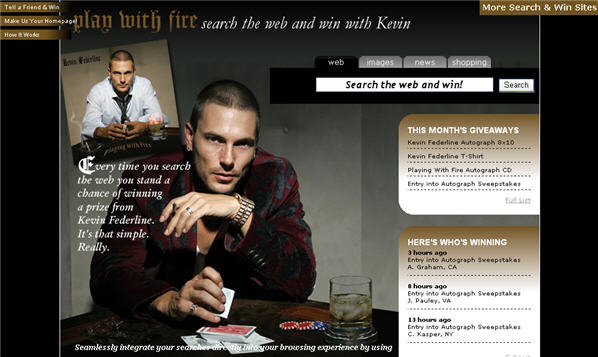 My SearchInsider column last week took exception with K-Fed launching his own search engine. Actually, I take exception with the entire concept of K-Fed that but that’s another point. In today’s SearchInsider, David Berkowitz retorts, rebukes and refutes my negativity around all things Federline, saying that the K-Fed engine shows that search is ubiquitous, search is evolving and search shouldn’t be always all business, no fun. Ultimately he says let the market decide whether a Kevin Federline engine is a good idea or not. Hard to refute that point.
Anyway, knowing David, he had a lot of fun writing the column and I certainly had fun writing the original column. The thing that amazes me is that in the past week, 40% of the total ink (or whatever the virtual variation of ink is) on SearchInsider has been devoted to the topic of Kevin Federline. Perhaps someday soon you’ll be able to pick up your local copy of SearchInsider at the grocery checkout and we’ll have great juicy articles about Britney’s rehab and the latest alien that professes to be Elvis, living in Minot, North Dakota.
One last point though David. You quoted me as saying that I would rather wear Fiberglas underwear than use the Kevin Federline search engine. That’s not actually true, I would rather wear Fiberglas underwear than attend K-Fed’s birthday party. And you asked where the phrase comes from. For the life of me I can’t remember where I first heard it, but I’m pretty sure it’s not a Canadian thing. I tried to look it up and couldn’t find any references so what the hell, let’s say that I originated the saying.
K-Fed Up with Celebrity Skinned Search
First published March 22, 2007 in Mediapost’s Search Insider
I’ve got a question for you: Would you want to do anything with Kevin Federline? Personally, the more Federline-free my world is, the better. But apparently other people don’t see it that way. You may have noticed earlier this week that K-Fed is actually launching his own search engine. Well, to be more accurate, he’s slapping his face on an existing back end, so to speak. I won’t go into the details of the K-Fed engine, except to say that it’s powered by Yahoo and it’s offered by Prodege.com.
Par-Tee with Britney’s Ex!
Apparently, making this your primary search engine could open the door to a chance to win tickets to Kevin’s private birthday party (I would rather wear fiberglass underwear), T-shirts and other paraphernalia all related to the somewhat questionable K-Fed brand. Apparently, an invite to K-Fed’s birthday party is “a once in a lifetime opportunity.” This has the ring of truth, as I might consider killing myself if I actually won.
This got me thinking. If we’re in the era of consumer-generated media, are we also in the area of consumer-generated celebrities? Does the increasing fragmentation of our society through an explosion of online channels means that even marginal celebs like Kevin Federline get their own small sliver of fame? If we have enough Kevin Federline fans somewhere and the Web has empowered them to have a voice unlike anything they may have been able to have before, is there a place for a Kevin Federline search engine? And, if so, does the future hold the promise of a profusion of celebrity skinned search sites?
Google Dresses Up Your Home Page
Ironically, Google also made an announcement this week releasing six themes for their personalized homepage. In this case, Google went out of its way to make sure that the themes are not commercial in any way. In Google’s words, these themes are all about “art and personality.” The new Google themes are clever, in that they are location-sensitive and have some cool little twists designed to “delight” users. For example, some of the scenes are outdoors, and the sun rises and sets in sync with where you happen to be located. With a Google theme installed, you may never have to look out your window again. But in a conversation with Google folks, they made a point of saying that they’re hesitant to open up an API to Google themes, for fear that it would cause a rush of commercialized skins, which could encroach on the user experience.
Blatant Commercialism is Skin Deep
Commercially oriented skins are nothing new, of course. Movies have released custom skins for MP3 players and other online apps that bury functionality under a sea of advertising spin. There are hundreds and thousands of desktop themes, wallpaper and screen savers with a commercial bent. But up to this point, search has been relatively “spin-free,” save of course for the advertising on the actual results page. But at least I don’t have to look at Kevin Federline when I’m searching for the symptoms of gout or trying to find an update patch for my latest Windows problems.
Just Give Me My Results, Dammit!
Based on a few new entries in the search space, it suddenly seems like we need personality mixed in with our search functionality. Search innovator K-Fed is not the only one pointing us in this direction. Microsoft has been playing around with Ms. Dewey (again an unfortunate choice of words), with the assumption that an undeniably attractive but distinctively bitchy female guide standing in front of a Blade Runner-esque streetscape will somehow make our search experience more complete. Perhaps Ms. Dewey could be K-Fed’s rebound after his split with Britney. Or perhaps both of them should have a cup of tea with Jeeves and see how being a search mascot worked out for him.
My feeling is that we want search to be a pristine experience. We’d like it to be minimalist, and we want to start from a neutral palette. We are so focused on intent and the task at hand when we interact with search that anything that gets in the way is simply a distraction. It adds nothing to the user experience. Search is very utilitarian task. We get in, find what we’re looking for and get out. However, with the lion’s share of the search market tied up in the hands of so few players, perhaps any tactic is worth a try to see if they can wrest even a small sliver of those searches away from the Googles and Yahoos of the world.
Where Are They Now?
By the way, the other celebrities that have their own search engines with Prodege.com? Meatloaf, Andrew Dice Clay, and Wynonna Judd. So the progressive degrees of “washed up” seems to be: having your own reality show, appearing on “Dancing with the Stars,” then having your own search engine. Now, I ask you, if Paris doesn’t have her face (or other assorted body parts) plastered on a search engine somewhere, how hot can this trend really be?
 Out of My Gord