SEM’s Seven Year Itch, Part One

First published January 11, 2007 in Mediapost’s Search Insider

There’s been a lot of speculation lately about the future of Matt Cutts. A few of Cutts’ posts and a recent interview have dropped the odd hint that the world of Google and the world of Mr. Cutts may not always be one and the same. While this is certainly noteworthy on many levels, it’s only one symptom of a much bigger issue, and one that will change the search landscape dramatically.

The fact is, those of us in the search space who have been doing it for a while (in my case, dabbling for 11 years, dedicated for eight now) are getting tired. We’re becoming burnt-out. As exciting as the ride has been since 2000, we’re beginning to realize that there is a life beyond search, or at least, the seat that we’re currently sitting in. There are a number of individual issues emerging that signal a significant change coming, and the time is now. We are succumbing to our own version of the 7-Year Itch.

A Case of Google-itis

First, let’s look at what will be happening with the engines themselves:

Google was recently recognized by Fortune as the best place in America to work. Tales of perks beyond the imagination of most poor working stiffs emerged from the Mountain View Shangri-La. Those of us who have visited the Google campus knew about a lot of these, but you could hear the rest of America’s jaw drop. Oh my God, they said collectively, what a place to work!

Well, yes… and no. The things that make Google great also make it a meat grinder. When you sign your life over at Google, you’re entering yourself in a sprint without a defined finish line, against thousands of other people determined and capable of getting there first. That’s okay when you’re young (as everyone at Google is), but at some point, life edges in on the dream. People get married, people have babies, parents age and require care. Somehow, a $500 subsidy for take-out food or on-site dry cleaning can’t make the realities of that life go away. There’s no rule saying you have to work zillions of hours at Google, but when everyone else is doing it, especially the two founders, are you the one that’s going to slow down? Either you keep racing, or you drop out. There’s little middle ground here.

And My Option is…?

Combine that with the fact that most of Google’s old guard are sitting on stock options that make them multimillionaires. Matt’s a wonderful guy and I’d like to count him as one of the friends I’ve made in the industry, but it’s got to be tough to motivate yourself everyday to put in the hours it takes to be Matt Cutts when there’s the substantial carrot of a very early and very lush retirement constantly hanging just above your head.

Matt’s not alone. That’s why one-third of the first 300 employees are no longer with Google. A story in the Houston Chronicle relates how 16 Google insiders cashed in more that $3.7 billion in stock last year (half of this coming from Larry and Sergey themselves), filling California’s tax coffers. And there’s more to come. By 2008, the state is counting on a cumulative $1 billion in state income tax from the sale of Google stock as the early guard cashes in. That represents 1% of the state’s entire annual general fund budget.

Changing of the Guard

Somehow, staying in the race becomes less compelling when the alternative is so damned attractive. It’s a testament to Google’s culture that more haven’t taken Door Number Two yet. But as the old guard moves on, that culture is shifting. Again, this is not unique to Google. Startups everywhere go through this, but few have been as successful or watched as closely as Google. A San Francisco Chronicle article looked at the shift of Google from a highly democratic family to a more conservative bureaucracy: “The feeling of ownership among employees, a natural when a company has 100 workers, was nearly impossible to maintain after the workforce grew into the thousands.”

Google’s not alone in this. Just a few weeks ago, I wrote about Tim Converse’s departure from Yahoo. Yahoo has seen several move on, some voluntarily, some not, due to a series of reorgs. Yahoo is a perfect case study of the tempestuous nature of the Web. Once sitting on the top of the search heap, Yahoo has felt a series of very painful bumps on the way down. It is now reinventing itself so it can turn around its market-share slide. Yahoo is a curious mix of old guard and new saviors, as its culture becomes redefined, for different but no less effective reasons than Google.

And finally, there’s Microsoft, unique amongst the three. Being late into the search game might actually benefit the monolithic giant here. Most of the recently assembled search team still feels the motivation that comes from the promise of a new endeavor. Microsoft is in the unaccustomed position of being the startup, the new kid on the block. Their legs are still fresh.

Today, I looked at the effect of the 7-Year Itch on the engines, but the impact is also affecting hundreds of search marketing companies. Stay tuned for next week!

The SEO Debate Continues

My earlier post about the future of SEO caught Jason Lee Miller’s attention over at Webpronews. So far, Jason is one of the few to grasp the Richter Scale implications of this shift in the SEM landscape. Danny Sullivan saw the danger signs some time ago. I traded a few emails with Danny on this and his response was:

“I did a lot of writing about personalized search about two years ago sounding the same alarm. Then it never really happened, the personal results that is. They’ll come, of course.”

Meanwhile, Kevin Lee continues to poke away at the SEM-SEO controversy that his partner David Pasternack started. There are those suggesting that this is an elaborate link baiting scheme on Kevin’s part. While his speculating on the future of SEO is certainly generating lots of controversy, and hence, links out there in the blogosphere, the cynics are missing the point that all those links are pointing to Kevin’s Clickz column, not his corporate online properties. No, I suspect Kevin’s motivation in this case is his self professed tendency to be a intellectual shit disturber. He likes to stir up polarized discussion, because if you know Kevin, there’s nothing he likes better than a good debate.

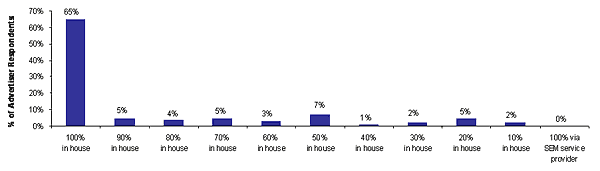
As you know from the previous post, I have a slightly different take (and I use the word slightly deliberately, I happen to agree with a lot of what Kevin said in his last column) on the debate than does Kevin. His point is that SEO can be brought in-house because for a lot of websites, you just have to do the basics right and they’ll get a huge lift. Couple this with the desire, expressed in the latest SEMPO survey, of a lot of companies to handle all this SEO in-house because there’s a lack of a recognized and trusted leader in the SEO Marketplace and it’s not that hard to see Kevin’s point. To be fair, Kevin also pointed out that a lot of companies want to bring their paid search in-house as well.

But here’s the thing. SEO is going to get a lot harder, not easier. And that increasing difficulty is going to be in area that today’s crop of SEO’s have next to no experience in: knowing the end user. And that get’s back to Jason’s story in Webpronews. He states:

“While focus on keywords has been the law of the searchland, SEO professionals will have to more diligently and acutely focus on the end user – every unique end user – mulling scenarios, personalities, and motivations, which makes SEO more akin to traditional marketing, where a firm grasp of psychological concepts is as necessary as the technical acuity of keyword targeting.”

Exactly, but in that paragraph lies a world of adjustment, and I’m not sure most SEO’s are up to the challenge.

Here are some things to think about:

As results become more personalized, the work ranking ceases to have meaning. Just a few months ago the question of ranking reporting came up in an analytics session I was participating in. This has been part of SEO since the beginning and has been an ongoing sore spot between the engines and the SEO community. I mentioned that ranking reporting might soon become irrelevant, expecting it to generate a bit of controversy (in that, I do share Kevin’s delight in stirring the pot sometimes). To my surprise, nobody picked up on it. Fellow SEO’s on the panel even failed to take the bait. I felt like screaming “The whole world is about to change as you know it!” but I chose instead to go to the exhibit hall for the free drink. It was the end of the day and I was tired.

SEO’s are all about controlled experimentation. We live to tally up suspected algorithmic factors and test, tweak and twiddle. We reverse engineer the algorithms. Say what you want, that’s basically what SEO is. It’s all about tactical maneuvering. I’ve been bemoaning the lack of strategic thinking, based on what users are actually doing, for years now, but the industry hasn’t changed much. To reverse engineer, you need a control to test against. You need at least one fixed target. Up to now, the universal page of results was that fixed target. How do you reverse engineer when you have nothing to set your bearings against?

As Jason so rightly points out, this new world of SEO is much more about marketing than it is a technical skill set. It’s about knowing your user intimately and where they tend to hang out, given a specific intent. It’s about staking out the most traveled intersections and gaining some presence there. It’s about knowing how they’ll use the new version of search to navigate the online landscape. And it’s about accepting, once and for all, that you really can’t control your presence on the search results page, however it appears.

And it’s here where Kevin’s view and mine coincide. In a lot of cases, it will be about doing the fundamentals right. If you have a site that has an established presence, then this is often enough. Make sure you connect the spider with the content. Make sure the content and your target customer share the same vocabulary. Make sure you’re not throwing any road blocks between your site and the search index. Do that, and accept the fact that your control pretty much ends there. That’s not to downplay the importance of this knowledge. I agree with Danny Sullivan that SEO skills are not nearly as common as David Pasternack seems to indicate. But I believe the days of the SEO hacker/hired gun are numbered. Personalized search may be what finally kills black hat SEO.

With that, organic optimization returns to its roots, and what the word organic should have meant in the first place. It’s about working with the client to help them understand how consumers use online to research and to help them turn their organization into an organic content factory. Help them use online to provide multiple and useful touchpoints for the potential consumer. Extend your presence into the well travelled online intersections. Establish best practices for SEO, and let the rest take care of itself. As Kevin rightly points out in his column:

“Alternatively, one could simply focus on producing great content and take whatever links occur naturally (the way Sergey Brin and Lawrence Page intended in the original PageRank system).”

It’s here where SEO’s have their biggest challenge. Can they transition from a technical experimenter to a trusted guide to online traffic patterns? I have my doubts. I have seen little evidence of this in the past. SEM’s tend to be further ahead in this regard, because of the targeting opportunities that the back end platforms provide. Ironically, this is where interactive and traditional agencies could regain a foothold, but in the later case at least, they’re still struggling with the whole concept of an empowered online consumer, and until this paradigm shifts for them, they have a huge blind spot when it comes to online strategy.

SEO’s have to reinvent themselves, and soon. Some of the skills will be transferrable, but many new ones have to be acquired, and these are not usually skills that are found in the same place. I expect a shakeout, and soon. A lot of SEO’s have been doing this for a long time, and they’re getting a little tired. Reinventing themselves is probably the last thing they want to do. Cashing out was probably more in their anticipated plans.

So, how soon is this going to happen. Let’s get back to Danny’s point. Personalization is nothing new, but I think 2007 is the year where it will make a noticeable difference. There are a couple of indicators of that:

Google is already experimenting with Geo-targeting results based on IP identification. Those of you in the States probably haven’t noticed, because the online world is very US-centric, but those of us who live on the outside are already dealing with the effects. In Canada, there is a significant difference in results seen in the main Google index depending on whether the query is coming from the US or Canada. It’s a constant bain of our existence, being based in Canada but working primarily with US clients. So even in North America right now, there is no such thing as a universal set of Google results.

Personalized search that users opt in for is finally gaining significant traction. All the 3 engines offer this, and often the fact that you’re signed in is completely missed by the user. As adoption of other functionality offered by the engines increases, the odds of being signed in when you launch a search rises dramatically. And for the engines, search history is enough additional information to make them confident in presenting personalized results. It gives them another reference point in addition to the original query. The difficulty in disambiguating intent for a query was the sole reason results weren’t personalized up to now.

What does the future hold for SEO? Well, as long as users continue to want organic results (and I think personalization will make this more true, not less) there is a need to gain presence there. But the rules of the game are being rewritten. For those willing to retrench, there’s a golden opportunity to redefine marketing as we know it. But it requires looking at a big picture, and, more importantly, using a customer-centric lens to look at that picture. It means changing our approach dramatically. It means drawing back from some highly specialized skills that some have developed, and taking a more balanced approach. Personally, I’m very excited about the possibilities. A little tired, a little burnt out, but up for the challenge. But perhaps that’s because I saw it coming.

Will Wiki Whack Matt Cutts?

Danny Sullivan has an interesting post in Searchengineland about the virtual rumblings over at Wikipedia about removing Matt Cutts because he’s not notable. Say what?

You know, community is a wonderful thing, but there are community dynamics at play, no matter whether the community is based in the virtual world or the real one. There tend to be what I would call conscientious blockheads, strongly opinionated people with a lot of time on their hands that tend to have an undue influence on most forums and wiki’s, or, in traditional terms, volunteer organizations. It’s a bit of a love hate relationship, because they are, after all, volunteers and often are the sole reason that the organizations and volunteer initiatives can continue to survive. But they tend to bend the collective view to their own strongly held personal perspective. And often, they exert their own need for control and recognition in this relative vacuum. Think PTA’s, think the executive of service organizations, think strata councils, think churches. I’ll bet you’ve all already thought of a person just like I’m describing, right?

Well, this type of person, armed with an Internet connection, has now found a new home, and this is true wherever online communities are gathering. Wikipedia would be a case in point. I think any rational person who has a modicom of expertise in the search space would know that Matt Cutts is probably one of the 10 most notable people in search, for a number of reasons that Danny Sullivan outlines (and I think Danny is shortchanging his own notability, but that’s another post).

The beauty of online communities are that there is a certain degree of transparency. We can all participate, if we choose. And us voicing our (hopefully) informed opinion is enough to hold the conscientious blockheads in check. Danny is doing exactly what we should all do, voicing his opinion and filling the vacuum.

The Future of SEO in a Personalized Search Interface

This is a debate that seems to have legs. A few posts back, I came to the defense of SEO from the user’s perspective.

In catching up with a few articles and chatting with a few key people in the industry, I’ve got another perspective that I’d like to share.

First of all, Joe Laratro in last Friday’s SearchInsider debunked Three SEO Myths, one of which was “Natural Search is Dead”. In it, Joe correctly stated:

“Natural search engine optimization is still thriving. It is more difficult today than it was five or six years ago, but the core of search results are still free. Natural Search Engine Optimization being dead is a popular myth because of the standardization of methodology that is now used. Each of the major search engines has released guidelines for Webmasters that detail the dos and don’ts of Web site optimization. Since more of the online world is aware of successful optimization techniques, they do not work as well. In other words, there is more competition from knowledgeable optimizers armed with the same toolsets.”

Back to this in a minute. Also, in sorting through some old articles set aside, I ran across this one from Todd Friesen about Learning the New Rules of Search. It touched on the same topic, looking at what might happen when SEO’s no longer have access to the intelligence tools they use on their competitors, through some type of authentication requirement.

“A move like this, which would block our ability to do competitive research at that level, would be a setback, if not a crushing blow, to SEO as we know it. That got me thinking. Where would that leave all of us search engine optimizers? What research avenues would be left?”

Finally, in the last few weeks, I have talked to representatives from the usability teams at Google, Yahoo and Microsoft. I asked each what was the major challenge for search. The answer varied slightly, but it all went to providing better results, aligned to individual intent. (By the way, I’m currently working on a series of articles from these interviews..more about this to come later)

So, to go back to the orginal reason for the post. What is the future of SEO? Both Joe and Todd are looking at this assuming the current paradigm of one query, one page of 10 organic results holds. In fact, the entire SEO industry is hanging on this paradigm. Right now, link baiting/building, optimization, competitive intelligence and all the rest are aimed at securing a top spot in the organic results. But what happens when there no longer is a “top spot” because every result is personalized, based on your geographic origin, your past search history, your behavior or preferences you’ve shared with the engines. That’s where search is going, through a number of different initiatives, and if less transparency with access to tools would deal a “crushing blow to SEO” imagine what that would do.

Now, that doesn’t make organic any less important to the user. In fact, the increase in personal relevancy will make it more important than ever. So I still stand by my original thought that organic results, of some kind, will always be part of the results set presented. But from a tactical perspective, the disappearance of universal search results throws a King Kong sized monkey wrench in the SEO works. In Canada, we’re already dealing with this as Google experiments with re-ordering organic search results based on Geo-targeting of user IP’s. The same is true in the UK and other markets.

But how do you tactically deliver SEO services in this new environment? The word ranking ceases to have meaning. There will always be a hierarchy in the results, but it will be different for each person. The control of measuring progress by positions achieved will come to a crashing halt and with it, the SEO industry as we know it. If you thought SEO was a black box before, wait til you try it under these new rules.

Most Shoppers Don’t “Shop Around,” at least Physically

A new study from the Grizzard Performance Group found that US Shoppers don’t have time to “shop around”, with 62% not bothering to compare prices at even two stores. However, they’re very open to saving money, right up to the time of purchase. It’s just that they don’t have the time.

This ties in with my previous post about real time inventory and e-shopping, currently being tested by a a few online services at malls and major chain stores. When we can quickly and conveniently check prices at a number of stores in our area through our handheld devices, trust me, shopping will change forever. And then, a whole new dimension of direct response marketing comes into play. Last minute pushes of discounts at the point of purchase, delivered through your mobile device. As the study by Grizzard indicates, consumers are very open to saving money on a comparable product, even if it wasn’t previously in your consideration set. So consider this. The shopping engine knows what you’re looking for, knows where you are, and knows what comparable products are in stock in the same store. The advertiser can purchase the right to push a message to you right at the point of purchase, offering you 15% off their product, or even offering an automated “match and beat” deal, where it automatically matches the price of whatever you’re buying, and takes a further 10% off. A store around the corner could do the same thing, making it worth your while to check out at least one more store. All these things could easily be handled by algorithms and pre-set pricing thresholds.

And what if we take the Priceline approach? You’re ready to buy, but before you do, you send an offer to stores in your area with what you’re willing to pay for a particular product. The store in question can then decide whether to accept your offer or not. It would be true consumer control. And the really ironic thing? It’s a whole bunch of sophisticated technology, but it brings us right back to old fashioned haggling over the price. Isn’t it fascinating that the more sophisticated the technology, the closer we get to how we used to shop a century ago?

Wikia Search: Should Google be Scared?

Wikipedia co-founder Jimmy Wales is creating a bit of a stir with his new project, a wiki based search engine temporarily called Search Wikia. Of course, the media are jumping at the chance to postulate whether this will be a Google killer. Wired.com has an interview with Wales that looks at the concept in a little more depth.

Wales definitely comes out swinging on the project website. First, he calls it “a project to create the search engine that changes everything”. Bold, if nothing else.

He then comments:

“Search is part of the fundamental infrastructure of the Internet. And, it is currently broken.

Why is it broken? It is broken for the same reason that proprietary software is always broken: lack of freedom, lack of community, lack of accountability, lack of transparency. Here, we will change all that.”

A community based search property is an intriguing concept, but not a terribly new one. Open Directory, GoGuides and others have gone here before. The difference here is the total opening of control, and using a wiki platform for collaborative development of the search index.

Here is the challenge, as I see it.

It’s dependent on the involvement of the community. Wales has no idea how the community will be managed, and doesn’t really plan on figuring this out. “I don’t think it makes sense to manage a community.” He’s right. You can’t manage a community, you incentivize them.  You give them a reason to participate. Wales seems to think altruism will be the motivating factor:

“It’s about building a space where good people can come in and manage themselves and manage each other. They can have a distinct and clear purpose — a moral purpose — that unites people and brings them together to do something useful.”

I disagree. There are a few altruistic netizens out there, but not nearly enough to help make this dream a reality. It’s not a scalable concept. But, you say, what about Wikipedia? Isn’t that based on the same premise? Yes, and no.

I believe that the main motivation on contributing to Wikipedia is to spout off on something you know about, and to leave a semi permanent footprint on the shifting sands of the Web. Whether it’s attributed to you or not, when you can contribute to Wikipedia, you can point to something and say, “I did that. That’s me..and this is how smart I am on this particular topic.” I don’t think altruism has much to do with it.

In a search engine wiki, your contribution would be hidden in a human powered algorithm. You wouldn’t leave a footprint. There’s no sense of you, no bragging rights. There’s no compelling incentive to participate. And to bite off something at the scope Wales is envisioning, you would need huge numbers of people participating.

Personally, I would like to see Search Wikia work. But there’s a reason why community based search hasn’t worked til now. It’s the same reason social tagging has questionable viability. Anytime you’re asking people to be involved, you’ve introduced a limiting factor. There are a handful of people that get involved in something like this. They’re enough to get a concept off the ground, and they’ll do it because they’re motivated by different things than the other 99% of society. But once you burn off that resource, you’re stuck. Wales dream depends on tapping into the other 99%, and I just don’t see that happening. We don’t want to work that hard. There’s no “whats in it for me?” reward for doing the heavy lifting.

But hey, maybe I’m wrong. Go ahead and take a few minutes to post a comment telling me why the average Net user is a more giving person than I believe them to be. I’ll even give you credit for helping contribute to the betterment of the online world 😉

US Statistical Abstract: Time Well Spent?

The U.S. Census Bureau just released their new Statistical Abstact for 2007. In it, they predict the amount of time adults and teens will spend consuming media in various forms:

  • 65 days in front of the TV
  • 41 days listening to radio
  • A little over a week on the Internet in 2007
  • Adults will spend about a week reading a daily newspaper
  • Teens and adults will spend another week listening to recorded music
  • Consumer spending for media is forecasted to be $936.75 per person

What was interesting about this was noticing the gap that still exists between TV and Radio consumption and time spent on the Internet. To me, it’s indicative of the nature of engagement, at least for now.

According to these stats, we will spend 10X the amount of time in front of a television than we will spend in front of a computer cruising the Internet. The media release didn’t elaborate on the nature of time spent on the Internet. Does this mean work time as well?

Given these numbers, one can understand why the lion’s share of ad budgets still go to television, and I expect that TV sales execs will gleefully quote these given every possible opportunity. But consider the following:

  • The consumption of entertainment content online is in it’s infancy. Strike that, it’s actually embroyonic. If YouTube is the barometer of where we’re at, we have an immense way to go. All the hype about online video is still largely centered around viral growth amongst very early adopters who are watching amateur videos less than 3 minutes in length. It’s not the actual current  impact of online video that’s creating buzz, it’s the paradigm shifting that we have to do when we consider the democratization of content creation, the searchability of the digital format and the interactive possibilities that come with the online distribution channel.  All these things speak to a totally new experience. We’re just not there yet.
  • Think about the difference in your engagement level when you’re interacting with the Internet, as opposed to passively watching TV or listening to the radio. Think about how you respond to advertising messaging, especially when it’s relevant to the task you’re pursuing. The influence of this difference in engagement on consumers hasn’t been quantified yet, but at a gut level, we know it should be significant, probably a quantum leap in effectiveness. Actually, the numbers drive this home. In the research that’s been done on the impact of various channels on consumers, the Internet consistently ranks near the top, usually right after word of mouth, and much higher than television. And it has this impact with one tenth of the exposure time.
  • We need time to change our habits. Television watching has been ingrained in our daily routine for decades. Radio for a bit longer. Newspapers for centuries. The Internet is just celebrating its first decade as a widely accessible channel, and high speed access is less than 5 years old. Given that, the one week number is actually quite remarkable.

I’m sure these numbers will be quoted often, and spun in drastically different directions, depending on who’s doing the spinning. At first glance, my thought was “only one week?”. But as I thought about it, the numbers just emphasized the vast potential of online. What will be fascinating is to revisit this in a year’s time and see how these numbers change. In Internet terms, 12 months is an eternity.

Should Google Stick to the Knitting or See What Works?

I was just doing some year end cleaning of my “to be blogged about” folder and found a couple of lingering items from a few months back. While most of that time, that would make them hopelessly outdated, these two touch on a bigger theme that is still relevant, and is aligned strategically to a book I just finished re-reading.

First, the here-to-fore neglected articles. Did-It’s Bill Wise wrote a Search Insider column on how Google wins by losing, and John Markoff at the NY Times talked about the concern over “Google Sprawl”.  Both talk about Google’s strategy of pushing into new businesses at a frantic rate, seemingly trying to reinvent everything at the same time. But they take slightly different approaches. Bill’s opinion is that the strategy works because the string of new challenges, and the many subsequent failures, continually generates buzz for Google that keeps driving it’s main revenue channel, search. The NY Times reports on recently voiced Google concerns that the myriad of new initiatives will confuse users and impact the user trust in the Google brand. It also touches on the implied conundrum that comes with Google’s goal to integrate functionality into a simple and elegant interface, making it the online Swiss Army Knife, and it’s desire to keep user data open, steering away from the Microsoft approach that landed them in hot water with the Department of Justice. The timing of both pieces was right around the Google acquisition of Youtube.

There’s a bigger piece here that seems to be missing from both viewpoints. Let’s look at Wise’s assertion first:

“By continually announcing that it’s expanding beyond search, Google gains tremendous buzz, which translates into higher stock prices, which translates into still more buzz. All that attention keeps Google top-of-mind; by being top-of-mind, Google draws more users and more loyalty towards the Google brand–which means more searchers flock to Google Search, and more searchers stick with it. And it’s through Google Search that Google actually makes its money.

All that buzz is only beneficial if the new launches don’t succeed. If Google were to successfully expand past search, users would mistrust it as a corporate giant bent on empire-building–a problem that’s certainly familiar to Microsoft. Because Google fails at really getting a hold beyond search, users don’t see any effects of Google’s empire-building, and instead only see Google as a company that’s continually on the rise.”

The problem here is that Wise is confusing strategy and a by product of an approach that’s baked right into Google’s corporate DNA. I really don’t believe Google is purposely trying to fuel the buzz machine by venturing into areas with low odds for success. I believe Google does this because they don’t know any other way. It’s part of their genetic code.

Next, John Markoff starts to uncover the clues that point to the bigger picture:

“Google executives generally answer questions about acquisitions by saying that the company is still experimenting with business plans, or by arguing that a program like Sketch-Up — a simple computer-aided design program — will have an indirect revenue impact by making the entire Google service more valuable.”

To be sure, the culture of grass roots innovation that has been scrupulously nurtured at Google is at the same time it’s greatest strength and it’s greatest challenge. And despite the fact that Google is being hailed as a pioneer, it’s ground that has been trodden before. Google is hardly the first to go down this path. Which brings me to my renewed acquaintance with Jim Collin’s and Jerry Porras’s book Built to Last.

The Google mandate that a percentage of their engineer’s time be set aside to work on new, cool and cutting edge products is a chapter that was stolen right out of 3M’s playbook. And 3M, like HP, like Sony, like Motorola and like many of the other visionary companies profiled in Built to Last, started without a business plan. These companies worried first about the who, and then worried about the what. Google is clearly following in the same footsteps.

In fact, in the book, Collins and Porras show how visionary companies often “try a lot of stuff and keep what works”. Here is a pertinent quote from the book:

“Visionary companies make some of their best moves by experimentation, trial and error, opportunism, and – quite literally – accident. What looks in retrospect like brilliant foresight and preplanning was often the result of “Let’s just try a lot of stuff and keep what works.”

Collins and Porras devote a whole chapter to the topic. They show how many iconic corporations struggled, often for years, before they found the right business model. Google has a leg up on these, as they already have a very successful cash cow that’s driving their ability to “try a lot of stuff”. And it’s one notable area where Collins and Porras offer a different viewpoint from previous seminal works, including Tom Peters’ and Bob Waterman’s In Search of Excellence. Peters and Waterman advocate “Sticking to the knitting”, warning “the odds for excellent performance seems strongly to favor those companies that stay reasonably close to the businesses they know.”  Collins and Porras counter that if that were always the case, 3M would still be trying to run mines in Minnesota, HP would be selling nothing but audio oscillators and American Express would still be a delivery service.

The challenge for Google comes in not impacting the user, as Markoff identified in his article. Ironically, it comes from Google’s initial success in search. If Google search wasn’t as successful as it is, Google would have free reign to experiment. But they have to pay scrupulous attention to the user experience. I’ve commented before that Google’s biggest obstacle as a visionary company is it’s early success.

Here, Google is faced with the Yin and Yang challenge that faces all visionary companies. How to preserve the core while at the same time stimulate progress? And this gets down to a fundamental place where Google might be veering off track. Google’s core purpose, and the one that Google search succeeds very well at, is to organize the world’s information and make it universally accessible and useful.  This should be what the company scrupulously protects. All of Google’s free time initiatives should be aligned to that core purpose. But Google seems to be trying to pursue a number of core items at the same time. Redefining how advertising is bought and sold (recent forays into print and radio) seems to have little to do with Google’s stated core purpose. Controlling the main intersections of the new online global community (the purchase of YouTube) might be tangentially related, but clear alignment is not apparent. If Google stuck to their initial core purpose, that gives them scads of room for growth and innovation.

If Google is going to pursue a grassroots culture of innovation, that’s admirable. If they want to try experimenting in a number of areas and see what succeeds, while at the same time pruning out the failures, they can take comfort in knowing that strategy worked well in the past, notably for 3M. But to go down this path, it’s essential that an overarching core purpose be defined and communicated clearly to each and every Google employee. Innovation has to be aligned with a common goal. And when companies try to identify more than one core purpose, they can lose direction. Google might be well advised to see how other trailblazers have handled this in the past. For example, the core purpose of 3M is to solve problems through technology. While it’s broad and all encompassing, it does provide a sense of direction for 3M employees.

If I was to identify one challenge for Google to face in 2007, it would not be the fragmenting their business model, or even defining one. It would not be nailing another surefire revenue channel. It would be deciding, clearly and unequivocally, what they want to do, communicating the hell out of that internally and by doing that, point all that formidable brainpower in one direction.

What We Searched for in 2006

First published December 28, 2006 in Mediapost’s Search Insider

Right about this time of year, you’ll see two things coming in your inbox in the way of search-related columns. First, there’s predictions for 2007 accompanied by scorecards of success for last year’s predictions; second, recaps of the top searches of 2006. I didn’t make any predictions last year, so I figure it’s too late to jump on the particular bandwagon, but as to the second, I’m fully on board! Last year, I took a look across the major engines and was somewhat disheartened with the lack of intellectual depth that was shown in our collective quest for knowledge. So, how did we fare this year?

Google Coming Clean?

Let’s start with Google. Unfortunately, one has to read between the lines on these various reports. The list isn’t actually the real list for any of them.. These lists are heavily filtered, and in Google’s case, seemingly altered to a substantial degree. Here is its reported top 10:
Bebo
Myspace
World Cup
Metacafe
Radioblog
Wikipedia
Video
Rebelde
Mininova
Wiki

A little investigative work at Google Trends (thanks to Danny Sullivan) soon uncovered the inconsistencies. Google’s reported No. 1 term, “bebo,” actually has nowhere near the volume of “myspace” and “world cup.” In fact, “bebo” is almost flat-lined at the bottom. I suppose there are internal excuses Google might have for the inconsistencies, including aggregation of misspellings, but just how many ways can you misspell bebo anyway?

The list actually becomes more interesting when you include some of the terms that got filtered out. A quick look shows that Google is often used for navigation. Terms like myspace and wikipedia are not queries for information, but a quick way to get to a site. Google has already deleted many navigational terms from the list, so let’s add the big ones, Yahoo, Google, MSN and YouTube and see what the trend chart looks like. Now we see the true search volumes, and that a lot of people are using Google to get from point A to B. What is a little disturbing is that searches for “Google” on Google hold the No. 2 spot, just behind Yahoo. This drips with irony, and not a little stupidity. “Hey..how do I get to Google? Oh..wait a minute, I’ll just search on Google” Duh!

Yahoo on the Red Carpet

Meanwhile, Yahoo seems to turning into the “Entertainment Tonight” of search engines. Once you navigate through the incredibly annoying user interface they slammed on it (please Yahoo, take two Jakob Nielsens and call me in the morning) you find that the top 10 on Yahoo are:
Britney Spears
WWE
Shakira
Jessica Simpson
Paris Hilton
American Idol
Beyonce Knowles
Chris Brown
Pamela Anderson
Lindsay Lohan

This is almost too sad to comment on. Almost. If these are the best things that searchers can throw at Yahoo, no wonder they’re struggling in the search engine showdown. It’s the equivalent of the tabloid rack at the grocery checkout counter.

Yahoo also allows a peek at other countries’ top-ten lists as well. Last year, the Germans showed a blend of Teutonic practicality and pure kinkiness, and nothing seems to have changed this year. The loosely translated Top Ten are as follows:
Weather
Route Planner
Erotica
Telephone Directory
Chat
Greeting Cards
Horoscopes
Games
Web
Paris Hilton

Well, at least wife swapping didn’t make the list this year.

The Brit Top Ten shows they love their dirt:
Heather Mills McCartney
Pete Burns
Big Brother
The Ordinary Boys
World Cup
Steve Irwin
Borat
Notting Hill Carnival
Zidane
Kate Moss

And my fellow Canadians? Well, at least we’re consistent, if not terribly exciting. NHL (The National Hockey League) tops the list once again.

The Search Engine formerly known as MSN

The MSN (now Live) list also shows a bias towards the entertainment side, but it also showed how out of touch I was with pop culture:
Ronaldinho
Shakira
Paris Hilton
Britney Spears
Harry Potter
Eminem
Pamela Anderson
Hilary Duff
Rebelde
Angelina Jolie

Okay, Britney I know, Pam I know, Paris I know. Who the heck is Ronaldinho–or what’s a Rebelde? I’ve since been clued in by soccer fans and a quick check on Wikipedia. Ronaldhino was FIFA World Player of the Year in 2004 and “Rebelde” is a Mexican TV series, for those of you equally pop-cult ignorant.

In the final analysis, what’s striking about these lists is what the search engines seem to be used for. Google has become the main intersection of the Web. Its top searches make clear its role as a traffic clearinghouse, routing millions of users through the results page as they navigate from point A to B. It’s infrastructural and essential. The top searches on Yahoo and MSN tell a different story–one of idle curiosity, no pressing plans and killing time. In a nutshell, this story crystallizes the fundamental problem Yahoo and Microsoft face if they hope to challenge Google as the king of the search hill. They have to become essential.

Happy New Year!

A Sign of Things to Come: eShopping at a Store near You

A small article in the Wall Street Journal (a subscription is needed to read the whole article) is a precursor of a big shake up to come. It’s something I’ve been predicting for sometime now, and while it will take awhile to gain traction, it will turn local retail upside down.

Three malls in California and one in Arizona have agreed to allow shoppers to check prices on actual inventory through text messages from their cell phones with a service called NearbyNow. According to their site, NearbyNow plans to add another 17 malls throughout the US to their network by April. Another service called Slifter is focusing on national chains like Best Buy, CompUSA and Foot Locker.

Here’s why this is revolutionary and why you’ll be hearing more.

  • For shopping, this represents discontinuous innovation. It’s a big win for the user, allowing them to shop smarter than ever before. Consumer demand will drive adoption of this new approach.
  • For retailers, this is scary as hell. By allowing their inventory to be captured realtime, they’re agreeing to be compared side by side with everyone else, including online retailers with no physical overhead to drive up prices. It completely levels the playing field.
  • As a number of technologies improve and converge, this will become substantially more useful and powerful. Mobile computing, GPS and search functionality will make this a must have for consumers.
  • It completely fuses the online and offline worlds, making the transition seamless.

This is one of those ideas you just know will take off, but there’s going to be some significant hurdles to overcome. These services are only as good as their success at signing up merchants. The more stores in the network, the more successful. If only a few are included, consumers will always wonder if there’s a better deal that isn’t part of the service, defeating the purpose. And a number of retailers will resist this trend til the bitter end. Ultimately, it will be consumer insistence that will force the laggards to join.

Another challenge will be the user interface. Right now, both services run on cell phones, meaning you have to deal with an awkward keypad and stripped down display. But this problem will rectify itself with advances in mobile technology.

In the world of shopping, this changes everything.