
Editor Loren Baker over at Search Engine Journal points out nasty little dilemma that Google has bought themselves into. With their acquisition of DoubleClick they also get DoubleClick’s search marketing arm, Performics. So what does Google do with the search engine optimization and marketing firm? A conflict of interest? Yes, one of fairly substantial proportions. My guess is that Performics may find itself with a for sale sign on it as Google actively shops it to agencies. And with agencies recently on buying spree, it shouldn’t be too hard to find a buyer. Check out the comment string as there are some interesting ideas put forward.
Category Archives: Online Trends
Will Search Become Google’s Forgotten Child?
Everyone’s jumping on the “Google dominating the advertising universe” bandwagon. BusinessWeek ran a article today speculating on Google’s omnipresent domination with their acquisition of DoubleClick plus some recently announced deals with EchoStar’s Dish satellite TV network and Clear Channel’s radio network. The primal fear even has its own acronym now, FOG, or “Fear of Google”. But in BusinessWeek’s article there’s one telling quote (emphasis mine):
“To date, Google has had one gargantuan advertising success. It developed an online auction platform enabling businesses, even those with little marketing experience, to easily bid for space to serve tiny text ads related to information Web surfers wanted at a particular moment. Most of these ads—which exist primarily to drive traffic to Web pages and, ultimately, generate sales—run on Google’s own search results pages.”
And there you have Google’s dilemma in a nutshell. The more aggressive they are extending their network reach into new channels, the more they come to rely on what, for them, has been the golden egg, their search engine. The “gargantuan advertising success” has actually been search engine marketing’s success. Google has been riding a consumer initiated wave as buyers have found an incredibly effective new channel to do their research on. The success that Google has enjoyed by riding that wave has more to do with the concept of search then it has to do with any particularly brilliant Google strategy. Google has keyed into that success by providing a very effective search tool. And if you’re looking anywhere for the secret to Google’s success, look no further than their obsession about user experience on their search engine. They’ve kept it clean, they’ve kept it relevant, and they’ve kept it a favorite choice of millions and millions of search users. That has given them the ability to monetize a tremendous amount of traffic and flow that money straight into the corporate coffers, enabling them to go on a shopping spree of unprecedented proportion.
I don’t begrudge Google for thinking big and planning to dominate the universe. It’s really the only direction they can go. But I would like to hear more people acknowledge the fact that Google success is built completely on the emergence of search as an essential online activity. And the emergence of that activity is due to a lot of pioneers in the area, not just Google. In its present form, search is best represented on Google but the very act of searching owes a huge debt to dozens of other companies, including current also-rans like Yahoo, Lycos, Excite, Overture, and the historic footnotes like Infoseek, AltaVista and All the Web.
Because of that I get a little frustrated when search does not get its proper due. Personally, I believe there is huge untapped potential still in search. But everyone is so focused on Google’s extension of its empire that I don’t believe search is getting the respect it’s due. It’s not getting respect from advertisers, it’s not getting respect from agencies and lately, it’s not even getting respect from Google.
I know that Google has some exciting plans for search, primarily wrapped around personalization and I look forward to hearing more about this. I hope that Google search team remains engaged pursuing the potential of this tremendously effective channel and doesn’t become diverted from this goal by the glitz and glamour of Google’s new marketing channels. I know the sales teams at Google are very much focused on the network and the other opportunities, seeming to take the power of search, which is currently buying all the lava lamps and free lunches at Google, for granted.
Telltale Signs of a Chasm Crossing from NY
It was an incredibly packed week (and hotel) at SES NY. As you’ve probably noticed, I didn’t get a chance to do any blog posts while I was there. But the good news I had a chance to sort through my inbox and set aside some post worthy tidbits that I’ll try to catch up with in the next week, so I’ll try to make up for lost time.
One of the things I chatted with a few friends about was a strong undercurrent of change in the industry. On the last day of the show I had lunch with Greg Jarboe and followed that up with a Guiness or two in the lounge with Chris Sherman and Matt Bailey. Besides the obvious (Google’s purchase of DoubleClick, IPG’s purchase of Reprise and the recent purchase of Global Strategies by WPP) there’s just a feeling of transition to a new stage for the SEM biz. Jarboe referred to it as the “gentrification” of the business (Greg is so erudite!).
After, in a quick chat with Shari Thurow (yes, we ironed out the wrinkles of our spat) and Anne Kennedy, Anne nailed it for me. We’re crossing the chasm. Isn’t it funny. I’ve written at least one column saying this was the case and did a series for MediaPost indicating we were in for sea level change, but I had to be reminded about it.
Perhaps it was the validation of being surrounded by a bunch of other SEMs. For most of the time, I’m somewhat isolated from the SEM community here in Kelowna. From this vantage point, I speculated that we were ready to cross the chasm but I had the comfort of being somewhat removed from the day to day machinations of the industry. But last week, I was in the thick of it and in the flurry of activity, I was wondering what was going on. It took Anne to point out to me that it was just what I had postulated on a few months earlier. Talk about not being able to see the forest for the trees!
There are a few symptomatic indicators that seem to indicate a chasm crossing is ready to happen:
The mainstream is adopting search, but they’re not sure where it should live. More and more companies are testing the search waters, but they’re hesitant to partner with an outside firm. Their answer, at least in the short term, is to build an in-house team to handle the campaigns. I’m getting this from all sides.
The major agency holding companies have all acquired search expertise. In order to try to stem the in-house tide, the IPG’s, WPP’s and Omnicoms of the world have all gone shopping for SEM expertise.
Awareness of search has moved up the C Level. For the first time, SEMPO’s Market Survey found that the executive team is not only aware of search, but keenly interested in it. This has been an ongoing frustration in the past for search marketers.
With all of the above happening, it’s going to be an interesting time in the search biz. Ironically, just as we’re waiting for the 800 pound gorilla to be crowned, another interesting observation I made last week was for the established search players to be rushing towards the next big thing. Google is stumbling over itself to rush past search, moving a lot of its focus to display, video and every other channel under the sun. I’m not so sure it’s wise to turn the spotlight from search. My gut feeling is it’s finally search’s time to shine.
Anyway, more posts to come this week..finally!
Google’s Gargantuan Footprint
First published April 5, 2007 in Mediapost’s Search Insider
A recent blog post by Anil Batra, formerly from Revenue Science, speculates that Google will soon be getting into behavioral targeting. Another post by A-list blogger Robert Scoble indicates that Google may be dialing down the presentation of sponsored ads for certain queries. Combine this with a few conversations I’ve had recently with Googlers, and it seems the company is already setting its sights beyond the search results page when it comes to revenue generation. One starts to get a sense of the footprint that Google is planning to put down on the future online landscape.
Getting Personal, One User at a Time
To me, the glue that holds all this together is Google’s move towards personalization. If the company can get that piece of the puzzle right, everything else falls into place behind it. And personalization moves Google beyond search into a lot of other applicable areas: the Google homepage, G-mail, Google News, desktop gadgets, to name just a few.
One of the issues I have with Google’s move towards personalization is that it stops short of really providing additional value to the average user. If personalization works well, it significantly enhances our search experience by providing relevancy unique to us. The signals that Google is watching to power the personalization algorithm are very much the same ones it would need to watch to introduce behavioral targeting of advertising messages. It’s all about the sites that people visit, the search results that they click on and the path they take online. If Google can use all these signals to help enhance the search results, it’s not that big a leap to be able to target messaging through its AdSense network on the sites you visit.
Google Everywhere You Turn
The key to all this for Google is ubiquity online. It need to be everywhere and it’s rapidly approaching that goal. While the pick-up on things like Gmail may not have been the runaway success that everyone was expecting, Google is beginning to offer enough online touch points to provide continuous interaction opportunities for any given individual prospect. Consider the touch points Google already controls. First, three out of every five searches that are launched online, anywhere, happen on Google, according to Hitwise. That’s 60% of hundreds of millions of searches daily, and that alone gives Google a virtual vice grip on the traffic channels of the Internet.
Next is Google’s AdSense network. Although it has not publicly disclosed how many sites are in this network, it’s estimated to be in the hundreds of thousands.
And then there’s Google’s toolbar. In a recent survey we found that about 42% of the participants we interviewed had the Google toolbar installed. In its full implementation, it tracks every single site you visit and streams this information back to Google servers somewhere.
Add to this the various other Google properties and tools you may interact with. This could include Gmail or a Google personal homepage, Google gadgets installed on your desktop, Google Checkout, Google Blog Reader, to name just a few. And that list keeps growing.
Finally, there’s Google analytics. One of the smartest moves that Google has done is introduce Google Analytics as a backend tool, free to Webmasters. The question is, why would Google offer a fairly robust analytics package free? The answer is that it gives the company a tremendous amount of data on the backend to supplement what it’s already collecting on the front end through click stream tracking. This closes the loop, giving Google two views of a massive dataset and allowing extrapolation from those two views.
BT High on Advertisers’ Wish List
When you add all these touch points together, you have the capability of driving the largest consumer-centric behavioral network in existence. And there’s an appetite for this ability to pinpoint precisely. In the last SEMPO market survey, advertisers indicated that behavioral targeting was their preferred option, with 78% of them willing to pay a premium for it. If you could offer advertisers the ability to present progressive messaging, tied to consumers’ movement through the buying cycle, with the ability to intercept them not just at the search results page but at various information sites where they would be gathering more information, you would have an extremely effective net in which to capture prospects.
The challenge for Google is to present behaviorally targeted advertising in a way that doesn’t impact the user experience. And this is likely the only sticking point standing between the search engine and the more aggressive rollout of behavioral targeting for advertisers. My suspicion is that work is currently underway on the technologies that would allow Google to always present the right message at the right time to the right person. There is a distinct danger in trying to push that too soon. It’s one of those things you have to get at least 70% right out of the gate. But if Google can do this, it’s a distinct win both for advertisers and consumers. We don’t mind advertising when it’s relevant to our needs. We only hate the stuff that gets in our way and keeps us from doing what it is we want to do.
Why Google Can Afford to Dial Back Search Ads
And this brings us to why Google can afford to experiment with dialing back the presentation of sponsored ads on the search results page. A few conversations with different Googlers seem to indicate that its future focus is definitely on the advertising network, rather than the search results page. If it can get the right message/right place/right time/right person equation nailed down, it can monetize traffic much more efficiently and further improve the user experience.
The key for Google, at least on the search results page, is keeping that top-of-page real estate highly relevant. The fact is, over 50% of all the clicks on the page are going to happen on the first three or four listings, whether they’re sponsored or organic. Another fact is that we don’t mind a mix of highly relevant sponsored and organic links at the top of the page, but we do mind having nothing but sponsored ads in the top four Golden Triangle locations. Our tolerance for this advertising drops like a rock with the lessening of relevance in the ads presented. If personalization and behavioral targeting would allow Google to further tweak the relevance of these ads and get it right more often, the monetization naturally jumps dramatically.
In our last eye tracking study we found that Google was the most efficient at monetizing traffic to the search results page in the long term. Although Microsoft and Yahoo were more aggressive in presenting ads in the top real estate, Google managed to maintain its click-through rates on both first time and subsequent visits to the same page of results.
Given the possible paths that Google could pursue (and the huge revenue-producing opportunities that lie down those paths) perhaps its mission statement should change from organizing the world’s information to always presenting prospects with the right marketing message at the right time. This certainly aligns better with its recent moves into every marketing channel imaginable.
Read more: http://www.mediapost.com/publications/article/58242/googles-gargantuan-footprint.html#ixzz2j4J4NTSo
Scoble Discovers Google’s Secret
Robert Scoble, in a recent blog post, cracked the Google monetization code on the search results page. In a conversation with an unnamed Googler he found that Google can afford to dial down the presentation of top sponsored ads because they’re just more efficient at monetizing the traffic. Of course, this shouldn’t come as news to anyone who read our last eye tracking report. We went into great depth about Google’s ability do more with less when it comes to sponsored advertising on the SERP.
I’m feeling a little blue in the face, but at the risk of repeating myself yet again I’ll make the point. Relevance at the top of the page is a sacred cow. The Area of Greatest Promise which occupies a tiny little triangle in the far upper left is the landscape you have to focus on if you want to present the best search user experience. For an in-depth walk-through of what the Area of Greatest Promise is and how it impacts the user experience, check out last week’s Just Behave column on Searchengineland. Also check out The Importance of Consideration Sets, the column I wrote the previous week. If you want to know how Google does more with less, you have to understand the basic fundamentals of user behavior on a search engine.
The fact is, when you look at Google’s ability to monetize the page they are leaps and bounds ahead of both Yahoo and Microsoft in this regard, yet they are by far the least aggressive than presenting sponsored advertising at the top of the page. The result? They keep scanning highest on this top real estate. They have higher click through on both first-time visits to the page and repeat visit. They don’t break user scanner behavior into two distinct paths, but keep it concentrated in the Golden Triangle. The result is that when they do choose to show sponsored ads in this area, they have much higher levels of engagement and click through over the entire interaction with the search results page, not just the first visit to the page. If you use the overall user experience as your metric, higher monetization will come as a natural result. The minute you try to force monetization by hijacking valuable real estate for purely commercial purposes, without consideration for what the user wants, you start eroding your revenue channel. It’s no great secret. Pony up 149 bucks and you can buy a 200 plus page report showing you exactly how Google does it.
The Art of Contradiction
First published March 28, 2007 in Mediapost’s Search Insider
From “The Argument Clinic,” Monty Python
Michael Palin: An argument isn’t just contradiction.
John Cleese: It can be.
Michael Palin: No it can’t. An argument is a connected series of statements intended to establish a proposition.
John Cleese: No it isn’t.
Michael Palin: Yes it is! It’s not just contradiction.
John Cleese: Look, if I argue with you, I must take up a contrary position.
Michael Palin: Yes, but that’s not just saying ‘No it isn’t.’
John Cleese: Yes it is!
Michael Palin: No it isn’t!
John Cleese: Yes it is!
Michael Palin: Argument is an intellectual process. Contradiction is just the automatic gainsaying of any statement the other person makes.
(short pause)
John Cleese: No it isn’t.
I think the world of SEO has spun into a prolonged Monty Python sketch. The flavor of the month seems to be manufactured debate designed to take up polar opposite positions on any given topic. There’s nothing like a little dustup online to get the creative juices going and generate a lot of blog activity, and, if the topic of that debate strikes enough nerves, a corresponding bushel of new links. It seems like no matter what someone says, someone else in the blogosphere automatically takes the contradictory viewpoint, sometimes not so much because he or she disagrees — but just because they want to post a comment on their blog and generate some links.
You Say “Potato,” I Say “Patattah”
There’s nothing new with online debate, but in the past it tended be fueled by real passion. Today I suspect that we’re all scanning the online landscape, looking for a viewpoint that we can be diametrically opposed to, just for the sake of generating some dialogue and some link bait.
And, just so we can be crystal-clear about this at the outset, when it comes to the above practice, I’m guilty as charged. In the past couple of months I’ve engaged in at least three or four of these debates in my own blog. Some I truly felt passionate about and some were simply me jumping on the other side of the question for the sheer purpose of having a little fun and perhaps generating a comment or two. Perhaps the low point of this particular form of online content generation reached its lowest point when both I and fellow SearchInsider David Berkowitz decided to open up the debate in this column on no less worthy a topic then Kevin Federline (just kidding, David, I know this wasn’t just a heartless exercise for you. I’m sure you’re very passionate about K-Fed.).
Dispassionate Debate
But I have to wonder how effective we can be in arguing if we don’t truly believe in the viewpoint that we’re arguing for. Dispassionate debate is supposed to be something we learn at school. We get randomly assigned one side of an argument, and it’s our job to effectively argue that viewpoint whether we believe it or not. The advantage of dispassionate debate is that you tend not to shoot your mouth off too fast. You take the time to do some research, learn the facts, and construct a logical argument without your face turning red, your heartbeat racing and your blood pressure rising through the roof. I’m the first to admit that when someone strikes a chord with me, I tend to take it a little more personally than I should — a situation I’m currently finding myself in with one of my blog debates.
Get The Juices Going!
But the debate that really get the juices going are those things we truly believe in. Just look at how passionate an entire industry got when the very validity of SEO was questioned. Take a browse through some of the hottest threads in either Webmaster World or Threadwatch and see how vitriolic comments can get when the raw nerves are exposed.
Passionate ideological debate is a good thing. It’s what built our society and it’s what’s driven the evolution of our civilization. If we can keep the focus of the debate on the validity of the ideas and not the person making the argument, then debate is a very good thing. It’s healthy, it lets the air in, it exposes ideas and allows us to ruminate on them. And if it happens on an online forum and it happens to help reinforce the structure of the Web by generating new links, then so be it. Again, it’s just one more way to where the Web takes the things we’ve always tended to do and elevates them to a new level.
In one particular debate I was told I should not take it so personally. After 45 years of living with myself, I realize I’m just not wired that way. I do tend to take things personally — and that’s usually what prompts me to post comments, whether they’re in a column like this or on my personal blog. And I’m not sure that’s such a bad thing. Yes, it might ruffle some feathers from time to time. But it’s a sign of passion — and one thing I truly love about this industry is the passion that always bubbles just below the surface. I love the fact that we’re quick to jump to the defense of ideas we hold dear. I love the fact that we’re a very eloquent group and we can make our points so well. In a column that came out last week, Bill McCloskey cried about the lack of passion in the e-mail industry. As Bill points out, I’ve never seen that to be true in search. We’re ready to argue anything, even if we don’t really hold our position to be true deep, deep in our heart.
After all, there’s no such thing as bad press — and perhaps there’s no such thing as bad link bait.
The Great K-Fed Debate
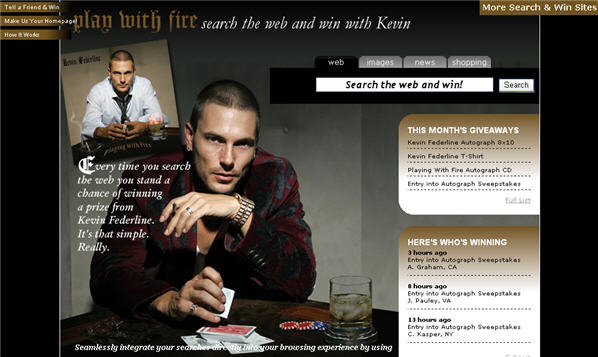 My SearchInsider column last week took exception with K-Fed launching his own search engine. Actually, I take exception with the entire concept of K-Fed that but that’s another point. In today’s SearchInsider, David Berkowitz retorts, rebukes and refutes my negativity around all things Federline, saying that the K-Fed engine shows that search is ubiquitous, search is evolving and search shouldn’t be always all business, no fun. Ultimately he says let the market decide whether a Kevin Federline engine is a good idea or not. Hard to refute that point.
Anyway, knowing David, he had a lot of fun writing the column and I certainly had fun writing the original column. The thing that amazes me is that in the past week, 40% of the total ink (or whatever the virtual variation of ink is) on SearchInsider has been devoted to the topic of Kevin Federline. Perhaps someday soon you’ll be able to pick up your local copy of SearchInsider at the grocery checkout and we’ll have great juicy articles about Britney’s rehab and the latest alien that professes to be Elvis, living in Minot, North Dakota.
One last point though David. You quoted me as saying that I would rather wear Fiberglas underwear than use the Kevin Federline search engine. That’s not actually true, I would rather wear Fiberglas underwear than attend K-Fed’s birthday party. And you asked where the phrase comes from. For the life of me I can’t remember where I first heard it, but I’m pretty sure it’s not a Canadian thing. I tried to look it up and couldn’t find any references so what the hell, let’s say that I originated the saying.
Does Online Video Give Us a New User Interface?
In Wednesday’s SearchInsider, Aaron Goldman looked at video search and what’s going to be required for it to truly become an interesting advertising vehicle. Some of the speculation comes from Aaron’s musing about what might happen if Google purchased Blinkx.
To me, video search is one of the more interesting growth areas for search in the future. Currently, there are some restrictions on video search that are imposed by the current state of technology. Our ability to index video is restricted to the addition of metadata. For each video clip, someone must take the time to include the tags indicating what the video is about. As long as video search relies on this, the opportunities for advancement are extremely limited. But right now we’re advancing on several technical fronts to be able to index content and not rely on metadata. Several organizations, including Microsoft, are working on visual recognition algorithms that allow for true indexing of video content. Advancements in computing horsepower will soon give us the sheer muscle required for the gargantuan indexing task. Once we remove humans from the equation, allowing for automated indexing video content, the world of video search suddenly becomes much more promising.
When this happens, we move accessing information in a video from being a linear experience to being a nonlinear experience. Suddenly we have random-access to information embedded within the video. As mentioned, the technology is being developed to enable this, but the question is, will we as viewers be able to adapt to this paradigm shift? The evolution of video has been one that is coming from a linear, storytelling experience. Every video is generally a self-contained story with a distinct beginning, middle and end. This is how we’re used to looking at video.
But when video search makes it possible to access information at any point in the video, how will that impact our engagement with that video? In the last 10 years, we’ve seen some fairly dramatic shifts in how we assimilate written information. We have moved from our past experience, where information was presented in very much a linear fashion in novels or books, to the way we currently assimilate information on websites. When we interact with websites, we “berry pick”, hunting in various places on the page for information cues that seemed to offer what we are looking for. Assimilation of the written word is much more erratic experience right now. We move in a nonlinear fashion through websites, picking up information and navigating based solely on our intent and the paths we choose for ourselves. One of the greatest revelations in website design was that we can not restrict users to a linear progression through our site, much as we might want to control their experience.
This adaptation has happened fairly quickly on websites, but will it happen as quickly with video? When we can search for and access information anywhere in the video, what does that do for the nature of our engagement with that video? Certainly it opens the door to some very interesting marketing opportunities, with what I’ve previously described as “product placement on steroids”. The ability to click on any item in a video and instantly be connected to more information about that item creates a tremendous opportunity for advertisers. But it also opens the potential for multiple paths through a video. Does watching a video become more like playing a video game, where we can pursue different paths and have different experiences depending on the path we choose? Does a travel video on Prague become an interactive virtual tour, where we choose our own path through Prague? And is that interactive virtual tour assembled on-the-fly from dozens of different video clips? do we assemble content based on our intent with the help of our video search tool? Do video producers take a dramatically more granular approach to producing content, leaving you to assemble the storyline from these individual bits of content, based on what you want to see?
This promises an extraordinarily rich user experience. Consider how this might play out for an individual user. We go to Google video search tool and search for the Loreta, one of the top tourist attractions in Prague. We find a clip that takes us on a quick virtual tour and within the clip we could click on other things of interest. For instance, we could climb to the top of the bell tower and take a look over Prague. We could click on any building and if there was a video available we would be instantly transported to that building. Or, if we choose, we could search for the nearest hotel and find the corresponding video clip. The entire video has been indexed so no matter what we click on, our video search engine can use that to initiate a query and bring us back the resulting clips. The clips are assembled into a virtual montage that we can navigate through depending on our interest areas. We create a virtual version of Prague, assembled from all the video content that’s available, and we can access just what we’re interested in and search for any content that might be embedded into any of those individual video files. Underneath this layer of video content there could be additional layers of functionality. For instance you could tie it in with mapping functionality, à la Google Earth. You could tie in Web search functionality so that you could easily click through to the relevant websites. This could also provide access to booking engines and a number of other potential actions that we could take.
Such an experience is not that great a stretch from where we are currently at. To see how it might play out take a look at Microsoft’s PhotoSynth.

PhotoSynth View of Piazza San Marco in Venice
It does just what I’m describing with video, only with pictures. It creates a 3-D world from the thousands of pictures that have been publicly shared. I highly recommend taking it for a spin, as it provides a fascinating look at what human computer interfaces can be.
As we start considering the possibilities for video, the problem is we’re still stuck in our current paradigm of how we interact with video. My feeling is once indexing technology allows us to truly index the content of the video, the nature of our interaction with video will completely change. We’ll take the sensory input we expect from video and extend that into our typical user experience with more types of content. Our interfaces will be more satisfying because they will become more like real life. They will engage more of our senses and put us into a deeper and richer virtual world. More and more, as technology progresses, our interface with technology will start to look more like our experience with the physical world. As this happens, we will have the ability to step from a interface that engages our senses of sight and sound into a more abstract world where we interact with written text. The transition between these two interfaces will be seamless and we can step back and forth as we wish.
The promise of video lies not so much in taking video as we know it and bringing it online. The promise of video is that it provides a distinctly different user experience which could prove to be the new interface to technology. But to make this happen we have to be able to index and search for the content that lies embedded within video. We have to be able to take that video content and manipulate and mold it into a virtual world that we can interact with. And that is the promise that lies within the next-generation video search.
K-Fed Up with Celebrity Skinned Search
First published March 22, 2007 in Mediapost’s Search Insider
I’ve got a question for you: Would you want to do anything with Kevin Federline? Personally, the more Federline-free my world is, the better. But apparently other people don’t see it that way. You may have noticed earlier this week that K-Fed is actually launching his own search engine. Well, to be more accurate, he’s slapping his face on an existing back end, so to speak. I won’t go into the details of the K-Fed engine, except to say that it’s powered by Yahoo and it’s offered by Prodege.com.
Par-Tee with Britney’s Ex!
Apparently, making this your primary search engine could open the door to a chance to win tickets to Kevin’s private birthday party (I would rather wear fiberglass underwear), T-shirts and other paraphernalia all related to the somewhat questionable K-Fed brand. Apparently, an invite to K-Fed’s birthday party is “a once in a lifetime opportunity.” This has the ring of truth, as I might consider killing myself if I actually won.
This got me thinking. If we’re in the era of consumer-generated media, are we also in the area of consumer-generated celebrities? Does the increasing fragmentation of our society through an explosion of online channels means that even marginal celebs like Kevin Federline get their own small sliver of fame? If we have enough Kevin Federline fans somewhere and the Web has empowered them to have a voice unlike anything they may have been able to have before, is there a place for a Kevin Federline search engine? And, if so, does the future hold the promise of a profusion of celebrity skinned search sites?
Google Dresses Up Your Home Page
Ironically, Google also made an announcement this week releasing six themes for their personalized homepage. In this case, Google went out of its way to make sure that the themes are not commercial in any way. In Google’s words, these themes are all about “art and personality.” The new Google themes are clever, in that they are location-sensitive and have some cool little twists designed to “delight” users. For example, some of the scenes are outdoors, and the sun rises and sets in sync with where you happen to be located. With a Google theme installed, you may never have to look out your window again. But in a conversation with Google folks, they made a point of saying that they’re hesitant to open up an API to Google themes, for fear that it would cause a rush of commercialized skins, which could encroach on the user experience.
Blatant Commercialism is Skin Deep
Commercially oriented skins are nothing new, of course. Movies have released custom skins for MP3 players and other online apps that bury functionality under a sea of advertising spin. There are hundreds and thousands of desktop themes, wallpaper and screen savers with a commercial bent. But up to this point, search has been relatively “spin-free,” save of course for the advertising on the actual results page. But at least I don’t have to look at Kevin Federline when I’m searching for the symptoms of gout or trying to find an update patch for my latest Windows problems.
Just Give Me My Results, Dammit!
Based on a few new entries in the search space, it suddenly seems like we need personality mixed in with our search functionality. Search innovator K-Fed is not the only one pointing us in this direction. Microsoft has been playing around with Ms. Dewey (again an unfortunate choice of words), with the assumption that an undeniably attractive but distinctively bitchy female guide standing in front of a Blade Runner-esque streetscape will somehow make our search experience more complete. Perhaps Ms. Dewey could be K-Fed’s rebound after his split with Britney. Or perhaps both of them should have a cup of tea with Jeeves and see how being a search mascot worked out for him.
My feeling is that we want search to be a pristine experience. We’d like it to be minimalist, and we want to start from a neutral palette. We are so focused on intent and the task at hand when we interact with search that anything that gets in the way is simply a distraction. It adds nothing to the user experience. Search is very utilitarian task. We get in, find what we’re looking for and get out. However, with the lion’s share of the search market tied up in the hands of so few players, perhaps any tactic is worth a try to see if they can wrest even a small sliver of those searches away from the Googles and Yahoos of the world.
Where Are They Now?
By the way, the other celebrities that have their own search engines with Prodege.com? Meatloaf, Andrew Dice Clay, and Wynonna Judd. So the progressive degrees of “washed up” seems to be: having your own reality show, appearing on “Dancing with the Stars,” then having your own search engine. Now, I ask you, if Paris doesn’t have her face (or other assorted body parts) plastered on a search engine somewhere, how hot can this trend really be?
Google Home Page gets Skinned – and One Change of Note for SEOs
I just had the official walk-through of Google’s recent announcement for personalized home pages. In a nutshell, they are allowing users the opportunity to skin their home page with one of six different themes. The goal, and I quote, is to “delight users”. And they don’t just want to delight them in the short term. They want this to be a long-lasting love affair with the Google home page.
Actually, in the call, we got sidetracked a little bit with something that, to me, was far more interesting. I’ll get to that in a second but first of all let’s look at the noteworthy aspects of Google’s announcement. The theory here is that the more you can personalize your home page, the more likely you are to interact with it on an ongoing basis. And if there’s a certain amount of cool involved, it will hopefully keep you coming back. Of course, Google wants this implementation to be technically clean so they’ve approached it with their typical engineering anal-retentiveness.
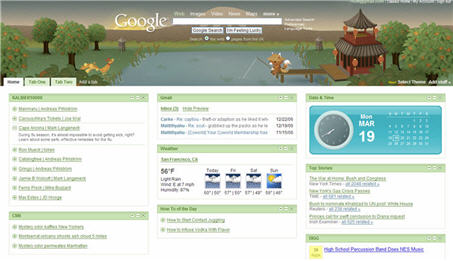
The application of the theme is restricted to the top of your personalized home page. Google was very careful to make sure that the graphics didn’t impair either the performance of the page or your ability to get to the information on the page. They’ve taken some fairly ingenious workarounds to this. The themes are launched with a CSS framework and the foreground images are transparent gifs, layered over a tiled background that allows resizing of the browser without impairing the look and functionality of the page.
Google also, and again I quote, wanted this to be about “art and personality”, not about a thinly “skinned” (if you’ll pardon the pun) advertising pitches. They’ve only released six themes in this first round because they wanted to set the bar high. They indicated that they would likely be releasing more over time. And they also indicated that they are considering opening up a skinning API in the future, but they would rather not have highly commercially oriented skins, i.e. promoting the launch of a new movie, suddenly intruding on the personalized home page user experience.
One feature that is pretty cool about the new themes is that they are location sensitive. When you load a new theme the first thing you’ll be asked to do is enter your zip code (right now this release is only aimed at the US, but a release for Google’s other localization areas should come in the near future. I did add one in Canada, but I’m not sure if it’s updating itself). After that, you’ll find your seeing updates itself reflect the time of day and, in some cases, the season and your local weather.
Here are some examples. In Bus Stop, the weather impacting the bystanders changes based on what you might be seeing your window.

In Beach, the time of day will change your view over the seascape. When the sun sets out side, it should also be setting on your monitor.

And, in the seasonal theme, you’ll not only see the theme change based time of day, you’ll also see the changes of the seasons.

Google also promises some Easter eggs, hidden in amongst the themes.
All in all, it’s a cool add-on to the Google personalized homepage. Of course the rationale behind this announcement is fairly transparent. Google is pushing hard to gain more face time with the average user, and this gives them a front to attack on. The more time you spend the Google home page, the more chance you will have to interact the other Google properties. Apparently, Google is seeing some very strong growth trends through 2006 with personalized homepage usage. They’re also seeing a huge ramp-up of content delivered for the home page through their Gadgets API.
The SEM Easter Egg
But what about the search marketing implications? There’s nothing about this particular announcement that should impact how the personalized home page could be used for personalized search, other than Google’s hope that the addition of a personalized theme would lead to more interaction with your homepage. But there was a functional roll out recently by Google that could have implications for the search marketing community. This is something that I wasn’t aware of and was lucky enough to get a quick walk-through.

When you sign in to your personalized homepage, you’ll now see a small “add a tab” link beside the tab at the top of your home page. When you click on this you’re asked to name your tab and if you leave the Feeling Lucky check box checked, Google will go out and find the content to put on your new page.

For example, I added a tab called SEO and Google automatically populated it with the latest headlines from SEOmoz, SEO News, Search Engine Land, Search Engine Watch and a number of other SEO sites.

I asked Google how it was determined what sites would be included in this set of default content. Apparently, it’s decided by the most common choices of other people who have added a similarly named tab. In other words, these represent the aggregate choices of an ad hoc community, defined by the people who are interested in SEO and have decided to add these sites as content to their home page. And the set of default choices will constantly be refined, based on the most popular choices of people who add that tab. However, once you’ve added the tab to your own home page, your default content set remains static.
Okay, that’s interesting. But let’s factor in Google’s other recent announcement, the fact that they now have an integrated personal suite that shares user data from search history and what you have on your personalized home page. It’s not clear right now how much of an impact the content you’ve chosen to include on your personalized home page has on your personalized search results, but Google has said they wouldn’t “preclude” the use of this information in the personalized results algorithm.
Let’s further explore the implications. In these areas of interest, what gets included in the default content set under a possible “add a tab” category might have a significant advantage for any searches that fall within that content area. The more people who leave the Feeling Lucky? check box checked, the more people that will have these default content providers represented on the homepage, which will in turn likely impact their personalized search results. As we start exploring personalized search more and more, we’re starting to see the possible tactics that are emerging for gaining visibility on a personalized search page.
So what’s the bottom line here? Google’s new themes are cute and will likely lead to a higher degree of usage, but they have little impact on the world of search marketing. However, the “Add a Tab” functionality could potentially have a lot more impact.
 Out of My Gord