The Inevitability of Personalized Search

First published February 15, 2007 in Mediapost’s Search Insider

Google’s announcement a little more than a week ago that it would be showing personalized search results to more people through a change in the sign-in/sign-out default signaled perhaps the most significant change in search marketing in the past few years. Fellow Search Insider David Berkowitz dealt with some of the SEO implications in his column on Tuesday. Today I’d like to deal more with the user side of the story. Although Google’s announcement heralds a relatively minor change in terms of user experience, at least for the present time, it represents a step down a path from which there is no return. This path marks a dramatically different direction for search that will have far-reaching implications, both for advertisers and users.

Google Gets Personal

First, a brief recap of Google’s announcement and what it means to users right now. Here are the details: Now, everyone signing up for a Google account gets Search History enabled by default. The opt-out box is positioned so that most people would likely not even notice it during the sign-in process.

Whether or not you have Search History enabled, you get personalized search turned on by default. This means that Google will subtly change your results, based on various “signals,” like what you have on your personalized Google Homepage and what sites you’ve bookmarked as Google favorites. Of course, if you have Search History enabled, this is the main “signal” for personalized search


Finally, and probably least significantly, everyone gets his or her own Google Home Page when s/he signs up for a Google account.

The End of One Page for All

Let’s leave aside the privacy issues of Search History right now. That’s a topic that deserves a column by itself. It’s the end of the universal search results page that I want to touch on today.

There has been significant dissent voiced about Google’s move to personalized search, and it’s coming primarily from one source: search engine optimizers. In opposing personalized search, they’re saying it degrades the user experience. I responded by saying that it was the wrench that personalized search throws into their SEO plans that was raising their ire. But let me set aside my jaundiced view of the search world for a moment and chronicle its concerns (excluding privacy issues), as near as I can understand them:


  • Taking control away from the user by making personalized search a default and making it more difficult to toggle on and off 
  • Fear of anomalous browsing patterns (i.e. going to visit a number of humor sites on a whim or the invite of a friend) unnaturally biasing search results 
  • The “machine learning” algorithms that power personalized search not being smart enough to really provide more relevant resultsI’ve come out as saying that personalized search is inevitable; the day when all of us see the same page of search results is rapidly coming to a close. To me, this just seems obvious. But still, there are those that protest. Here’s one example from Michael Gray, a well know SEO Blogger: “I’ve never met a business owner who’s said, ‘Man, you know what, I wish the search engines could create anarchy by making sure no two people got the exact same results for the exact same search — that would be the best thing since sliced bread.'”

    In fact, Michael’s beef seems to be a consistently recurring theme among the dissenters, that a move to personalization suddenly seems to open the door for chaos on the results page. I believe the opposite is true.

    Every Search is an Island

    I am an individual, with unique interests, experiences, values and goals. My intent when I search for hybrid vehicles, or New York hotels, or Smart Phones, or any of the hundreds of other things I search for monthly, will be significantly different than all the other people that launch those same searches. I want a search engine smart enough to know that. I’ve always said that humans are complex, far too complex for a simple search box to get it right. That’s why personalized search is inevitable. If we want search to move to the next level, to get smarter, more intuitive, more relevant, we need to leave standardized search results behind.

    Does this mean Google will get it right out of the box? No. It will take baby steps towards what personalization eventually needs to become (although I believe those steps will be in rapid succession, because Google can hear the competition hard on its heels). Yes, there will be many who find that in the early stages, personalization may be more frustrating than it is useful. But for search to mature, these are growing pains we’ll have to endure.

    I’ve been labeled as an early proponent of personalization. I’m not sure this is necessarily the case. To me, it’s not a question of liking or disliking the recent moves by Google. To me, fighting search personalization is as pointless as refusing to accept today’s weather.

The Personalized Results are Coming, The Personalized Results are Coming!

Okay, sometimes the temptation to say I told you so is overwhelming. Danny has a nice long post in Searchengineland about Google’s changes to Personalized Search, making it more of a default and less of an option for millions of users. Danny details it more than I intend to, so please check it out.

As Danny says, he’s been talking about personalization for years, but up to now, it never materialized. After interviews with head user experience people at all three engines, I felt the time was right for personalized search to roll out (check The Future of SEO in a Personalized Search Interface and The SEO Debate Continues). And it appears my sense of timing was bang on. Much as I’d like to claim to be prescient, it’s really just common sense. You could see all the engines inching towards it. Now, Google has just upped the ante a little.

There are two major implications to this: what it means for search marketers, especially organic optimizers, and what it means to users. I’ll deal with each in turn.

What it Means for Search Marketers

The “Is SEO Dead? Rocket Science? A Scam?” Debate has been winding it’s weary way through several blogs in the past few weeks. My take was that SEO is, and will continue to be, vitally important as long as organic search results continue to be important to the user. Based on what I’m seeing, that continues to be very much the case. But, organic optimization now has a completely new rule set, which will irritate the hell out of many organic optimizers. The disgruntlement is already beginning to show. Michael Gray, better known as Graywolf, was the first to post a comment on Danny’s story:

Just because I ordered my coke with extra ice last time doesn’t mean I want it that way this time. I hate personalized SERP’s, I despise it even more that they don’t tell me they are personalized, and I loathe not being able to turn it off. I also have extreme antipathy for not being able to keep my search history on and not be part of personalized search.

Let me have it the way I want, not the way you think I do. I don’t want SERP’s that work like Microsoft programs that try to anticipate what I want to do, because more often than not it’s wrong. Bring back truth, purity, and clarity to the SERP’s.

Graywolf is complaining as a user, but I can’t help thinking that the more significant pain he’s feeling is as an organic optimizer who’s world suddenly just became a lot more complicated. “Truth, purity and clarity to the SERP’s”? In whose eyes? Come on. Personalization is being implemented because it enhances the user experience. It doesn’t take a “Rocket Scientist” (sorry, couldn’t resist) to see that one set of search results is not the best way to serve millions of users.

As Danny said, there’s now an explosion of new fronts for the organic optimizer to consider. Right now, Google is only injecting a few personalized results into the search page, but expect that threshold to gradually creep up as Google gains confidence in the targeting of the results to the person. The days of the universal results page are numbered. Which means that the days of the reverse engineering approach to SEO are equally numbered. I’m sure people will try to figure out ways to spam personalized search, but as I’ve said before, reverse engineering requires a fixed constant to test against. Up to now, the results page and the other sites that appeared on it represented that fixed constant. That’s gone now.

So where does that leave SEO? Well, it’s certainly not dead, but it has dramatically changed. You can’t optimize against a results set, but you can optimize against a user. Let’s use an analogy that’s often been used before to describe SEO. Think of it as Public Relations on the Web. If you launch a PR campaign, you don’t target a particular position on the front page of the NY Times, you target a type of audience. You plan your release distribution and messaging accordingly. And you give reporters what you think will catch their attention. Most of all, you have to wrap your campaign around something that’s genuinely interesting. Then, you hope for the best.

Now, SEO becomes the same thing. You don’t target the first page of results on Google for a particular term. You target an end user. You wrap your site messaging in terms that resonate with that user. You write in their language, you give them a reason to seek you out, and you sure as hell don’t disappoint them when they click through to your site. You do all this, and you remove all the technical barriers between your content and the indexes you need to be in. Then, you hope for the best.

The problem with SEO has always been that it’s been treated like some magical voodoo that can be applied after the fact, like some “secret sauce”. And yes, that was what the infamous Dave Pasternack has been trying to say. He just went several steps too far. The fact is, with universal search results, you could actually do this. Thousands of affiliates have made millions of dollars doing it. Link spamming, cloaking, doorway sites..the fact is, up to now, this bag of tricks has worked. It’s gotten harder, but it’s worked. Site owners looked to SEO to help them hi jack traffic that wasn’t rightfully theirs. They hadn’t done the heavy lifting to create a site that justified a place in the top rankings, and they tried to take an easy short cut.

But now, organic optimization means that you have to do the heavy lifting. It has to be integrated into the entire online presence. What Marshall Simmonds has done with About.com and the NY Times is a perfect example of the new definition of SEO. Get to the front lines, to the people who are churning out the content, and teach them about what search engines are looking for. Make sure SEO best practices are baked right into the overall process flow. Work with the IT team to create a platform that entices the spider to crawl deeper. Work with the marketing team to crawl inside the head of your target audience and figure out the who, the when and the why. Don’t worry so much about the where, because you can’t really control that any more. It’s a tough paradigm to break. We’ve been struggling with our clients for the past year or so. They’re still fixated on “being number one” for a particular term. We’ve been trying to ease them into the new reality, but it’s not easy.

I guarantee this will create an identity crisis for the SEO industry. As recently as a few months ago I was moderating a panel that was talking about analytics, and in the Q&A someone asked the panel, who had a few very well known SEM’s on it, about what they used for ranking reporting. The names of various options were thrown out and people started scribbling them down. I saw this and thought I had to comment.

“You know, the whole concept of ranking is quickly becoming irrelevant”

Nobody lifted their head, they were still busy writing down tool names. Maybe they hadn’t heard.

“As search engines move to personalized results, there will be no such thing as ranking. It will all be relative to the user.”

That should get their attention. Nope, nothing.

One of the search marketers said, “Yes, but knowing how they rank is still important to people.”

Huh? Am I speaking a different language here? I shook my head and gave up.

So, does this mean SEO is dead? Absolutely not. It becomes more vital than ever. Here are a few things that remain to be true. Preliminary results from the new SEMPO survey say SEO continues to be the number one tactic in search marketing. Yes, people want to bring it in house, but they recognize it’s importance.

Why do they think it’s important? Because it kicks ass in ROI. Here are the results from another recent study by Ad:Tech and MarketingSherpa, asking advertisers about the return they get from various marketing channels.
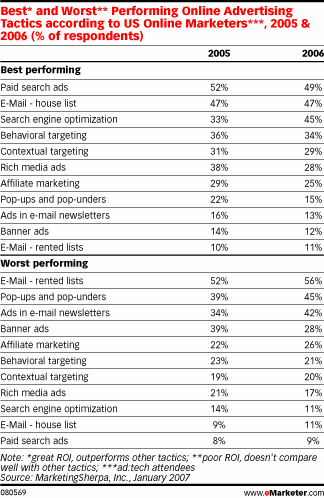
080569

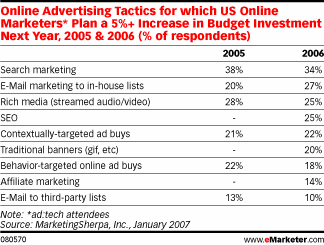
The biggest jump from year to year? SEO. Now, let’s look at where marketers plan to spend more money in the next year.

080570

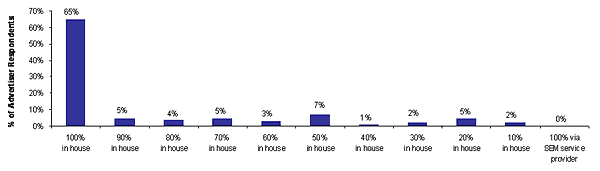
SEO, from flatlined last year to looking to spend 25% more this year. So SEO definitely isn’t dead. But it is moving to a new home. Here’s some early results from the SEMPO State of the Market Study (by the way, final results should be available next week. Look for them):

SEMPO2a

It’s true that most companies would far rather bring SEO in house, if they could. And when we consider the new definition of SEO, it probably makes sense for SEO to be integrated into the internal work flow. But the problem is that there’s not a lot of SEO expertise out there. If SEO was so easy, why don’t more companies do it, or do it well? Contrary to Pasternack’s argument, it’s not a “set and forget” type of tactic. It requires a champion, buy in and diligence.

I think the future is bright for SEO as a skill set, but we’re talking a modified set of skills. I talked about this in a recent SearchInsider column and a follow up online debate with Andrew Goodman. My view of the future for the really good SEO’s out there fall into three categories:

Get a (Really Good) Job

As companies bring this in house, there will be a firestorm of demand for skilled SEO Directors, but ideally as employees, not consultants.

Broaden Your View

Become an expert in how consumers navigate online and help your customers with the big picture, including the new reality of SEO.

Adapt and Survive

Find a new online niche where your search honed skills give you an advantage.

User’s View

Okay, this is already a much longer post than I intended, so I should probably talk about personalized search from the user’s perspective now.

Personalized search is a big win for the user. Don’t judge by the first few tentative steps Google is taking. Personalization is a much bigger deal than that. Google is easing us in so the experience isn’t too jarring. By the end of 2007, all 3 of the major engine’s results pages will look significantly different than they do today. Personalization will be like a breached dam. Right now we’re seeing the first few trickles, but there will be a wave of much deeper personalization options over the next several months. Search will become your personalized assistant, tailored to your tastes. As you search more, your results will draw more and more away from the universal default and closer and closer to your unique intent. Immediately after your query, you’ll be dropped into a much richer search experience. Disambiguation will become much more accurate, and you’ll find that you will pretty much always find just what you’re looking for right at the top of your page, without having to dig deeper. Here’s how I see it playing out at each of the big three:

Google

Google has a religious devotion to relevance, and as they gain confidence with personalized search and their ability to disambiguate, this will manifest itself with a laser focus on relevance above the fold. They will continue to maintain a good balance of organic results, but these results will not just be the current web search results. They could be local, image, news or a mix of each. And ads. Yes, you won’t escape ads, but Google will be the most judicious in what they show. Expect more stringent quality scoring, down to the landing page level and a high degree of relevancy in the ads that do show. Google will be the most concerned of the three in disambiguating intent.

Yahoo

Yahoo will put their own spin on personalization by wrapping in Social Search. They will continue to leverage their community, as they currently do in Yahoo! Answers so when you’re logged into Yahoo, you’ll be plugged into their community and that will impact the search results you see. Relevancy will be determined more by what the community finds interesting than what you find interesting, although it will be a mix between the two. Yahoo will target two types of searches, serendipitous search, where you’re looking to discover new sites, and what I call “frustrated” search, where your own efforts to unearth the data online have come up empty and you want the help of the community. When it comes to monetization, Yahoo will be the most aggressive, pushing more ads above the fold into Golden Triangle real estate. These ads will trail Google’s in terms of relevance

Microsoft

Microsoft will use their targeting capabilities and probably tie in some behavioral targeting to personalize their search results. Also expect personalization in the Microsoft product to be integrated at a deeper, more ubiquitous level, into apps and OS. This probably won’t happen in 07, but it will be a long term goal. When it comes to ad presentation, Microsoft will fall somewhere between Google and Yahoo in both the number and relevance of the ads being presented. The heaviest investment will be in building out the platform to manage and model the ad program, rather than in policing the quality of the ads themselves.

It promises to be a very interesting year in the Search Marketing biz!

New Click Fraud Numbers: But Can You Trust Them?

There’s new click fraud numbers out from Click Forensics indicating that click fraud is on the rise.  In fact, according to the study, click fraud on high-value keywords could be as high as 20%.  The overall industry average click fraud rate for the fourth quarter was 14.2%.  According to the report, the average click fraud rate on PPC ads on search engine networks was 19.2% for the fourth quarter of 2007.

In the report I saw it didn’t indicate which search engine networks this number was coming from.  I would have to assume that this includes both first-tier and second-tier search engine networks.  Some further data around this would be helpful, as my suspicion is that a majority of the click fraud being reported by Click Forensics is likely to coming from second-tier networks that don’t have the same stringent click fraud filtering mechanisms in place as Google, Yahoo and soon to be newcomer to the space, Microsoft.

Andy Beal casts doubt on these numbers in his blog MarketingPilgrim.com, making the salient point that you have to remember they’re coming from a company that has a vested interest in the growth of click fraud.  Also Click Forensics sample includes only companies that are concerned enough about click fraud to actually use Click Forensics to monitor fraudulent activity on their sites.  One has to assume that these companies would be especially vulnerable to click fraud and are not an accurate representation of the total universe of advertisers.  Like Andy Beal said, it’s a bit like going into a hospital and asking a number of people if they feel sick.

Perhaps it’s coincidence, but about the same time that this report was coming out, Danny Sullivan had a conversation with Shuman Ghosemajumder at Google about their concerns on some of the click fraud reporting that’s coming from companies like Click Forensics.  Apparently one of the main points of contention is around the use of the back button on a browser.  I had previously talked with Shuman about some of the reported numbers around the click fraud issue in their concern about inflation of those numbers.

Regardless, at this point it looks like we’re still going to be grasping at straws when we try to put scope around the click fraud issue.

Kevin Lee on the Lee-ching Effect of Search

Kevin runs a great column on a topic I explored awhile ago in SearchInsider: are search engines leeching value from the web? Kevin approaches it from a slightly different angle than I did, but the conclusion was similar. Vendors are beginning to resent having to pay for every search generated touchpoint with a consumer. Kevin’s point, which I share, is: Get Used to It!

Here’s the 10 second summary of the idea, but please take some time to read the column. Consumers continue to turn to search to connect with an online vendor, even after the initial introduction. The vendor has to either maintain a prominent position in the sponsored ads, or, in some cases, pay an affiliate who is maintaining a high organic position (this reference is somewhat ironic, coming from the company that says SEO is simple enough that these affiliate sites should be cut out of the ecosystem). The vendor resents having to pay this recurring toll every time the customer visits them.

Having to invest to maintain share of wallet with a consumer is nothing new. It’s just that the new power of online and search in part makes this investment more focused than it’s ever been before. It used to be that maintaining enough top of mind to ensure a continuing connection with a customer was spread out over a number of marketing channels. Somehow, advertisers would accept this. But now, with the focused use of search to navigate the web, including return visits to a particular site, the cost is being concentrated in one channel. If anything, this introduces efficiency into the marketplace and could potentially save the marketer money, but all they see is a growing cost they have to pay to one channel to keep customers they thought they had already won. The missing piece here is solid data about the shift of influence from more traditional channels to the new search one. The marketer doesn’t know whether they have to maintain all the previous marketing activity, or can they confidently begin moving budget to the new one, namely search.

Read Kevin’s column, and then take a look back at my view. It’s a thoughtful look at an interesting shift in marketing dynamics and is a refreshing change from some of the other opinions currently coming out of Did-It.

The Goodman – Hotchkiss Smack Down

Okay…maybe it’s nowhere near the Pasternack vs the Rest of the SEO World Debate that’s currently going on (which is apparently now even spawning it’s own T-shirt), but Andrew Goodman took exception to my recent SearchInsider column, where I also ponder the future of SEM/SEO.

To save you a ton of reading, I’ll summarize the salient points of both.

My take:

SEM shops, and in particular, SEO shops, have been so tactical and have developed such a specialized set of skills that it will be difficult for us to step back and look at the bigger picture necessary to guide us in the next evolution of search into a more personalized channel. Further, as the current reality of universal search results pages gives way to personalized results, the market value of this highly developed skill set, largely based on the current paradigm of optimizing to gain rank, will begin to lose value to potential acquirers as rank ceases to have any meaning. This will create a shakeout in the industry as some of the best practitioners become employees with large companies and others can’t keep up with the new evolution of search.

Andrew’s take:

I missed some factors, in particular the fact that you can’t predict financial fads and roll ups and acquisition are often driven more by buzz from Wall Street than logic, and that acquisition is often driven by the target’s client list and expertise in a skill set that the buyer doesn’t currently have. Further, Goodman feels that contrary to my point, SEM’s are actually pretty strategic in their execution of campaigns and that our front line approach in customer acquisition is giving us exactly the skills needed to market in the new online reality. He goes on at some length about how the majority of the agency world is drastically out of touch with this new reality.

Of course, both Andrew and I being Canadians, we’re probably both way too polite and pragmatic to create much of a stir. Note the carefully worded way Andrew threw down the gauntlet:

Gord Hotchkiss argues that SEM firms aren’t getting acquired for large sums mainly because they’re too tactical and don’t have skills that help them work on segmenting and customer profiling. I tend to think that the picture is more complex. Or maybe, it’s actually simpler. Either way, Gord’s assessment of current reality is correct, but his analysis is wrong.

It’s kind of like Mac n Tosh, the really polite Warner Brothers gophers, in the WWF. “You hit me first.” “No, I insist, you take the first swing.” “No, no, that would be rude, please put me in a pile driver.”

But I do encourage you to read Andrew’s post, as I think it definitely adds to the perspective. And here, I’d like to dive a little deeper on some of the points Andrew brings up:

I happen to think search marketing is a fine training ground for the strategic mind. Of course, no small consulting firm is given the keys to the entire marketing strategy for a large client, but discounting for size, the influence of the search marketer is impressive. Look at all the data clients already let search marketers work with! While expensive, ponderous segmentation and market research exercises are not the typical MO of the searchie, that’s often because these don’t translate very well to the particular campaigns they’re asked to work on.

Well, in most instances, this usually contradicts the point Andrew is making. While I agree that we often get access to a lot of data, it’s usually in support of the crushing load of tactical work that has to be done in search. We need to dive into conversion data, site stats and a mound of other data to tweak and optimize the campaign. And it’s this deep dive into the data that often keeps us from seeing the big picture. And yes, segmentation and market profiling are ponderous work, and that is tactical, but it’s the ability to take the results and apply them strategically that truly sets apart great marketing. I agree with Andrew that there’s a real danger of misuse of profiling, and it’s horrendously abused in the traditional agency world to justify expensive sponsorships that are more about boondoggles and perks for agency execs than it is about effectively reaching target consumers. But to me, the biggest thing missing in Search is the who and the why. We know where and we guess at what, based on a series of tests.

Here’s how it usually works. We test for best position. We come up with messaging and test for effectiveness, often based on a set of metrics that are end of funnel targeted, because that’s the best we can do right now. There’s testing, testing and more testing.  Andrew makes this point as well:

(Testing is) certainly something search marketers are uniquely skilled to do. In paid search, we learned “direct marketing analysis on steroids,” not from any book, but from the ground up. Now we’re busy writing the book.

This brings us to a point that came up during our panel at the recent Microsoft Summit. One member of the audience equated search to direct marketing. This is a common comparison, but it points to the very reason most SEM’s are too myopically focused. Here’s one definition I found for direct marketing:

Direct marketing is a type of advertising campaign that seeks to elicit an action (such as an order, a visit to a store or Web site, or a request for further information) from a selected group of consumers in response to a communication from the marketer.

From a marketer’s perspective, this pretty much sums up search. It’s what we all want people to do through search. But, and here’s the thing, it’s often not what the user wants to do. The point at which search is used and the point at which the consumer is ready to take the action could be seperated by days, weeks or even months. Here’s another symptom of our short sightedness. When we measure actions, we show a strong bias towards the purchase end of the funnel. Most marketers either don’t or can’t measure promising activity earlier in the funnel. It’s often not our fault, because the leap from measuring end of funnel activity to full funnel activity is huge, and largely impossible. It requires a sophistication of reporting that’s beyond the ability of any single platform. So we tend to focus on what we can measure. And this leads to an increase in short sightedness.

What we need is the who and why. We need to look at presentation of our messaging through the eyes of the target. We need to understand intent, and deliver on it. That dramatically reduces testing cycles. When you learn to do that, your strategy defines itself. Contrary to Andrew’s point…

Customer profiling? I think it’s useful, but let’s not get too cute.
(By the way, I think Andrew’s Canadianism is showing here. Most Search Marketers I know would call it BS)

…knowing your customer isn’t cute, it’s critical. Up to know, search has been able to effectively deliver leads without this understanding. That’s a testament to the power of search as a channel. But those days are rapidly ending. My point is this view is now essential to reach customers in a more personalized search reality, or if it’s not essential now, it will be very very soon. And knowing your customer means research, profiling and creating paradigm shifting frameworks, such as personas. And I don’t mean in the way traditionally abused by agencies, but in highly effective ways pioneered by product designers and employed by Future Now, who Andrew refers to.

A few totally awesome data analysts in these firms – and a handful of independent analysts – are doing exactly the right things, while most everyone else in the agency infrastructure is not empowered to act on the power of the data (or put less politely, they’re just pretending). Agency culture is still dominated by the power of “creative,” and subjective judgments of “spots.”

Okay, here’s one point in where Andrew and I are in complete agreement. Agencies don’t get it, and although some bright individuals within the agency structure do, they’re hamstrung and stiffled by crushing inertia and old thinking. Andrew seems to think I implied agencies wouldn’t buy because they knew how to do it. That wasn’t my point. It was agencies won’t buy because they think they know how to do it. And the distinction is important. In fact, somewhere on my desktop is a half finished blog post where I looked at why this happens, but I shelved it because I thought it might be too “impolite”. Maybe it’s time I dug it up and finished it. But in the meantime, everything that Andrew points out as being wrong in the agency space I agree with totally.

From the ashes of all of this rises search. Which, though highly tactical, is a great training ground for strategic minds like Joe Morin, who is now CEO of StoryBids, a startup that offers an auction system for product placement.

Again, in trying to point out a difference in opinion, Andrew actually helps reinforce a point I was making. Joe is a good friend and a great example of the handful of survivors who are evolving into the new reality. I mentioned that the challenge for SEOs in particular (which was Joe’s background, along with being a private investigator) was in being willing to draw back from their current view and skill set and to reinvent themselves to find a niche in the rapidly evolving online ecosystem. Joe is a master of this and acts as a great example for the industry. Andrew also mentioned he has some skin in a new game, and as one of the smarter people in search, he’ll evolve quite nicely as well. And I think in the word “evolve” we come to the crux of this. Perhaps the best way is to sum up with the following comparisons

Traditional Agencies = Dinosaurs
SEMs/SEOs Unwilling to Change = Mastadons
SEMs/SEOs Embracing Change = Primates

SEM’s Seven Year Itch: Part Three

First published January 25, 2007 in Mediapost’s Search Insider

The 2004 acquisition of SEM firm iProspect by the advertising network Isobar marked a turning point in the search marketing industry. Various reports pegged the total value of the deal at about 50 million dollars, including potential earn-outs. IProspect founder Fredrick Marckini stood to be a very wealthy man.

The iProspect deal wasn’t the first or last acquisition to happen. But the valuation of the deal (together with an earlier Performics/DoubleClick deal) set a new high-water mark for the expectations of the owners of other search shops. Suddenly, it looked like there was a very lucrative exit possible. After years of struggling in the search space, we found that we might just be holding the winning lottery ticket. Up to this point, there was a bit of a taboo about talking of acquisition in SEM circles. We all routinely professed our love for search and how we just couldn’t see ourselves doing anything else. But, hey, a $50 million dollar check can change your thinking somewhat. Suddenly, the SEM community indulged in a little daydreaming and started frequenting the Jaguar Web site and checking out property prices in the Hamptons.

But the flood of acquisitions that was predicted never happened. It was more of a trickle, and when we were privy to details about valuations, they were significantly under the iProspect deal. There are a number of reasons for that (perhaps the topic of a future column). But the fact is, while the owners of search shops have had their appetites whetted, the window for highly profitable acquisitions may have passed by. Here’s why.

Tactically, We’re Awesome

Search marketers are brilliant tacticians, whether they work on the paid or organic side. It’s what we excel at. The biggest show in the SEM industry, ironically titled Search Engine Strategies, is really three or four days jammed packed with tactics, not strategies. We myopically focus on page position, always shooting higher. It’s all about rank. It’s all about being No.1.

What we’re not particularly good at is stepping back and looking at the big picture — the hows and whys of search, and, most importantly, the whos. While this is true across the search space, it’s most apparent with the organic optimizers. Virtually no one in the SEO world has given a hoot about messaging, user experience or intent. It’s all about crawling your way to the top spot. In the last year, I’ve seen a few SEOs starting to change their thinking, but the vast majority is still obsessed with blowing holes in the ranking algorithms.

Rank Becomes Irrelevant

However, we’re rapidly approaching the day when being No. 1 ceases to have any meaning. That’s a view that is tied to the concept of a universal results page. A user searching for “bass” in Seattle sees pretty much the same results page as someone searching in Salisbury or Saskatoon. In this context, rank not only has meaning, it’s the magic bullet.

Currently, the engines are rolling out personalization of results in a number of flavors. Soon geo-targeting, demographics and personal histories will be bigger determiners of the results, and the order you see them in, than the skill of a search optimizer. An aspiring musician in Seattle searching for “bass” may see the biggest selection of bass guitars in the Pacific Northwest in the No. 1 spot.  An angler in Saskatoon will probably see the top bass fishing spots in Western Canada. And the person using their laptop and wireless connection to search for “bass” in a Salisbury pub could well see the official site for Bass Pale Ale.

A New Rulebook

On the organic side, this dramatically changes the rules of search. The hyper-developed technical skill set of SEOs suddenly needs to be rounded out with a deep understanding of the target user. The optimization tactics we felt were going to guarantee us an early retirement, while still valuable, will take a back seat to the ability to segment and understand our target prospects. More important, we have to understand the online paths they’re likely to take, and help our clients intercept them with effective messaging and successful interactive experiences. These are the skills that will be in high demand in the future. There will always be a place for a talented organic optimizer, but it will be as a rather well-paid employee, not a multi-million-dollar acquisition.

Where do these new skills exist? Well, they’re more evident on the sponsored side, as new platform enhancements have allowed the best paid search practitioners to start to segment demographically and geographically. It’s forcing us to do our homework on who our prospects are. And unfortunately, our potential acquirers, the large agencies, believe they have deep bench strength when it comes to segmenting and profiling prospects, certainly deeper than the average SEM shop. I still don’t believe they’re done a particularly good job of porting traditional market research skills to the new consumer-empowered online reality, but I suspect I’d have a hard time convincing them of that.

You know who’s really honing these skills? The behavioral targeting practitioners. Search marketer should start paying a lot more attention to what’s happening in the BT camps.

A Chronic Itch

So where does that leave the average SEM agency? Is a profitable exit still an option as our seven-year itch demands to be scratched? If your valuation depends largely on tactics that gain higher rankings and concentrates on the “where” (on both the organic and sponsored side) rather than the “who” and “why,” your window has passed. But if you’re up for the change and not only embrace the inevitable reality of personalized and integrated search but pioneer the understanding of it, a new market will emerge. That’s the good news.

The bad news is that there’s a lot more hard work and learning that has to happen to position yourself in that market, and this time we’re not the front-runners. The truly passionate will persevere and adapt. The rest will find themselves with some pretty good job opportunities — but the summer house in the Hamptons and the Jag XKR convertible will be long shots.

Pasternack’s at it Again

David Pasternack of Did-It is decidedly unrepentant in his campaign against SEO. He’s at it again in a Q&A on DM News. At this point, it’s beyond intellectual debate and seems to be all about generating a storm of activity, with himself at the center. As Danny Sullivan said  “It’s all getting pretty tired”. David continues to insist that you would be a fool not to bring SEO in-house, as anybody can do it, but apparently with paid search (Did-It’s business model) the opposite is true, as only a fool would try to manage their paid search in house.

You know, I was one of the ones that did see some logic (albeit a little convoluted) in David’s original column, and Kevin Lee’s subsequent columns to try to further clarify. There are two sides (or more) to every argument and I usually try the view from both sides before commenting. But I have to say Pasternack is going beyond the reasonable here. The fact is, with many of our clients, it’s organic search they seek consulting help with and it’s paid search that they keep in house. I frankly don’t see a big difference in the level of sophistication required in both channels. In fact, I would say there are more dimensions, and more potential traps, on the organic side. Here are some other reasons why you’re most definitely not a fool if you’re looking for a partner on the SEO side:

SEO Touches Everything

Sometime ago, I wrote a column about why an effective SEO campaign is so difficult to launch within an organization. The biggest reason is that an effective SEO campaign touches many aspects of the business. It’s embedded in content, which generally involves at least marketing and often includes legal, management, product groups and virtually every aspect of the business. And buy in of the IT department is absolutely essential. SEO doesn’t live it one place. To be effective it has to overarch everything. A partner can help make that happen. Talk to many in-house SEO practitioners and they’ll tell you one of their biggest challenges was selling SEO internally. It’s one of the most common immediate pains we solve when we partner with a company.

Nobody is Helping You With SEO

Right now I’m at a Summit hosted at Microsoft aimed at helping people use AdCenter more effectively. Microsoft is most decidedly not telling us how to rank higher on Live Search’s algorithmic results. Neither is Google or Yahoo! Other than the rather thin Webmaster Guidelines (according to Pasternack, all you need to know), there’s very little effort on the part of the search engines to help you understand algorithmic ranking. Why should they? They don’t make money from it. So you have to cobble your information together from various forums and blogs. There’s no official answer source for algorithmic problems. That’s why Search Engine Strategies attendance continues to grow. It’s also why SEMPO is introducing a organic optimization training program.

Nobody is Investing in Making SEO Easier

According to Pasternack, Did-It has “killer technology”. They do have a proprietary bid management tool, and it’s okay, as are many others. I’m not sure I’d call it “killer technology”, as that implies that it kills the competition. That’s just not true. Maestro is just another flavor of  bid management, with some cool features, and some noticeable gaps when you compare it to some of their competitors. But the fact is, there’s a market for building tools to help manage PPC campaigns. Driving this are the engines themselves, who are dedicated to taking the pain out of managing paid search, and are likely the ones who will be introducing “killer technology”, as there’s a strong economic win in it for them and they have substantially more resources than a company like Did-It. The engines are not dedicated in the same way to making SEO easier. The landscape is too messy and the division between white and black is too vague. It’s more open than it used to be, with the efforts of a few individuals (i.e. Matt Cutts, Jeremy Zawodny, Tim Mayer) and the odd tool (i.e. Google’s Webmaster Tools) but it’s nowhere near the scale of development on the paid side, and it never will be.

The Damage Can Be Long Lasting

If you screw up on a PPC campaign, it can be turned off while you figure out what went wrong. It can cost some lost budget, but that’s about it. Screw up on your SEO and it can take months, or even years, to fix the damage. And every day, you’re missing out on traffic that you’ll never get back. It’s all about risk, and there’s substantially more risk on the SEO side. Ask anyone who inadvertently got their URL banned.

SEO is More Difficult to Manage and Control

Paid search keeps you in control. You can measure campaign performance, adjust bids, turn off individual keyphrases or entire campaigns and introduce robust testing frameworks. While this increases the complexity of campaign management, it does leave you in control. With organic optimization, you have to throw your best guess against the algorithm and hope for the best. You surrender control the minute your site is spidered.

The Returns Can Blow PPC Away

Frankly, you’ve be a fool not to fully leverage the potential of organic, because if you do it right, your returns will blow anything you’re getting from the paid side out of the water. There’s a lot at stake, and the returns can continue for a long time, whereas the best managed paid campaign’s benefits end the minute you turn off the tap on the funds. Why wouldn’t you want to make sure you’re exploring every opportunity available to gain better organic visibility?

More of Pasternack’s Wisdom

In the interview, Pasternack made a number of observations that I wanted to deal with individually:

Everybody’s not angry: only a small percentage of readers with an inferiority complex who happen to call themselves SEO experts

Apparently, Pasternack’s brush only paints in black and white, which probably simplifies his world greatly. His one sided comments rubbed a lot of people the wrong way, myself included. I’d argue whether I’m an SEO expert, and I don’t believe I have an inferiority complex. I do travel in those circles however and talk to a wide number of people and generally find that we’re developing a similar attitude to Mr. Pasternack’s credibility in the industry.

I wonder what percentage of Danny’s (Sullivan) show attendees are there to find the “magic SEO elixir.” I would guess a very high percentage. I suppose we all have to cater to our audience.

I happened to be sitting next to Danny as he first read the above quote. “Harrump” would be the diplomatic term for the response. The fact is, SES attendees are not looking for the magic SEO elixir. They’re looking for answers because there’s precious few places they can find them. They’re generally not going to get them through the engines, at least through the official channels. Organic optimization can be complicated, depending on the challenges present. Ironically, many of the attendees are the very same in-house tacticians that Pasternack says should be more than adequate to optimize the site. In many cases, they’re lost and desperately looking for guidance. If SEO is so simple, where is there such a demand for answers? There’s a reason why attendence continues to grow at shows like SES and PubCon. There’s a reason why SEO oriented sites are amongst the most highly trafficked sites on the web (according to Alexa), including Matt Cutts Blog (#1256), Searchenginewatch (#811), Searchengineland (#3963 and growing) and Webmasterworld (#226). People are looking for answers to complicated questions. Not rocket science perhaps, but not a lead pipe cinch either. By the way, Did-It and their Frog Blog are not quite at the same level (#63,244) as these sites that deal with the supposedly artificial “mystique” around SEO.

I would do a Google search for the term “search engine optimization” and run away from any company which can’t even get themselves into the top five organic results. Doctor, heal thyself! And don’t believe for a second that these firms are not trying to get themselves to this coveted position. If they did, they’d win every sale. Maybe I would even hire them.

Okay, let’s apply Pasternack’s logic to himself. Do a search for paid search management in Google and see if Did-It has presence. Here, I’ll save you the trouble:

googlesponsoredsearch

Hmm, don’t see Did-It there. Should we assume that Did-It isn’t very good at what they do? Is it because the return isn’t worth the investment? It could be a number of reasons. And unlike Pasternack, I would hate to make assumptions about their lack of presence because I don’t have all the facts. Carrying this further, let’s look at some of the top SEO agencies, according to Advertising Age’s recent survey in their Search Fact Pack. Of the top 20, none of them are currently ranking in the top 5 for “search engine optimization”. Does that mean you should run from them? No, there’s probably other reasons for it.

Obviously, there is no such thing as the final word in an internet based debate. But a word of advice to Dave Pasternack here. At some point stirring the pot turns into flogging a dead horse.

Yahoo Rolls Out Relevancy Rankings on Paid Search

The rumblings have been in the works for sometime, but Yahoo has set Feb 5 as D-Day for the roll out of their new quality and relevancy scoring on paid search ads. No longer will bid price be the sole determining factor that determines position, bringing Yahoo! closer to Google’s model.

In a release that just hit my inbox, Yahoo says:

“With the new ranking model, all Yahoo! search marketing ads in the U.S. will be ranked by quality in addition to keyword bid price. As a result, Yahoo! will be able to provide a more relevant search experience to users, more valuable customer leads to advertisers, and additional opportunities to its distribution partners.

“Yahoo! is very excited to introduce our new, more quality-focused ranking model because it has the power to significantly enhance the experience we deliver to our users and unlock the full potential of Yahoo!’s search marketing network,” said Terry Semel, chief executive officer, Yahoo! Inc. “With this important piece in place our new search marketing system will allow Yahoo! to more effectively connect people with the businesses, products, services and information they are passionate about.”

Sure, it’s marketspeak, but what do you expect from a media release? Posts about the roll out should be going live soon on the YSM blog, but as of this posting, they weren’t live yet. There’ll probably be something on the Yodel blog as well, but again, nothing yet.

A number of people will post on what this means for execution of marketing strategies. I’d like to comment about the user experience and what this means. Here are some findings about interactions with top sponsored based on our most recent eye tracking study:

Yahoo devotes more screen real estate to top sponsored ads than either Google or MSN. This often marginalizes the presence of organic listings above the fold at typical resolutions. While Google and MSN often shows 2 or 3 organic results at 1024 X 768, often Yahoo only manages to squeeze one result in.

People tend to scan 3 or 4 results at a time, and they almost always start at the top, including these top sponsored ads. They also like to include one organic result in this initial scan set. Yahoo’s regular presentation of 4 top sponsored results breaks the user’s desire to have an organic alternative in their scan set.

Yahoo’s emphasis on top sponsored ads did mean they captured the highest click throughs of any of the 3 engines on top sponsored ads, FOR FIRST VISITS ONLY. On repeat visits, these click through rates dropped dramatically on Yahoo!, but Google managed to hold their rates steady.

Yahoo had the highest occurrence of pogo sticking (returning to the results page after clicking through to a site) and a number of these were after a click on a top sponsored ad. This indicated that many searchers didn’t find what they were looking for, and purposely avoided top sponsored ads on the repeat visits.

All of these findings indicate that Yahoo’s announcement will be good news for users. These top sponsored ads are a key monetization strategy for Yahoo, and if they can improve performance by increasing relevancy, it will mean less pogo sticking and keeping users from avoiding these listings on repeat visits. And good news for users will translate into better results for advertisers.

Of course the cynical side of me asks, “what took you so long?” I think the time is right for Yahoo to leapfrog Google, not keep playing catch up.

Top Spot or Not in Google?

Brandt Dainow at Think Metrics shared the results of his campaign performance with Google Adwords and came up with the following conclusions:

    • There is no relationship between the position of an advertisement in the Google Ad listings and the chance of that ad being clicked on.
    • Bidding more per visitor in order to get a higher position will not get you more visitors.
    • The number one position in the listings is not the best position.
    • No ad position is any better than any other.
    • The factor which has the most bearing on your chance of being clicked on is the text in your ad, not the ad’s position.

These conclusions were arrived at after analyzing the Google ads he ran this year. He says,

“while position in the listings used to be important, it is not anymore. People are more discriminating in their use of Google Ads than they used to be; they have learned to read the ads rather than just click the first one they see”

This runs directly counter to all the research we’ve done, and also that done by others, including Atlas one point. So I decided it was worth a deeper dive.
First, some facts about the analysis. It was done on ads he ran in October and November of last year, for the Christmas season. He acknowledges that this isn’t a definitive analysis, but the results are surprising enough that he encourages everyone to test their own campaigns.
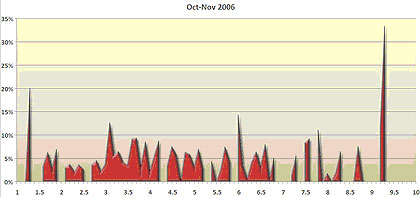
In the following chart, he tracks the click through per position.

Dainow
Brandt expected to see a chart that started high on the left, and tapered down as it moved to the right. But there seemed to be little correlation between position and click through. This runs counter to our eye tracking, which showed a strong correlation, primarily on first page visits. Top sponsored ads on Google received 2 to 3 times the click throughs.

enquirorank

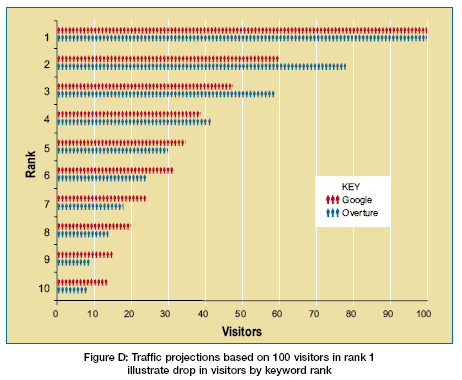
Further, Atlas OnePoint did some analysis from their data set, and similarly found a fairly high correlation between position and click through on Google and Overture/Yahoo.

atlasrank

So why the difference?

Well, here are a couple thoughts right off the bat. Dainow’s data is exclusively for his campaigns. We don’t see click through rates for the other listings, both paid and non-paid, on the page, so we can’t see how his ads stack up against others on the page. Also, it may be that for the campaigns in question, Brandt’s creative is more relevant than the other ads that show. He makes the point that creative is more important than position. I don’t necessarily agree completely. The two work together. The odds of being seen are substantially higher in the top spots, and your creative doesn’t work if it isn’t seen. The discriminating searcher that Dainow sees emerging who takes the time to read all the ads isn’t the searcher we see in eye tracking tests. That searcher quickly scans 3 to 4 listings, usually top sponsored and the top 1 or 2 organic listings and then makes their choice. This is not only true of our study, but the recent Microsoft one that just came out. Although Dainow’s charts over time certainly seem to show that position is less important, there could be a number of other factors contributing to this.

I will agree with Brandt though that if seen, relevant and compelling copy does make a huge difference in the click through rate of the ad. And for consumer researchers in particular, I still see search advertiser’s cranking out copy that’s not aligned to intent. But all the evidence I’ve seen points to much higher visibility, and hence, click throughs, in the top sponsored spots.

When looking at analysis like Brandt Dainow is presenting, you have to be aware of all the variables. In this case, I’d really like to know the following:

  • What were the keywords that made up the campaigns
  • What was the creative that was running for his clients
  • What was the creative the competition was running
  • What were the overall click throughs for the page

In doing the analysis, you really need to control for these variables before you can make valid conclusions. Some are ones we can know, others, like the overall click throughs, only the engines would know.

But Dainow is quick to point that his findings show the need for individual testing on a campaign by campaign basis. And in that, we’re in complete agreement. Our eye tracking tests and other research shows general patterns over common searches, and the patterns have been surprisingly consistent from study to study. It probably gives us as good idea as any what typical searcher behavior might be. But as I’ve said before, there is no such thing as typical behavior. Look at enough searches and an average, aggregate pattern emerges, but each search is different. It depends on searcher intent, it depends on the results and what shows on the page, it depends on the engines,  it depends on what searchers find on the other side of the click. All these things can dramatically affect a scan pattern. So while you might look to our studies or others as a starting point, we continually encourage you to use our findings to set up your own testing frameworks. Don’t take anything for granted. But that’s a message that often doesn’t get through. And my concern is that advertisers looking for a magic bullet will read Dainow’s conclusions highlighted at the top of this post and swallow them whole, without bothering to digest them. And there’s still far too many question marks about this analysis for anyone to do that. I’ve contacted Dainow to set up a chat so I can find out more. Hopefully we can shed more light on this question.

SEM’s Seven Year Itch, Part Two

First published January 18, 2007 in Mediapost’s Search Insider

There’s another controversy stirring in the SEM blogosphere, and this one is revolving around the very future of organic optimization, the yin to the paid yang of search. While this debate rears its head with predictable regularity every few years, there’s a different flavor to this one. This time, rather than an inter-industry turf war, it’s the search user that will ultimately decide the fate of SEO. And that opens up part two of SEM’s seven-year itch: what life will be like on the agency side.

A (Very) Quick History of SEM

First, a little back story. The search marketing industry has gone through one significant evolution since it began in 1996. Back then, it was a grassroots movement that started on the back of the popular search engines. More than a few have called that relationship parasitic. We worked to game the algorithmic results of Infoseek, Altavista, Lycos and Excite. We did it because there was no choice. At the time, the only way we could buy results page real estate was with terribly ineffective banners. Everybody knew that it was only the results that people looked at, and they were generating huge amounts of traffic. The higher the position, the more traffic we could expect. The organic optimization side of search has actually changed very little in the past decade. The techniques have become more sophisticated, on both sides, but it’s still all about driving listings higher for selected key phrases.

In 1998, the first reinvention of search marketing took place. Bill Gross introduced paid search through Goto, later Overture, and now Yahoo. Google followed suit in 2000. Suddenly, a whole new dimension opened up. Many moved to the paid side of search. Some remained resolutely on the organic side. And, over time, many search shops embraced both.

The introduction of paid search has been the most significant change in our industry. It has largely propelled search to where it is today. From the agency side, it demanded a whole new skill set, as we pioneered the fundamentals of bid management and, more recently, market segmentation, conversion tracking and robust testing. But one thing remained the same. Fundamentally, whether paid or free, it was still all about gaining the best real estate on the search results page.

Our Day will Come (We Hope)

Whatever side of the search marketing street we hung our shingle on, many things remained in common. We started small. We remained dedicated to search. We worked our butts off. We loved what we did. And very few of us got rich. But, we consoled ourselves, we’re part of the fastest-growing sector in marketing, and there’s got to be a payoff. We know search. Everybody searches. That’s got to be worth something. Now, many years later, we’re beginning to wonder.

The paths SEM shops chose to take have diverged over the past seven or eight years. Some have remained small, largely built around one or two skilled practitioners. Some have pursued growth and built scalable infrastructures, often fueled by eager venture capital investment trying to grab a piece of the search tidal wave. In the later case, positioning themselves for an acquisition was a common exit strategy. In a few cases this has worked, the iProspect/Isobar deal being the most notable example. In some, the inevitable stress, change of culture and diversion of focus ended up knocking the legs out from under the company. At one point, Websourced was one of the largest SEM firms in the industry. A few weeks ago, it effectively closed its doors, being absorbed into its parent, MarketSmart Interactive.

Pondering Our Future

Whatever path we chose, we’re all coming to the same crossroads. We’ve put in a lot of sweat equity, often at the expense of huge portions of our non-search lives. Unlike the early employees of the search engines (see last week’s column), we don’t have any stock options sitting in a drawer somewhere–or even the security of a regular paycheck. We’ve invested everything we have, both personally and financially, in nurturing our individual companies along, hoping that at some point, in some way, we could cash in that asset to finance the next phase of our lives, whatever that might be. Up to now, the ride has been so fun that we weren’t too concerned about getting off. But soon, we may have no choice.

The fact is, search marketing is on the cusp of reinventing itself again, and if the introduction of paid search in 1998 split the industry in half, this new incarnation will fragment it in a million pieces.

Next week, I’ll continue by exploring the next reinvention of search–and where that leaves SEM agencies.