ChaCha and the Search Tango

There’s a new crop of search interfaces coming out, many spin offs from the big engines themselves, and I’ll be trying to take a look at them from the user’s perspective. Today I took ChaCha for a spin. Here’s some background (and hype) from their About page

“ChaCha stands out as different and better in a landscape cluttered with common search engines because it uses the World’s most powerful technology – The human brain.

ChaCha’s goal is to provide a better search experience by combining results that are hand-picked by our knowledgeable human guides with the best computer-generated search results. In those cases where you can’t find what you need with our instant results, ChaCha will connect you with a live human guide who will find the information for you through an instant messaging-style search session.

Scott Jones and Brad Bostic, two dynamic entrepreneurs who were not satisfied with millions of irrelevant search results provided by first generation search engines, believed a better experience could be created by tapping into human intelligence. Since starting ChaCha, they have been hard at work with the ChaCha team to create:

  • A smart search engine that “learns” by tapping into human intelligence so its results are always improving
  • A place to find exactly what you’re looking for instantly
  • Help from people who are knowledgeable about the very thing you are looking for when instant results don’t have the answer “

Fellow Enquiro blogger Marina Garrison tried out Cha Cha and shared her thoughts. Here are mine. Unfortunately, there’s no good news here for the Cha Cha team.

“A Better Search Experience”

I started out by looking for hotels in Kauai. I used the default, automated search. At the same time, I did a search on Google for the same query. My intent was to compare my options, so I was looking for a link that would show me a number of properties. Google did pretty well, with both official and unofficial accommodation guides rounding out the top algorithmic results returned in the customary fraction of a second. Definitely something here I would click on.

Cha Cha’s automated results were far less satisfying.
  chachaorigsm

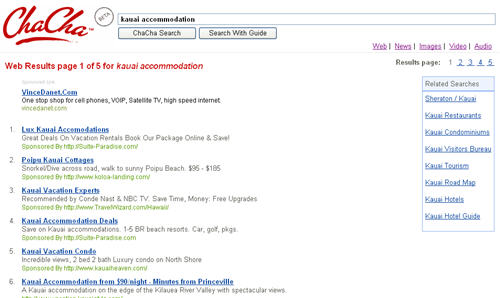
First, there was a sponsored link at the top, but no advertiser. That’s okay, it’s a beta, so I didn’t really expect one. But all the other results have a “sponsored by” line at the bottom. I’m confused. Are they sponsored links or not? Confusion is not good in a user experience. The results were mostly for individual properties, not very descriptive, and the same site showed twice in the top 4 results. The only guide I saw was well down on the top 10, and it wasn’t an official guide. The results weren’t really matched to my intent. Strike Two.  Once again, what was it that Cha Cha was offering?

ChaCha’s goal is to provide a better search experience by combining results that are hand-picked by our knowledgeable human guides with the best computer-generated search results.”

Oh..right. Okay, maybe I’ll try the “knowledgeable human guide” because after all, “it uses the World’s most powerful technology – The human brain”

I hit the search with guide button

The interface changed and opened up a pane on the left. There was a pause of at least 10 seconds while I waited to connect with a guide. In 10 seconds on Google, I’d have clicked off the page by now, but I’ll be patient. Finally I’m connected to DelaineL, who greeted me with a “Good Afternoon”. This despite I did this at 10 am local time. Hmmm..mental note for Scott and Brad, our “dynamic entrepreneuers”…you’ll have to work out that time change thing.

Now, I wasn’t sure what to do. Do they just pick up from the last query I did? There were no instructions I could see. I waited. Finally DelaineL sent me a “Hi!”. I guess I have to reenter my query in the message box. We’re approaching a minute now. I told Delaine (not sure whether this is a male or female Delaine) I was looking to compare hotels in Kauai. I wanted to be fair, giving my human guide a chance to give me the types of results I was looking for.

“Find exactly what you’re looking for instantly “

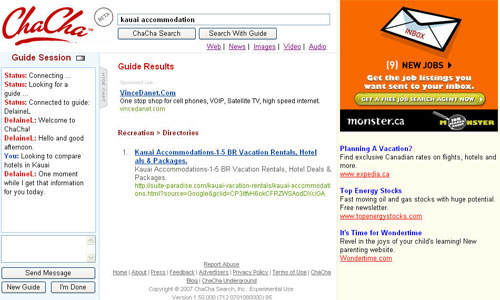
I was expecting a page of 10 results to pop right up. Instead, after many more seconds, I got one.
chacha1sm

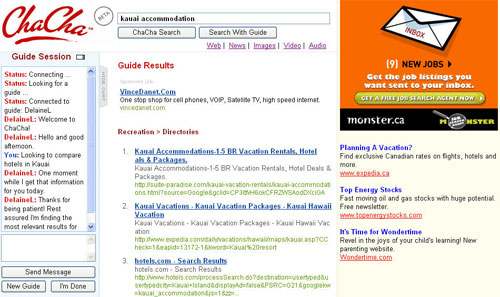
And it was for the same site that showed up twice in the top 4 organic results. This was the best that the “world’s most powerful technology” can do?  Also, the page they sent me was actually a landing page built for a Google Adwords campaign. Not really what I was looking for. So, was this the only result I was going to get? I asked my guide. I was told the second result was loading. When it came up, it was an Expedia search results page, along with an apology for the delay and the assurance that Delaine was looking for the most relevant results. The response sounded suspiciously canned though.
chacha2sm

I guess that’s what took the time, the guide went to Expedia and launched the search for me. I guess that’s good.

“People who are knowledgeable about the very thing you are looking for “

Okay, I’m sure Delaine is an excellent person, kind to kids and animals, and is probably an expert in many areas, but what makes him/her an expert on Kauai? How does Delaine know what I was searching for? Does ChaCha have a room full of people monitoring my initial search activity, and when I click on the guide button, a red light starts flashing and an announcement rings out at Cha Cha Headquarters, “Attention, we need a Kauai Expert on seach 1045..Stat!!” ? I somehow doubt it. Lets put the “knowledgeable” line down to more marketing spin.

Also, do we really want a human somewhere knowing what we’re searching for? I don’t think so. Most of us prefer to search anonymously, or at least what we think is anonymously (ignorance is bliss in this case, until we’re rudely awoken by a AOL debacle). I suppose if someone were really stuck, they would try their luck with a search guide, but based on my experience, it wouldn’t be something I would ever do again.

By this point, I had spent a good 2 or 3 minutes doing something that would take a few seconds on Google, and I didn’t get results any better than I would have received there. Sorry ChaCha, but you hit a sour note with me.

And now I go on my user experience diatribe. There’s obviously a lot of infrastructure behind Cha Cha. I have no idea how many human guides they have but to make this scalable (they say thousands), but it appears that they’re paid by the search. This is not a cheap start up. But this will undoubtedly fail. It offers no compelling reason to use it. It’s far inferior to other options that have established themselves with users. A little bit of research should have shown this. I’ve talked to a few people who have used it. None of them will ever use it again. I’m sure the people at ChaCha will say they had tremendous response from their initial tests. BS. If thats the response they got, they weren’t doing the tests correctly. This will be a waste of a lot of people’s time and some significant investment on somebody’s (apparently Jeff Bezos) part. And it could have been avoided with proper usability testing. There’s a lot wrong with ChaCha, and not much right. The interface is junky and clunky. It’s like a flashback to the dot com bubble.

If you’re going to Cha Cha, try not to step on your partner’s toes. I’m still limping.

Postscript

After the post, I ran across Rob Garner’s SearchInsider column from yesterday (obviously have to clean out my folders more often) on his experience with ChaCha. While not ideal, it seems Rob is more optimistic than I am:

“I would bet that they find a niche in the market with a loyal user base, and that we may see more innovation from them to come in the form of user interface, and/or behavioral research. “

I guess one thing ChaCha has going for it is the ability to get live user feedback, real time. I hope they listen.

Why No “Golden Triangle” in the Microsoft Eye Tracking Study

Over at Searchengineland, Danny Sullivan did a deeper dive into the Microsoft Eye Tracking Study that I posted about last Friday. In it, Danny said:

“Interesting, the pattern is different that the “golden triangle” that Enquiro has long talked about in its eye tracking studies, where you see all the red along the horizontal line of the top listing (indicating a lot of reading there), then less on the second listing, then less still as you move down. “

I just want to draw a few distinctions between the studies. In our study, we wanted to replicate typical search behavior as much as possible, so let people interact with actual results pages. In the Microsoft study, they were testing what would happen when the most relevant result was moved down the page and how searchers responded to different snippet lengths. The results, while actual results, were intercepted and were restructured in a way (i.e., stripping out sponsored ads) to let the researchers test different variables. We have said repeatedly that the Golden Triangle is not a constant, as is shown in our second study, but follows intent and the presentation of the search results.

In fact, the Microsoft study does confirm many of our findings, in the linear scanning of results, the scanning of groups of results and the importance of being in the top 5.

Another potential misconception that could be drawn from Danny’s interpretation of results is hard and fast rules about how many results searchers scan. He settled on the number five. When looking at eye tracking results, it’s vital to remember that there is no typical activity. Please don’t take an average and apply it as a rule of thumb. Averages, or aggregate heat maps, are just that. They’re what happens when you take a lot of different sessions, varying greatly, and mash them together. Scanning activity is highly dependent on the intent of the user and what appears on the search results page. A particularly relevant result in top sponsored, matched to the intent of the majority of users, would probably mean little scanning beyond the first or second organic result. On the other hand, if the query is more ambiguous, you could see scanning a lot deeper on the page. The Microsoft study used two tasks that would generate a limited number of queries, and recorded interactions based on this limited scope. Our studies, while using more tasks, still out of necessity represented the tiniest slice of possible interactions.

After looking at over a thousand sessions in the past 2 years, I’ve learned first hand that there are a lot of variables in scanning patterns and interactions with the search page. An eye tracking study provides clues, but no real answers. You have to take the results and try to extrapolate them beyond the scope of the study. We spent a lot of time doing this when writing up both our reports. You try to find universal behaviors and commonalities, but you have to be very careful not to accept the results at face value. Drawing conclusions such as snippet lengths should be longer or that official site tags should become standard are dangerous, because it’s not true for every search. The study actually found that ideal snippet length is highly dependent on the task and intent of the user.

If anything, what eye tracking has shown me is the need for more flexible search results, personalized to me and my intent at the time.

New Microsoft Eye Tracking Study

Microsoft has just released the results of an internal eye tracking study that looked at the impact of snippet length. For more detail, visit Marina Garrison’s blog where she looks at the notable findings.

msheatmapm

A few quick ones and some comments:

Snippet length doesn’t seem to impact people’s search strategies.

This makes sense to us. We found scanning for word patterns rather than actual reading. In fact, a longer snippet may actually detract from the user experience in certain scenarios, such as navigational search. It makes it more difficult to pick up information scent quickly. Remember, we’re on and off the search page as quickly as possible.

People scan 4 listings regardless

This is definitely aligned with the Rule of 3 (or 4) we found in our eye tracking study. We found, however, that this isn’t a hard and fast rule, but rather a pretty common tendency. It changes depending on whether top sponsored ads appeared, how closely aligned the top result was to intent and other factors. But in general, we would agree that most people tend to scan 3 or 4 listings before clicking on one.

Scenario Success Rates Dropped Dramatically as the “Best” Listing Moved Down the Page

No big surprise here. This was referred to in our first study as the “Google” Effect, and it comes from our being trained that best result should show up on top. I actually co-authored a paper with Dr. Bajaj and Dr. Wood at the University of Tulsa about this very topic. By the way, it was Dr. Bajaj that called it the “Google” Effect, not me, so please Yahoo and Microsoft, don’t beat me up on this one.

The report is available for download.

US Statistical Abstract: Time Well Spent?

The U.S. Census Bureau just released their new Statistical Abstact for 2007. In it, they predict the amount of time adults and teens will spend consuming media in various forms:

  • 65 days in front of the TV
  • 41 days listening to radio
  • A little over a week on the Internet in 2007
  • Adults will spend about a week reading a daily newspaper
  • Teens and adults will spend another week listening to recorded music
  • Consumer spending for media is forecasted to be $936.75 per person

What was interesting about this was noticing the gap that still exists between TV and Radio consumption and time spent on the Internet. To me, it’s indicative of the nature of engagement, at least for now.

According to these stats, we will spend 10X the amount of time in front of a television than we will spend in front of a computer cruising the Internet. The media release didn’t elaborate on the nature of time spent on the Internet. Does this mean work time as well?

Given these numbers, one can understand why the lion’s share of ad budgets still go to television, and I expect that TV sales execs will gleefully quote these given every possible opportunity. But consider the following:

  • The consumption of entertainment content online is in it’s infancy. Strike that, it’s actually embroyonic. If YouTube is the barometer of where we’re at, we have an immense way to go. All the hype about online video is still largely centered around viral growth amongst very early adopters who are watching amateur videos less than 3 minutes in length. It’s not the actual current  impact of online video that’s creating buzz, it’s the paradigm shifting that we have to do when we consider the democratization of content creation, the searchability of the digital format and the interactive possibilities that come with the online distribution channel.  All these things speak to a totally new experience. We’re just not there yet.
  • Think about the difference in your engagement level when you’re interacting with the Internet, as opposed to passively watching TV or listening to the radio. Think about how you respond to advertising messaging, especially when it’s relevant to the task you’re pursuing. The influence of this difference in engagement on consumers hasn’t been quantified yet, but at a gut level, we know it should be significant, probably a quantum leap in effectiveness. Actually, the numbers drive this home. In the research that’s been done on the impact of various channels on consumers, the Internet consistently ranks near the top, usually right after word of mouth, and much higher than television. And it has this impact with one tenth of the exposure time.
  • We need time to change our habits. Television watching has been ingrained in our daily routine for decades. Radio for a bit longer. Newspapers for centuries. The Internet is just celebrating its first decade as a widely accessible channel, and high speed access is less than 5 years old. Given that, the one week number is actually quite remarkable.

I’m sure these numbers will be quoted often, and spun in drastically different directions, depending on who’s doing the spinning. At first glance, my thought was “only one week?”. But as I thought about it, the numbers just emphasized the vast potential of online. What will be fascinating is to revisit this in a year’s time and see how these numbers change. In Internet terms, 12 months is an eternity.

No Real Surprises in the Latest iCrossing Study

iCrossing released the results of a new study conducted by Harris Interactive just before the holidays. The study looked at the role of online in the CPG market. A media release outlines the key findings, including:

  • Consumers look for CPG’s online, with 39% of US adults confirming they’ve conducted a search for CPG’s.
  • Women do this more than man. Footwear and apparel lead the categories searched for.
  • Online CPG searches often result in offline sales. Much of this activity is looking for sales or special offers at traditional bricks and mortar retail locations.
  • Activity is spread pretty evenly over search engines, retailer websites and manufacturer’s sites. Shopping engines and consumer information sites have substantially less traffic.

There are a few notable take aways here that speak to the future use of online. Most CPG’s have been slow to move to online as a marketing channel. The more commoditized the product, the less the online research activity, or so traditional marketing wisdom has told us. Certainly, CPG’s have been very slow to enter the search arena, yet the iCrossing study tells us that there is a significant portion of the consumer population are turning online to research these every day purchases.

To be honest, I think the study is probably underreporting the frequency of this. At Enquiro, we’re steering away from self reported survey based vehicles as a sole vehicle to look at search behavior, because we find that people have trouble recalling how often they use search and what they use it for. It’s become second nature for us to turn to online, and that in turn usually means search. So in a survey like the iCrossing one, memory lapses usually mean overly conservative numbers.

Another notable trend that would influence the findings are the increasing spread of high speed internet access. The likelihood of this CPG online activity happening is directly related to how handy a computer with an internet connection is. The more ubiquitous access is, the more we’ll do a quick look up on everything. About the only purchases I make now that I don’t do some form of online research about are groceries. And as local search becomes more robust, that will probably change too.

I’ve been predicting another surge of advertising dollars migrating into search over the next year or two. As we understand more how universal online research truly is, and how a lot of major advertisers are completely missing this very important touchpoint, more budget will find it’s way into search. While there are no real surprises in the iCrossing study, it’s good that major advertisers are continually reminded that they’re missing a rather large boat.

Year End Lists and the Stories They Tell

I was just putting a Search Insider column in the can for next week (it will run next Thursday) about the year end lists that are coming out of the various search engines and it brought up a few observations, together with a story that hit my desk about Google capturing 63% of searches.

First of all, the top ten lists. Here are the reported lists from each of the engines

Google Yahoo Microsoft
  1. Bebo
  2. Myspace
  3. World Cup
  4. Metacafe
  5. Radioblog
  6. Wikipedia
  7. Video
  8. Rebelde
  9. Mininova
  10. Wiki
  1. Britney Spears
  2. WWE
  3. Shakira
  4. Jessica Simpson
  5. Paris Hilton
  6. American Idol
  7. Beyonce Knowles
  8. Chris Brown
  9. Pamela Anderson
  10. Lindsay Lohan
  1. Ronaldinho
  2. Shakira
  3. Paris Hilton
  4. Britney Spears
  5. Harry Potter
  6. Eminem
  7. Pamela Anderson
  8. Hilary Duff
  9. Rebelde
  10. Angelina Jolie

First of all, I say reported because these aren’t actually the real top searches. Danny Sullivan had a good post pointing out the inconsistencies. These are filtered, sanitized and in Google’s case, apparently manipulated. The same could be true for the others, but unfortunately, they haven’t provided a tool like Google Trends that we can use to trip them up.

Be that as it may, it’s the comparison between them that holds the story that I touched on in the column, but would like to explore in greater depth.

Look at Google’s list. It’s obvious that people are using Google to interact with the web. They’re using it like a tool, to get to where they’re going. This becomes more apparent when we add the real top searches, the navigational queries that were filtered from the list.

googletrendsnav

People use Google to get to Yahoo, MSN..and even Google (okay, I’m still trying to figure that one out).

Look at Yahoo and Microsoft’s list. It’s the online equivalent of the trash tabloid section of the local magazine rack. These aren’t essential searches, these are fluff. It’s the searching you would do if you had time to kill. It’s the searching you would do if you had nothing better to do. It’s the searching you would do if you weren’t using Google for something useful.

I’m sure part of this comes from Yahoo and Microsoft’s portal roots. It speaks to a different philosophy towards search. Google aims to be the Web’s Swiss Army knife. It appears that Yahoo and Microsoft aspire to be the Entertainment Tonight of the Internet. When it comes to the Internet, Google is infrastructure, Yahoo and Microsoft are superstructure.

And that’s a fundamental issue for Yahoo and Microsoft. To win, or even hold their own in search, they have to offer tool-like utility. They have to live, breath and eat usability. They have to beat Google at Google’s own game. It’s not an easy task, and it’s getting harder every day. The latest numbers from Hitwise show they’re losing ground, not gaining it. According to the just released report, Google has a 62.79% share of searches for the 4 week period ending Dec. 16, compared to 21.9% for Yahoo and 9.28% for Microsoft. The number has been consistently trending up for Google, and trending down for the competition.

One last thing. Yahoo can say they focus on usability, but take a tour of the interface they put on their top 10. This would be enough to make Jakob Nielsen go postal. It’s one of the most irritating interfaces I’ve run into in a long time. It’s completely in Flash, launches with an irritating video clip, and makes you hunt around for the plain HTML version. I just know somewhere in Sunnyvale, there’s a team patting each other on the back for putting this thing together.

Stepping into the Did It/Web Guerrilla/Searchengineland Fray

I came in this morning, and what did I find? Another tempest stirring up in the blogosphere! Danny Sullivan, Kevin Lee and Greg Boyser have all waded in, so what the hell, I’ll dive in too.

First, a little history. Did It President David Pasternack started the whole deal sometime ago when he took a swipe at SEO, calling for it’s imminent death. I’m not going to elaborate, but for those of you interested, here are links to the original article, and a follow up article.

Now, Kevin Lee from Did It has written a ClickZ column, adding some clarity, but also predicting organic results being pushed below the fold because sponsored ads are more relevant. I’m going to set aside for a moment the SEO spamming question that Kevin raises. Greg and Danny do a pretty passionate job of defending SEO.

I’d like to speak from another perspective, the search user. There are a couple things that should be considered here.

First of all, contrary to Kevin’s point, just paying for an ad doesn’t make it relevant. That’s because the vast majority of marketers don’t consider the intent of the search user. They assume that everyone is ready to buy right now. That assumption is at least 85% wrong. Go ahead, do a search for any popular consumer product. I’ll bet the ads you see are talking about lowest prices, free shipping, guarantees and other hot button items that are aimed at a purchaser. But study after study shows that search engines are used primarily for product research, not purchase. The problem is that marketers have a very biased set of metrics they use to measure return. They measure ROI based on purchase, so when they test, these types of ads tend to pull the numbers they’re looking for. But the metrics aren’t capturing the full story. The 85% of users that are researching are basically ignored. No value is assigned to them. Until PPC marketers figure this out, they’re not doing the user any favors.

Our research shows that a very interesting interaction takes place with the researcher versus the purchaser in that Golden Triangle real estate. Both users look at the top sponsored ads when they appear. They both look at the organic listings. Frankly, there’s not a lot of difference between the scan patterns. But it’s where they click that makes the difference. When they’re ready to buy, based on a recent eye tracking study, about 45% click on top sponsored, and about 55% clicked on the top 1 or 2 organic links. Almost a 50/50 split, FOR THOSE THAT ARE READY TO PURCHASE. But when we look at the other 85%, the ones doing research, EVERYONE OF THEM clicked on the organic link. And in the test, the same site appeared in both spots, so relevancy of the destination was equal. As long as users want organic links, organic optimization continues to be important.

Look, David Pasternack can ring the funeral bell for organic all he wants, but the fact is, it’s not his call. It’s the user’s. Yahoo has actually done exactly what he and Kevin are predicting. They’ve moved organic down the page, jamming more sponsored on the top. Based on Did It’s comments, this should be good for the user, right? It should be more relevant, pushing the “spam” down below the fold. Wrong. Google kicked Yahoo’s ass in user experience in our latest study by every metric we looked at. And they’re definitely winning in the big picture, including stock prices. The difference. About 14% of Yahoo’s screen real estate (at 1024 by 768 pixels) was reserved for top organic. 33% of Google’s real estate went for top organic. You want more proof? Ask, back in the Ask Jeeves days, pushed organic totally off the page, doing exactly what Kevin and David call for and filling the top with sponsored. Take a look at Ask now. Organic is back above the fold. Spend some time talking to Ask usability lead Michael Ferguson about how the absence of organic worked out for them.

And it’s not that sponsored links provide a bad experience. Our study proves Kevin somewhat right. Top sponsored links, for commercial queries, delivered the highest success rates. But those were in highly structured and commercially oriented scenarios. That doesn’t represent all searches. It’s not that we avoid sponsored links, but we do want a choice and we want relevance, ALIGNED TO OUR CURRENT INTENT. Google has recognized that to a much greater extent than their competitors, and they’re eating their lunch.

There’s a reason why 70% of users choose organic. We’ve done a number of studies over the past 3 years, and that number has remained fairly constant.  It can’t be because those results are filled with spam. I actually just chatted with Marissa Mayer at Google, and she continually emphasized the importance of organic on the page. It’s a cardinal rule there that at least one organic result will always appear at 800 by 600. It’s mandated by Larry and Sergey. And that’s because they know it’s important to the user. We want alternatives. And we will be the judge of relevancy. That’s why Google has stringent click through measures on their top sponsored ads. If they don’t get clicked, they don’t show. The top of the Golden Triangle is reserved for the most relevant results, period, and in more than 50% of the cases, those are organic (either through OneBox or traditional organic).

So we in this industry can debate sponsored versus organic. We can make predictions. We can post in blogs til the cows (or frogs) come home. But it’s not our call. It’s not even the engine’s call. It’s the user’s.

The Coming Storm: Search and Consumer Privacy

First published November 9, 2006 in Mediapost’s Search Insider

Earlier this week, in OnlineSpin, Seana Mulcahy wrote about two new complaints filed by consumer groups with the Federal Trade Commission. The shadowy subjects of tracking online behavior, analytics and targeting are outlined in the complaints.

Earlier this year, in an interview, I predicted a showdown between search engines and consumers around privacy issues. I suspect these two complaints could be the harbinger of the coming storm.

The Natural Convergence of Search and Behavioral Targeting

It makes all kinds of sense for the worlds of search and behavioral targeting to overlap, and the conjunction of those two worlds is a very powerful place indeed for the marketer. Behavioral targeting allows you to track and target potential customers based on their click stream. You can identify promising click streams based on sites visited and behavior on those sites. The odds of picking the right person at the right time to receive your message go up substantially.

Now let’s look at search. At some point in the buying cycle, which is mirrored by the click stream, almost all consumers will turn to a search engine to look for more information. This is a rather momentous point. At the earliest occurrence, it often indicates when the consumer switches from awareness to consideration. It’s when they become actively engaged in the act of purchasing, which puts them in a whole new mindset. From that point forward, they could turn back to the search engine at different times to assist them in the purchase. The key is that consumers who are using a search engine are very receptive to information about the product or service, because they’ve requested that information. Push turns to pull.


The Challenge with Search

The problem with search right now is knowing where the consumer is–at which touch pointIs it early in the cycle, near the beginning of the consideration phase, when consumers are compiling candidates for their consideration set? Is it somewhere in the middle, when they’ve assembled their set and are comparing features or looking for reviews? Is it when they’re ready to purchase? It’s almost impossible to tell from the query, because as past comScore studies have shown, there is often not a search funnel. The same query could be used at each point in the cycle.

Given this inability to disambiguate intent from the query, most marketers aim for the sure bet. They go for the purchase, because it’s much easier to track conversions and ROI. Do a search right now on any engine for “digital cameras” and look at the sponsored ads that appear. I guarantee they’ll be aimed at someone ready to purchase. Is this the query you would use if you had done your research and were ready to purchase one specific model? Would you even buy online? Probably not. But it is the query you would use if you were starting to consider your options.

You’re not alone. The marketers on the results page are missing over 80% of potential buyers by focusing on the less than 5% who are ready to buy now. It’s just not a good match-up for the advertiser or the consumer.

Enter BT

Now, if you were able to combine behavioral targeting with that all- important search touch point, you could serve a research-based ad if you knew at what stage in the buying cycle the consumer was, based on his online visits. You could take the guesswork of matching the message to the person. And finally, we could start to pull away from the pure direct response tactics that restrict the effectiveness of search. It’s tremendously powerful.

This is not something in the far-distant future. The mechanisms are already in place for search engines to track your online behavior. Tool bars, mini apps, personal search history. All of these can and do track where you’ve been. Everybody is being tracked to some degree.

But as Seana pointed out in her column, most of us are blissfully unaware of it. That’s because it’s been relatively benign to this point. In return for a handy tool bar that offers increased convenience, the ability to index your desktop and other added functionality, we just click the accept button without really reading what we’re accepting. Up to now, there hasn’t seemed to be any consequences. But in the background, the engines are quietly collecting terabytes of click-stream data. And the time is coming when that data will be put to use.

Privacy Storm Front

At first, it will be subtle and a little unsettling. The search ads we’ll be seeing will be targeted much more precisely. They will seem to speak just to us. It will be like the advertiser is reading our mind. We’ll be thrilled at first, but eventually, we’ll read an article somewhere that will explain the uncanny ability of the advertiser to give us just the right message. It’s because they’ve been watching us, tracking what we do online. And it won’t just be on search, it will be throughout the search engine’s advertising networks.

“Hmmm” you’ll say to yourself, “I’m not sure I’m okay with that.”

More and more consumer groups will launch protests. Politicians will sense opportunity and jump on their soapboxes. There will be a very vocal minority that will rail against this “Big Brotherism.” There will also be a group of advertisers that will continue to step way beyond the acceptable, using targeting to subvert the user experience, rather than enhance it, hijacking the user and taking them to places they never intended. This will add fuel to the fire. And because they’re the most visible target, the search engines will bear the brunt of the attack.

In the end, we’ll realize there’s much more pro than con here. Effective targeting will generally add to our experience, not take away from it. We’ll toy with trying to use a third-party privacy filter, but in the end, most of us won’t be willing to give up the additional functionality in return for maintaining an illusion of anonymity online. Much of the usefulness of Web 2.0 (I know, I hate the term too, but at least it’s commonly understood) will be dependent on capturing personal and click-stream data. We’ll give in, and the storm will gradually fade away on the horizon.

At least, that’s my prediction.

Thou Shalt Not Google (unless it’s on Google)

First published November 2, 2006 in Mediapost’s Search Insider

goo-gle: Function: transitive verb: to use the Google search engine to obtain information about (as a person) on the World Wide Web
Merriam-Webster Online Dictionary.
Of all the things that Google’s lawyers have in their basket, apparently stamping out inappropriate use of “Google” as a verb is right on top of the stack. It apparently irks them no end.Now, I can really sympathize here. It’s a little known fact that my last name has actually suffered the same fate as Google. In Japan, of all places, Hotchkiss has become the generic name for the office stapler. Each time a worker lost in the maze of cubicles at Mitsui and Co. says, “Pass me the Hotchkiss” I die a little inside. I kid you not! Check out Wikipedia.Mind your Ps and GooglesNow, according to a post on Google’s official blog, it’s not the fact that we Google on Google that causes the Google legal department to have hissy fits. It’s if we try Googling on Yahoo and MSN. It can’t be done. Not all tissue papers are Kleenex, not all copy machines are Xeroxes. To quote the post:

You can only “Google” on the Google search engine. If you absolutely must use one of our competitors, please feel free to “search” on Yahoo or any other search engine.

Hmmm..people are using the word “Google” to refer to Google’s competitors, and it’s Google that’s upset? Unless I’m missing something here, shouldn’t it be Yahoo and MSN that should be miffed?

I Google, therefore I am…

The inclusion of Google in the English lexicon is “faintly unsettling,” according to the folks at Google. They fear that Google will lose its identity as a trademark once it slips into common usage. They explain:

A trademark is a word, name, symbol or device that identifies a particular company’s products or services. Google is a trademark identifying Google Inc. and our search technology and services. While we’re pleased that so many people think of us when they think of searching the web, let’s face it, we do have a brand to protect, so we’d like to make clear that you should please only use “Google” when you’re actually referring to Google Inc. and our services.

Now, I know that Google has way too much money, and they have a team of very bright 12-year-old lawyers (or at least, they look 12) trying to reinvent the law. But in this case, I would suggest slipping down to the Google cafeteria for a double decaf low fat cappuccino and relaxing. There are better windmills to tilt at than this one.

Once again, who’s in control?

The irony here is that the very entity that has probably done more than any other to put control in the hands of the consumer is now fretting because consumers are exercising that control. We associate search with Google. We endorse the brand by using it as a verb. It’s just this critical mass that makes Google such a formidable competitor in the highly promising search market. Frankly, it’s not the fact that their brands became generic terms that hurt many of the companies that Google uses as examples. It’s because the companies became complacent and let the competition catch up, losing the distinction that their brand once afforded them. The consumers didn’t take the brand away from the company, the company surrendered the brand to the competition.

In the corporate culture that says “don’t be evil,” apparently improper use of “Googling” is now defined as evil. Just to make it clear, Merriam-Webster defines evil as “morally reprehensible.”.  Perhaps someday “google” will also mean “to spend one’s time unproductively fighting frivolous legal battles.” At this point, it’s a toss-up with “disney.”

A final word to Google’s legal team: As you’re putting together those multi-page lawsuits, go ahead and feel free to use the Hotchkiss. I don’t mind.

What Happens when the Whole World Becomes Searchable?

First published September 21, 2006 in Mediapost’s Search Insider

There are a few items that crossed the threshold of my inbox recently that led me to speculate about search in the grand scheme of things.

First of all, fellow Search Insider David Berkowitz talked about online data storage, and how it could introduce reams of new content into online depositories, there to be connected to by consumers through search.

Secondly, Apple and Google are in talks about iTV, Apple’s new set-top box that allows you to view downloaded video on your TV, at the same time making it searchable.

Welcome to e-World

The fact is, the whole world is becoming digitized and indexable. It’s not a new trend, it’s been making inroads for the last two and a half decades, but there seems to be a tipping point of convergence that’s rapidly approaching. National and international news is almost fully digitized, and local news is following in the same footsteps. There are now digital editions of most periodicals. And Google is doing its level best to digitize every book ever written. So the print world is well on the way.

The Genetics of Music

For electronic media, music is largely in the digital domain, and the searchability of it is rapidly improving. The biggest bottleneck is in trying to categorize and rationalize what is largely a subjective experience. I either like music or I don’t. How do you make that searchable? Well, interestingly, Pandora’s Music Genome Project is trying to do just that. Since 2000, it has analyzed hundreds of thousands of songs based on over 400 attributes or “genes” (hence the Genome moniker) which include melody, harmony, rhythm, instrumentation, singing styles, lyrics and arrangements, to name just a few. It’s a large-scale attempt to make music searchable by something other than genre, artist or title, which is far too limiting for most of us. The Pandora interface, in its attempt to be intuitive, doesn’t allow for power searching, but it’s still a quantum leap forward in allowing us to help define our likes and dislikes in the musical universe.

What You See is What You Search

If you take this same approach to video entertainment, there is a much more complex, and therefore richer, content depository to mine. Think of the universe of movies, TV shows and documentaries that exists, each loaded with dialogue, topicality, visuals and styles. As complex as music can be, video explodes the content to be categorized and analyzed in a dozen different directions. It provides a huge indexing challenge, but therein lies the promise and profitability. And it appears to be a challenge that Google is ready to take on. Of course, we haven’t even touched on aspects like consumer-generated video content (the YouTubes of the world, which seems to be the latest overladen bandwagon) and social tagging.

We’ve Only Just Begun…

But that’s the globally visible world, the tip of an immensely large iceberg. There is very little in our physical world now that isn’t digitized somewhere. There is a virtual mirror for almost every physical presence. Store inventories exist in the digital domain, and have for some time. Aggregating those inventories and making them searchable turns the entire world into your personal shopping mall. We leave GPS trails as we move from point A to B. Our vehicles churn out detailed performance summaries via the onboard computer as we do so. Mobile computing makes the very stuff of our personal lives; our thoughts, our activities, our appointments, our contacts, all digital and indexable. At work and at school, we all produce content on a daily basis. My daughters are content producers each time they do homework, and increasingly, that work is in bits and bytes.

As the barriers disappear between our hard drive and the Net (the subject of David’s column) all this content theoretically can enter the public domain and be searchable. Increasingly, the question we ask ourselves is “where do I draw the line between my private and my online world?” File sharing becomes a substantially bigger deal.

Brain Melting Questions

Fellow blogger Mitch Joel calls these kind of questions “brain melters.” I like that. It captures the mind-numbing aspects of this stuff. Our electronic footprint is now bigger, and in some ways more real, than our physical one. There is this vast binary universe out there, terabyte after terabyte of data that grows each and every second, capturing the essence of who we are and what we do. And the sole door to that world, the channel we all must pass through to gain entry, is search. In the act of searching, we connect to that universe.

Cast the search question in that light. Realize that we have yet to scratch the vast potential of this fundamental glue that holds the Internet together and bonds us to it. Imagine owning the solitary access point to everything!

Google, Yahoo and Microsoft are jockeying for position to do just that. It should excite the hell out of their respective shareholders, but it should scare the hell out of us. Do we really want this much power in the hands of so few?

These are big questions, and I’d love to get your viewpoint. Leave your thoughts on the Search Insider blog, or drop me an email at gord@enquiro.com.