Notes from China

First published May 31, 2007 in Mediapost’s Search Insider

I let Chris Sherman convince me that if I had to choose one overseas show this year, it should be SES China in Xiamen. Part of me is thanking Chris, and part of me is cursing the hell out of him. To be fair, he warned me that this is a cultural shock of significant magnitude. He was right.

I’ll leave the personal observations for my blog. One of the reasons I came was that I knew this was the most important online market in the world, and I had to dip my toe in for myself. For that, I do have to thank Chris. A few weeks ago I was in Florida for the Search Insider Summit, and made a note of some advice Esther Dyson passed in the keynote presentation to the ersatz “Bill Gates” (played by David Vise): “Make sure your kids learn Mandarin.” Xie Xie (thank you), Esther. You’re absolutely right.

Big, But Just Beginning

Let me give you some sense of the magnitude of this market. Right now, the Chinese Internet market is the second largest in the world, only a whisker behind the U.S.: 150 million users to the U.S.’154 million. But the U.S has 68% penetration. That 150 million represents only about 10% of the Chinese market. At full saturation, the Chinese market will be almost seven times as large as that of the U.S.

But don’t make the mistake of projecting the U.S. experience onto the emerging Chinese market. Chinese culture is vastly different from ours, and their online community reflects this difference. For one thing, much of the Chinese online experience will likely happen through mobile devices, since the mobile market is much more mature here. While the number of Internet subscribers is 150 million, the number of cell phone subscribers is significantly higher, nearly 500 million (as of October, 2006) and is growing at the rate of 5.5 million subscribers per month. For another, the Sino mind just clicks at a different speed than ours.

Hot and Noisy Online

One of my favorite phrases I’ve learned while here was renao, which loosely translates into “hot and noisy.” It was explained to me by Deborah Fallows from the PEW Internet Group, an U.S. ex-pat living in Shanghai for two years with her husband, author and journalist Jim Fallows. It sums up so much of what I’ve seen here. The Chinese like to be bombarded by visual stimuli. They operate at a frenetic pace, juggling several things at once, each loudly demanding attention. Some look at this as a lack of maturity in the Asian market. Western eyes see Chinese Web sites as garish, and we think this is because the designers aren’t very sophisticated yet. Perhaps it’s just designers catering to their audience, who like it “hot and noisy.”

Savoring Information

The other difference is how Western cultures treat information, compared to the Chinese. In the West, information is in no short supply, and for the most part, we inherently trust the source of that information. We believe most things we read online to be true. Our biggest challenge is to wade through the mountain of information available to us and to eliminate the irrelevant. The Chinese treasure information yet have a healthy skepticism as to its veracity. While Western Web users are ruthless in their filtering of information, particularly on a search page, the Chinese are more apt to gather and consider, taking time to digest and choose. They often have multiple windows open at the same time, both as a way to keep busy with the slower load times typical in China, and also because they like their desktop “hot and noisy.”

Keeping an Eye on the Market

One of the reasons I was here was to share preliminary findings from an eye-tracking study we did with Chinese users on the two main Chinese search properties, Baidu and Google.cn. This difference in user behavior became very apparent in the study. In North America, the average interaction with a search results page, from launch to first click, is generally less than 10 seconds. In the Chinese study, we saw averages of 30 seconds on Google and up to a minute on Baidu. While North American scan activity is condensed in the Golden Triangle, in China, it’s spread around the page.

It’s fascinating to watch an individual session. The eye zips around the page, picking up information in an apparently haphazard manner. Baidu has been taken to task for the opaque nature of its listings, where you can pay for placement. The results are also much more prone to affiliate spam (on both engines, but particularly Baidu) than we see in North America. But the Chinese don’t mind. Baidu has captured 62% of the search market here, compared to 20% for Google. After all, lack of trust in information is nothing new to the Chinese. Why should it be any different on a search engine?

Everyone I’ve talked to here agrees. This is a market ready to explode. Innovation is happening organically and at an incredibly rapid pace. The development cycle to turn out new functionality on Chinese sites is 30% to 50% as long as their North-American-based rivals. As somebody told me, “In China, you point, shoot and then aim. Deliberation will kill you here.”

This is a lesson Google is learning the hard way. Chris noted that the level of sophistication has increased immensely from the last trade show here, in 2006. The Chinese Internet market is like a Beijing taxi: there may be no logic to its route, but it’s sure getting to wherever it’s going in a hurry!

Logging in from China – Part IV

I’ll soon be on NW 08 back home (well, technically, Seattle, but close enough). Beijing proved to be less frantic that I expected. It was certainly intense by North American standards, but it almost peaceful compared to the chaos of Xiamen.

This is definitely a city that’s preparing to welcome the world. That becomes apparent even upon landing. Two huge new terminals are being built at the airport. These are massive buildings that run forever along the existing runway.

My visit to Beijing was limited to what could be seen in one day. Chris (Sherman) and I had planned to spend a rather full day seeing as much as we could. We got to the hotel in the evening and both agreed that we weren’t prepared to hit the town quite yet. We opted instead for the hotel’s own uninspiring but adequate buffet. The consolation was that included unlimited, serve yourself draught beer. Now, this is an idea that should be adopted by the west!

Our hotel was the Prime, about a 20 minute walk from Tiananmen Square and Forbidden City. The western chain hotels in the area were more than twice the price and the Prime was rated fairly well in TripAdvisor, so I thought it should be adequate for a couple of nights. It was no Sheraton. Even when I cranked the air conditioning to full, the barest whisper of air could be felt coming out of the crate. The air in the room was about a dead as the Ming dynasty. The place was inundated with German tourists and the service was decidedly indifferent, after the almost fawning approach I found at the Sheraton in Xiamen. It wasn’t a disaster, but this is probably the first time that I found a TripAdvisor rating perhaps a little too high. I’ll try to remember to post a comment to this effect.

Early the next morning, after a picturesque sunrise that unfortunately was made more colorful due to the thick layer of smog perpetually hanging over Beijing, we negotiated with a taxi to take us to the Great Wall at Badaling and then back into the city to drop us off at the Forbidden city. We got to the Great Wall in good time and missed the worst of the crowds. Word of advice. Don’t go to this location of the Great Wall in the middle of the day. You’ll be fighting crowds the whole way.

From the parking lot, we had two choices. We could go explore the Wall to the east or west. On the west side, the Wall climbed at a near vertical angle up the Jungdo pass high to the mountain above. On the other side, the Wall climbed at a much more leisurely angle up the other side of the pass. Chris and I are two middle aged guys that are letting youth go reluctantly, so of course we chose the more vertical of the two options. Beside, we reasoned, the view at the top will be better.

First, let me say the Wall was amazing. As we climbed, the views were spectacular in every direction, with terraced mountain sides towering over the river and temples below, with small lookout towers and temples dotting the mountain side above us. But this is no westernized tourist experience. This is slogging up uneven stone steps, some a few inches in height, some over a foot, sometimes with no handrails, squeezing past picture takers and those that just need to catch their breath. In each watchtower, there were treacherously narrow steps leading to the top lookout. In some cases, the steps were so warn you had to precariously try to find a foothold on either side. This would never be open to the public in the west, the liability exposure would just be too great.

We made it to the top, after climbing up well over a 1000 feet, step by step, and were rewarded with a spectacular view. Another group reached the top at about the same time and we asked one of the group if they could take a picture of Chris and I. They in turn asked us to take a picture of them. They asked where we were from and what we did. Every time I’m asked what I do, I never know exactly what to answer. Search engine marketer is too obscure for most people’s frame of reference. So when Chris mentioned he was a search marketing consultant, I expected the typical glazed over response and polite nod, indicating the person was thinking, “I don’t know what the hell that is and I really don’t want to know.” Therefore, I was surprised when the group grinned and one of them said, “Do you know who this group is?” We had climbed up the wall with a group of Google engineers from Mountain View, who were in China for a joint workshop with a bunch of their Chinese counterparts. What the hell are the chances?

After the Great Wall and a quick visit to the temples at the foot of the pass, we met up again with our taxi driver and headed back into Beijing to the Forbidden City. The immense scale of the place defies imagination. The palace is in full restoration mode for the Olympics, and the difference between the weathered and grime encrusted non restored buildings and the freshly restored ones were amazing. Two of the bigger palaces were completely shrouded in scaffolding, so we couldn’t see them. Just as well, because the day and the previous climb was starting to catch up with both of us by this point anyway. We exited into Tiananmen square, were suitably impressed by the vast expanse of the space and the monolithic architecture of the surrounding public buildings(why is it that the more repressive the regime, the less imaginative their architecture?) and then decided to try to find our way back to the hotel.

Our hotel was on Wangfujing Road, which Chris assured me just one year ago was a major thoroughfare. Today, it’s being transformed into a pedestrian mall. This served as an example of how Beijing, and China at large, is being transformed for 2008. There was an army of workers, basically ripping up the old road top and replacing it with tiles. There was almost no equipment in sight, other than the odd ancient air compressor and portable generator wheezing away. The work had been done by pick axe, shovel and sweat. You throw enough people at a project and it’s amazing what can get done. The coincidence of the historic tie to the Great Wall and the amazing work that went into it two thousand years ago was not lost on us.

After our own “long march” we made it back to the hotel and both collapsed for a couple of hours. Then, we rendezvoused and headed to out to dinner at Quanjude Roast Duck Restaurant, the home of the original Peking Duck. This restaurant is famous in Beijing and is on the “must stop” list of many visiting celebrities and dignitaries. We fit into neither of these categories and so were ushered to the fourth floor, which I suspect was reserved for all the westerners who don’t know what they’re doing. We ordered the Masterwork, a full duck, along with some accompanying soup, rice and greens.

The duck emerged on a cart and was brought to our table, accompanied by a skilled carver who soon masterfully sliced off every scrap of meat, leaving nothing but a picked clean carcass. The thinly sliced duck was given to us, accompanied by thin pancakes (almost resembling a tortilla) and condiments. We were given a quick lesson on how to wrap the duck into small little bundles. Our instructor used chopsticks and made it look much too easy. After the first attempt we both gave up and used our hands. This is probably why we were sent to the fourth floor, reserved for the “Peking Duck” challenged. Saves embarrassing yourself in front of the locals. Despite the awkward preparation, the food was amazing, washed down with the ubiquitous and very cheap Chinese beer. A cultural experience and a great dinner, for less than $50 US for the two of us. A bargain!

After dinner, we hit Wangfujing Road again for the walk back to the hotel, just a few blocks away. Our construction crew was still hard at it, at 11 at night. In fact, the pace in the street was more frenetic that it had been that afternoon when we were there.

The visit to Beijing was a perfect end cap to an unforgettable trip. I won’t bore you anymore with how amazed/dumbfounded/assaulted I was with China. It was important to be here. It’s important for anyone from the West to make their way here. It’s the emerging Yin to the western Yang and will form a very powerful counterpart to the historic western world dominance. I will never understand the market, the people or the culture, nor should I. It’s not really for me to understand. I was glad to experience it, even just for a week. In chatting with Chris over our decimated duck, as little as I know, I’m probably still ahead of 99% of other westerners. You can’t get a sense of China unless you’re here. There’s no way you can do this at arm’s length. It’s an immersive experience.

I know I’ll be back. And it’s not the romantic return I envision to Europe, where the culture beckons on a very emotional level. It’s an inevitability. The market is too important, the tide is irresistible. No matter what you choose to do or where you choose to do it, to be successful, your path and China must inevitability cross. And on my return, I’ll have all the mixed feelings I currently do about the country and its people.

Logging in from China – Part III

“How did you like China?”

Knowing I have less than 48 hours left in the country, I’m just beginning to prepare my answer to the inevitable question. But there is no easy answer. You see, you can’t “like” China. Like implies a relatively calm and detached, non-committal response, a distant discernment that you have some control over. You can experience China or survive China. You can be amazed by, immersed in, assaulted or befuddled by China. You can be bemused, disgusted or delighted by China. Often, you can experience all of these things at the same time. China is a tidal wave, a sensory explosion, a cultural monsoon. You don’t just “like” it. You live it, and try to figure out the impact afterwards.

I knew participating in SES China would be interesting. It proved to be more than I ever imagined. One of my favorite things was meeting Deb and Jim Fallows, two US ex-pats who are making Shanghai home for two years. Jim is a noted author and journalist for The Atlantic. Deb works with the PEW Internet Project. Together they decided to dive into the incredibly deep pool that is China and try to provide some perspective for their US audience. I naively asked how they were finding the experience. Each, independently, gave the same answer. “Some days I don’t think I’ll make it through to lunch, and some days I think two years won’t be nearly long enough”. Check out Deb’s one week journal she wrote for Slate and Jim’s website. It will give you a tiny glimpse of China, through worldly but still western eyes.

There’s a lot here to digest. Part of me (admittedly a very small part of me) is intrigued by taking the dive myself and following in the Fallow’s footsteps. There is an incredible market emerging, and one feels that you have to try to get your bearings relative to it or you may be missing something of tremendous importance. But I fear that once you started down this path, it would be all consuming. I’m not sure I’d emerge intact. Most of me wants to run for home and try to digest all that I’ve heard, seen and experienced.

One of the stats I quoted in my presentation was that China is now the second largest internet market in the world, at 150 million users, just slightly behind the US at 154 million. But that represents 68% market penetration for the US, and slightly more than 10% for China. I was here presenting the results of an eye tracking study we did on Chinese users interacting with Baidu.com and Google.cn. The results were puzzling, but I found that permanent puzzlement is the norm here, at least as far as westerners go. By the standards we would apply to North American engines, Google offered a significantly better user experience, but Baidu’s market share is 62%, compared to Google’s 20%. And the trends are not moving in Google’s favor. China has chosen Baidu, even though Google may be the more logical choice. Logic is only one of the factors at play here, and it’s a relatively minor one at that. Searching in China is a totally different experience than it is in the US. We use search as a tool. China uses it as a window to the online world. They spend more time on the search results page. Way more time. The average time on a search results page in North America before a click is less than 10 seconds. The average time we saw on Google China was 30 seconds, and on Baidu, almost a full minute. In North America, we tend to very quickly scan a few results, looking for signs of relevance. In China, the entire listing is scanned, and in Baidu’s case, the entire page is scanned. I interpreted this as a less successful user experience. One person who came up to me after the presentation offered another interpretation: this was how the Chinese spend their time online. In North America, information is something to be begrudgingly waded through. In China, information is treasured. We tend to scan and discard the irrelevant quickly. The Chinese like to savor information, to digest it more slowly, to take the time to judge the relevance for themselves. Remember, in the west, we have a lot more trust (sometimes that trust may be misguided, ironically the topic of one of Jim Fallow’s books) in our information sources. The Chinese have learned differently through experience.

Also, in North America our interactions with the search results page are linear, logical and efficient. We zero in on what we’re looking for quickly. The Chinese tend to pick up the information in a pattern that would seem haphazard to us. Eyes dart around the page, scanning here and there. This didn’t make sense to me until I went to China. Now, in the appropriate cultural context, it makes perfect sense. Deb Fallows told me there’s a phrase in China, renao, that, loosely translated, means “hot and noisy”. That’s how the Chinese like it. Explosions of stimuli, amounting to what we in the West would consider an assault on our senses. When you translate this to a search experience, it’s a frenetic scanning of the page. Sure, Baidu’s page is loaded with affiliate spam and pay for placement links. Sure you have to dig deeper and take twice as long to find what you’re looking for. But that’s okay, because time on the internet is valued highly here. Maybe, just maybe, Google is too efficient for its own good in this market. We’ll be publishing the full study soon (mid June is the optimistic date).

This morning, I had my own taste of “hot and noisy”. Chris Sherman and I were to catch the ferry over the Gulangyu, an island highly touted as the favored tourist attraction here (this is a link to a virtual tour that you, like I, will have to be satisfied with for now). But with limited time available (our flight to Beijing was leaving at 1:30 pm) we decided to instead just randomly wander the streets in the vicinity. It proved to be a good choice. The ferry terminal was on the main drag, and on the opposite side was the inevitable stretch of newly erected high rises. Throw in a McDonalds and Pizza Hut for good measure. But just a block further in, we found the real Xiamen. We found ourselves in the middle of a traditional Chinese street market that stretched for blocks. There was not another westerner in sight, as we walked past stall after stall. If it walked, crawled, slithered, hopped, swam or grew anywhere in the vicinity, it could be found here. My wife, Jill, is deathly afraid of frogs. As we were wandering, I saw frogs for sale by the bag. The thing was, they were still alive, packaged in netted bags about the size of a small shopping bag. There were probably 12 or so large frogs in each bag. There was food of every description, live and dead, including a rather large carcass of some kind that was being energetically hacked to bits by a petite woman with a huge cleaver. And there was no refrigeration in sight. Eel and squid lay right next to cookies and biscuits. While it was a sight to see, it did nothing to whet my appetite.

Now, I’m on the plane to Beijing. From everything I’ve been told, my immersion into China has been extraordinarily gentle to this point. Xiamen is, according to one guide book, “the softest of landings into China”. Beijing represents “hot and noisy” at it’s most frenetic. I’m preparing myself. I’ve got somewhere around 40 hours left before I board the plane back home. I’m both treasuring the time left and dreading it. I can sympathize completely with Deb and Jim Fallows. I’m not sure I’ll make it to dinner tonight, but I also hate to leave.

“How did I like China?”

That’s like saying “how do you like being alive?”.  It’s just too big a concept to be adequately covered by such a small question.

Logging in from China – Part II

My first experience in Mainland China was an awe inspiring cab ride from Xiamen airport to my hotel, and I mean awe in it’s archaic sense: the power to inspire dread. It’s not that I hadn’t been warned. But I had exactly one option to get from point a to point b, and that option was an impossibly dilapitated vehicle, painted a brilliant shade of mauve, with matching seat covers, that loudly proclaimed to the world that it was a taxi, in big block letters 2 feet high painted on it’s hood. i admired it’s positive affirmation of it’s profession, even if it looked a little under qualified for the job.

I climbed in, gave the driver my printed sheet of directions (thanks to my friend Pavan Lee at Microsoft. Pavan, your translations have already saved my butt a number of times) and before I had a chance to settle back in my mauve chariot, we had screamed away from the taxi stand and had entered the melee that is Xiamen traffic.

This experience had been described to me, but the description did no justice to the reality. I know my attempt will likewise fall far short, but I’ll give it a shot anyway. First, it was night and pouring rain, so visibility was minimal. There were roads, lane markers and traffic lights, but other than to lend justification to the job of some traffic control bureacrat somewhere, they seemed to serve no other purpose. The traffic lights were a complete puzzle to me, with blinking red, green and blue lights spread in random patterns, with no indicators of what they might mean. The cab weaved back and forth across the entire width of the road, often running down the lane marker itself, cutting in front of vehicles, then being cut off in turn, always accompanied by blast of horn. Bikes appeared out of nowhere, often carrying two passengers and assorted baggage, all wrapped in plastic in a futile attempt to stay dry. And the bikes came from every direction, then took off in every direction. It seems that riding a bike in China makes you invincible, because these riders were obviously not concerned for their safety. It was one gigantic game of chicken, involving everyone in Xiamen, and the loser would be the first to back down. It’s probably a blessing that my senses were dulled from the flight in, otherwise I would have been cowering on the floor. But apparently, it could have been worse. I was chatting with Chris Sherman, and on his ride in from the airport, he got caught in a traffic jam that was irritating the hell of out everyone, and they were making their displeasure known. Obviously, something was obstructing traffic ahead, and drivers were hitting new heights of aggressiveness, trying to get past the blockage. Finally, Chris’s taxi pulled even with the obstruction and he got a chance to see what it was. It was an old man, who had the unmitigated gall to get in the way of a car, which hit him and left him sitting injured in the middle of the road, bleeding profusely from his head. No one was offering assistance to the old man, who just sat and rocked back and forth, holding his head. The biggest concern of all drivers was navigating past the unplanned delay.

I recount this experience, because with some time to reflect on it, I realize my cab ride (hopefully not Chris’s) was somehow symbolic of China itself. It’s an ancient vehicle, going at breakneck pace to an undetermined but vitally important destination, with no apparent plan or directions to guide it. It doesn’t so much matter where you end up, as long as you get there quickly.

I’ve been struggling to put into words my impressions of this place. This is a culture of immense complexity and contradiction that defies the attempts of the western mind to define it. My brain is a linear thing, that tends to value unambiguity and clarity. In China, my brain is on overload. Everywhere I turn, there is contradiction and schizophrenic bipolarity. There is an explosion of stimuli and activity, of signals that are often diametrically opposed, of monumental ambition and dense cultural (and governmental) restriction.

Here are just a few of the contradictions I’ve noted in the last 48 hours.

Inside my hotel, which is a beautiful 5 star Sheraton, all glass, polished wood and gleaming tile, the service is deferential and gracious to the point of near embarassement. I walked out of the fitness club yesterday and suddenly the girl at the front desk bolted upright and started running after me. I thought I must have forgotten to do something or had left something behind. I stopped as she shot past me and lunged for the elevator button. She was just sending me on my way back to my room. But should I step foot out the front door, and not pay complete attention on the busy street in front of the hotel, I would be run over without a second thought. There is no consideration for pedestrians here.

Just down the street from my hotel is a huge shopping complex, complete with a WalMart’s, McDonald’s and Pizza Hut. Western brands like Levi’s, LaCoste and Esprit are prominently displayed. It’s a temple built to consumerism at it’s extreme, with prices comparable to what I would find back in Canada. In Canada, the average yearly salary is probably around $45,000. In China, in the cities it’s about $1000 and in the country, $300. The gap between the rich and the poor in China is widening every day.

From my hotel, I can’t access sites like Wikipedia, yet Xiamen is a hot bed of domain registration and unabashed online entrepreneurialism that definitely crosses into some pretty grey territory.

Monolithic structures are being erected everywhere, as the government continues a full scale campaign to scrub China’s dirty underbelly and erect a new, gleaming showpiece of affluence and modernism. But the showpieces are being built to cater to an peculiarly eastern view of western ideals, big, glitzy and screamingly commercial. It’s as if somebody Feng Shuied (Feng Shui is officially illegal here, by the way) Las Vegas. And in the process, many reminders of one of the world’s oldest civilizations are being erased.

That’s just a few. Literally, cultural contradictions are everywhere here. But perhaps it’s not a problem. China has lived with complexity for thousands of years. For the Chinese, it’s business as usual. It’s only the western mind that tries to impose clarity where none may be required. China is a vast, dense and vibrant organism, a society of immense ambition and near unlimited resource. For now, they picture the affluent west as the ideal to be obtained at all costs, but in a peculiarly skewed eastern way. But I sense that as China stirs and finds it’s global potential, it will rewrite the definition of success, eliminating the Anglo-American bias that marked the last two centuries.

There are a number of challenges that China has to face. I can’t help feeling that this culture is straddling the tracks, caught between two rushing locomotives that surely must collide. The results will either be catastrophic, or cataclysmic. One thing is for sure. Now that this dragon has been unleashed, there’s no turning back. The world will be a different place.

Logging in from China

I’ve been in China for about 40 hours now, and I’m still trying to decide what my first impression is. It’s a little unfair, because the first 20 of those hours were spent in Hong Kong, which isn’t really China.

I get the sense that China is collectively cleaning the house for a visitor, and they’re determined to impress. Unfortunately, (to me, anyway) it seems the standards they’ve set for impressing are western ones. It’s as if China is trying to embrace all things Western, all at once. But, like I said, those are very early impressions.

Hong Kong perhaps epitomizes this attitude, but it’s nothing new for this city. It’s always had one foot in the west and one in the east. And it’s also been used as a showpiece for over a century. I have to believe the pace of the “spruce up” has picked up in anticipation of the 2008 Olympics though. Entire sections along the Harbour on the Hong Kong side have been razed and are being rebuilt. In 20 hours, many of which I spent sleeping after spending over 24 hours in the air and various airports getting here, it’s pretty tough for me to get a sense of the real Hong Kong. I do believe it wasn’t in the few places I looked, however.

Hong Kong does seem to be built to be efficient. I transfered from the airport to my hotel, the Harbour Plaza in Kowloon, with nary a hiccup. The Airport Express, a high speed training linking the gargantuan airport to Kowloon and Hong Kong, zipped me to the Kowloon station in about 20 minutes. It was fast, antiseptic and terribly efficient. I was a little worried about taking public transit at close to midnight, but I needn’t have been. I’d be in more peril taking my daughter to the mall at home (significantly more, which is why I just won’t go there). I was deposited at the station, a 10 minute drive from the hotel by cab. Thankfully, I had printed out directions in Chinese and gave them to the cab driver. I think he was the only person I met in Hong Kong that didn’t speak English.

If you’re going to Hong Kong, definitely check out the Harbour Plaza by Whampoa. Once again, TripAdvisor doesn’t let me down. The room was a little small but very tasteful. The lobby was spectacular. (A sidenote here..that seems to be common in China, spectacular lobbies to impress the guests, which goes back to my original point. China is out to prove something to the West). The highlight was starting my first morning with a visit to the fitness room and a swim in the rooftop pool, overlooking the harbour. Okay, I’m impressed!

I asked the concierge what I could do in the 4 or 5 hours I had before I had to head back to the airport. He suggested a trip to nearby Tsim Sha Tsui shopping district and the famous Nathan Street. Here, I was the victim of racial profiling. Every single shill man for cheap tand sleezy tailoring shops in a 400 kilometer radius descended on me. I literally had them running across the streets, pushing people out of the way to get to me. Okay, I was one of the few caucasians, and I stood out like a sore thumb with my suit jacket slung over my shoulder and my laptop in a backpack in the stifling humidity (more about this in a minute) but I didn’t see anyone else accosted in this way. I’m pretty sure I served as a source of immense amusement for the Hong Kong natives who were watching me get mauled like a t-bone in a dog pound. Normally I would have just ignored them, but I wasn’t sure what was culturally correct. After saying some polite “no thank you’s”  which led to a much longer conversation that I was looking for, I realized my first plan was better. Ignore..ignore..ignore. I walked several blocks up Nathan, realizing that this was not really the Hong Kong I was looking for.

And now, the humidity. It’s a stifling, hot wet blanket that sucks the life blood out through your pores. I live in a semi arid climate, on the northern tip of the Sonoran desert (yes, Canada does have a desert..one) and I don’t do well in humidity. New York constantly throws me into a shirt drenching spasm of perspiration. But New York is bone dry compared to Hong Kong. I had worn what I thought would be a nice light shirt. Within 3 blocks, it was literally soaked everywhere. I might has well thrown it in the harbour and then worn it for my little tour around town. I was drawing stares (polite, but noticeable) and several bemused looks as I left a trail of melted Canadian in the middle of Tsim Sha Tsui . By the time I decided to turn around and head back to the shuttle stop at the foot of Nathan Street, I hesitated to run the gauntlet again, due both to the cascades of perspiration dropping from me, and the phalanx of eager suit hawkers just wating for me to once again cross their paths. I opted to go a few blocks off Nathan and walk back on a side street. It didn’t help with the humidity, but I did miss most of the “really nice custom suit for you” come ons.

I still had a few hours, so I decided to hop on the Star Ferry over to Hong Kong Central. It’s one of those “must dos”.  The harbour is really spectacular. I landed on the other side after a quick but refreshing 8 minute ride. A quick look on the map showed be there was another ferry terminal close to the new massive Convention Hall. I thought this might be a nice walk along the harbour, after which I could catch a ferry back that would drop me a few feet from my hotel. What I wasn’t counting on was that the Chinese Government has decided to rip up that particular stretch of the harbor to rebuild it. So after hitting dead end after dead end, I zigzagged far away from the harbor, trying to find my way to the other ferry terminal. Of course, the exercise brought on another drenching bout of perspiration. People were crossing to the other side of the street, sure that I had some dreaded condition that caused me to expell copious amounts of fluids through my pores.

I finally found the terminal and headed back to the hotel. And it was here that I found my little slice of Hong Kong heaven. There was a nice park and walk way by the harbor, with a breeze blowing in. I found a park bench, put on my headphones and just watched the amazing scene as spectacular cloudscapes blew in over Hong Kong’s mountains while the ships and ferries passed below.

An Intimate View of the World Through Google’s Eyes

First published May 24, 2007 in Mediapost’s Search Insider

The walls are coming crashing down at Google. They’re in the middle of tearing down silos and aggregating content. But that aggregation will likely come with a very unique viewpoint some day: yours.

Last week at Searchology (an event I couldn’t attend, due to a conflict) Google unveiled universal search, along with a few other assorted tidbits. David Berkowitz covered this in Tuesday’s Search Insider, so forgive me if some of this is redundant, but I think we’re covering unique ground in our approaches.

Mixing up Google’s Buckets

The key for universal search? Results that come from a number of different sources: the Web, blogs, video, news, images, maps, local, product, to name a few, all presented on the same results page. And yes, ads. Because, in the words of Google’s Marissa Mayer, “sometimes an ad is the right answer.” So, in effect, Google is no longer a search engine. It’s an “idea portal,” aggregated from Google’s vast Web reach around a specific query, on the fly and brought together for the user. And Google, in its infinite wisdom, will apply a universal ranking algorithm across disparate content to pull what it feels is the most relevant to the top of the page.

Universal search, in one fell swoop, makes the idea of vertical search irrelevant, because Google is making it all horizontal. The company will assemble a smorgasbord of content from their various buckets, prepared right in front of your eyes in 0.23 seconds.

Does One Score Fit All?

But here’s the challenge. The task of applying a content-agnostic relevancy score is daunting, and according to Google, it’s the reason it’s only now introducing universal search, after a number of years in the lab. In fact, it’s so daunting, you’ll probably only see other types of content creep onto your results page in the most obvious of cases. For example, a search for a specific video that’s suddenly very hot will bring back the video clip near the top. For most searches, the net impact of vertical search will be the appearance of some additional links to other vertical “buckets” near the top of the results set. Like most things that can impact the user experience, Google is treading carefully here.

Just Add Two Dashes of Personalization

So why bother? Because universal search becomes much more interesting when you combine it with personalization. In a recent interview I did with Mayer, she said she didn’t see a strong vertical angle for personalization in the near future. I can’t help but think that personalization will drive universal search. In fact, I don’t think universal search works very well without personalization. In both cases, we’re looking at an on-the-fly algorithm that works over and above the base Google algorithm, reordering results for you. Google will be able to be more confident in offering a much richer and more diverse set of universal results when you can tap into previous search and Web history. It will give them a lot more background to help them put context around your query. With personalization, every search becomes your customized portal, centered on what’s on the top of your mind right now. And that’s pretty interesting, both for the user and the advertiser.

And One Cup of Assorted Advertising

Obviously, Google’s mind is straying down this path as well, because at Searchology, Mayer did a pretty intense backpedal from her previous position that display or rich media ads would never appear on the search results page. The official position is now: “potentially… possibly… probably.” Google’s statements used to be much more unequivocal, but lately, they’re sounding much less adamant and much more political. No door shall remain unopened, even if it’s just a crack, because chances are, Google may have to squeeze through it in the future.

Increasingly, the puzzle pieces of Google’s empire are falling into place. When you take personalization, universal search, enhanced ad serving capabilities and outreach into the most popular Web communities and bring them together, you start to see a pretty compelling network emerge, and it’s all centered on the user, one user at a time.

Universal Search and Other Surprises from Google’s Searchology

When Google yesterday invited a number of reporters to come down to Mountain View for an event they called Searchology, I figured they had something in the works. I had to turn down the invitation because of other commitments, but we sent Enquiro’s Director of Technology and analytics blogger, Manoj Jasra down in my stead. Sure enough, just after noon yesterday, I received a press release announcing the introduction of universal search. I haven’t had a chance to talk to Manoj about what else Google may have unveiled in Mountain View yesterday, but even just working my way through the official release from Google gave me plenty of food for thought. For the extensive list of the announcements and some running commentary, check out Danny’s post on Searchengineland.

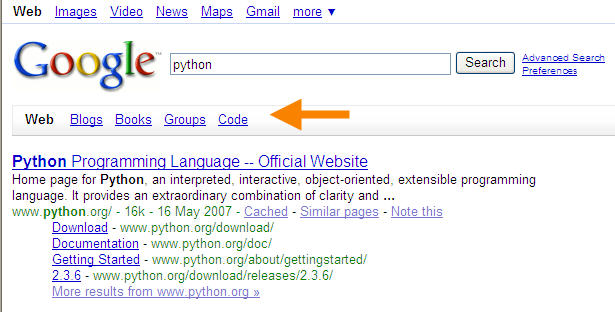
To me, the one thing that jumps out in this is the announcement of Universal Search. Basically, Universal Search is the breaking down of the information silos that currently exist on Google and blending them into a single set of results. The changes right now are very subtle. Web results still dominate the typical results page and the primary thing that would be noticeable by the user are additional dynamically generated navigation links that sit just about the results.

universalsearch

The key to universal search results is an on-the-fly algorithm that looks across all of Google’s information sources and prioritizes and ranks all the items coming from these disparate sources based on the user intent. Now, it’s in those last five words, “based on the user intent” that the really important piece of this comes out. Just a few weeks ago, I interviewed Marissa Mayer about the inclusion of Web history in the dataset to calculate personalized search results. This just gives Sep Kamvar and his personalization algorithm a lot more to chew on as they determine user intent. During the interview, I asked Marissa Mayer if personalization allows Google to be more confident in delivering vertical results. Marissa indicated that this was not an area they were currently looking at.

There are a lot of different things that we could do with this data. I’ll be totally honest. Verticals isn’t something that has been first and foremost in our minds so I don’t really think there’s a strong vertical angle here at the moment.

To me it just didn’t make sense. Couple that with yesterday’s announcement of Universal search results and I’ve got to conclude that Marissa was throwing up a smokescreen.

Personalized search is the engine is going to drive universal search. The two are inextricably linked. When you look at the wording the Google throws around about the on-the-fly ranking of content from all the sources for Universal Search, that’s exactly the same the wording they use for the personalization algorithm. It operates on-the-fly, looks at the content in the Google index and re-ranks it according to be perceived intent of the user, based on search history, Web history and other signals. It’s not a huge stretch to extend that same real-time categorization of content across all of Google’s information silos. That is, in fact, what Google’s announcement yesterday said. Call it a silo, call it a vertical, the end result is the same. As Google gains more confidence in disambiguating user intent, more specific types of search results, extending beyond Web results, will get included on the results page and presented to the user.

This introduces something else that opens up some interesting implications for Google. And again, if they choose to go down this path, it flies in the face of something that Marissa Mayer has previously stated. On the search results page as we know it, display or other types of advertising just don’t work that well. The search results pages is heavily text-based. We look for text, we respond to text, we click on text. Anything that’s not text acts as an interruption and distraction. There’s no place on this page for display or rich media advertising.

But if you mix up the search results page and start including things like images, video clips, maps, icons for audio files, you move away from the common paradigm of the text based search results page. The Google page becomes much more like a personalized, on-the-fly portal based around the intent of our query. As such, it includes stimuli from a lot of different sources, presented in a lot of different ways. There will be many things fighting for your attention. And in this paradigm, perhaps display and rich media advertising works better. In another announcement from Google, Marissa Mayer appears to have backtracked and open the door for this.

Yesterday, Marissa responded to a question about possible inclusion of non text-based ads in this way:

Well we don’t have anything to announce on that today. I do think this opens the door for the introduction of richer media into the search results page. We are now going to understand how users interact with that. And as Alan always likes to say search is about finding the best answer, not just the best URL or the best textual snippet.  

For us ads are answers as well. Searching ads is just as hard as searching the Web, as searching images. And so I was hoping that we could bring some of these same advances in terms of the richness of media to ads.

Greg Sterling, in his post on Search Engine Land, calls it something of a bombshell (Greg, I’m now regreting that I didn’t attend, as I would have loved to chat to you about this) and I agree. This is a significant retraction of Google’s long running stand on keeping display ads off the SERP:

There will be no banner ads on the Google homepage or web search results pages. There will not be crazy, flashy, graphical doodads flying and popping up all over the Google site. Ever.

Google said in their announcements that the changes for the user will be subtle at first. In fact, the position of the dynamically generated navigation links that appear about the search results will largely be ignored by most users. They won’t even know they exist. But in typical Google fashion, this tentative presentation of new functionality will be an incremental one. The typical path that Google takes when introducing new functionality is

  • subtly introduce new navigation options in the way of links that tend to be out of the primary scan path
  • make it an opt in experience for the user
  • gradually roll this functionality into a default opt in
  • eventually integrate more fully into the standard presentation of results
  • move to full integration and remove the ability for the user to opt out

if Google goes down this path with both universal and personal search, you can expect to see a substantially different look for search results in the near future. And as with most things we’ve talked about that Google is looking at introducing, there will be a trade-off between overall functionality for most users and a relinquishing of control for a small number of users.

My final point for this post is the speed of which Google is introducing new search innovations. A few weeks ago I posted that Google may be treating search as the forgotten child, devoting more attention to the sexier new channels they were acquiring, including pretty much everything under the sun. Matt Cutts was quick to post a comment saying that Google was still very much involved with search and that there would be a number of new things rolling out in the near future. It appears that I didn’t know what the hell I was talking about and now have to eat my words, as the announcements over the last few weeks have indicated that Google is still very much in the search game and is moving forward at, what for them, is breakneck pace.

I’ve often stated before the Google was the victim of their own success. Because they have such a large slice search market, any changes to the actual presentation of the search pages came with a lot of risk. It’s a major monetization channel for them, their biggest one by far, and any changes in user experience through the introduction of new functionality comes with the potential of dramatically reducing click through on sponsored ads. I predicted that this would make it tough for Google to really innovate with search and we would probably be looking to the smaller players to aggressively pursue innovation. Interestingly, much of my recent conversation with Ask’s usability team lead, Michael Ferguson, revolved around this point. That interview will be running tomorrow on Search Engine Land, with full transcript posted to this blog. If you look at what Ask is been doing with AskX:

AskX

 It’s very similar to what Google says they will be doing with universal search results. It’s taking content from a number of different sources and rolling it into one combined search results page. It came as a complete surprise to me when I read the release indicating that Google is moving aggressively down the same path. Google will not be taking the path that Ask is, by aggressively presenting new functionality on their main site, Google will introduce it incrementally, bit by bit. But expect the evolution of the search experience on Google to move fairly quickly.

All of Google’s announcements in the last few months point in the same direction. They all point to a highly personalized, highly relevant portal to all of Google’s information. Here’s my other prediction. While Marissa was very careful in past interviews to state that personalization is currently impacting only the organic search results, with no work being done on the personalized presentation of sponsored content, I smell another smokescreen. Personalized presentation of advertising content is just too huge a revenue opportunity for Google and we’ll be seeing it in the very near future.

Interview with Ask’s Michael Ferguson

I recently had the opportunity to chat with one of my favorite usability people, Michael Ferguson at Ask.com. You can find excerpts of the interview, along with commentary, on Search Engine Land in this week’s Just Behave column. Some of Michael’s comments are particularly timely now, given Google’s announcement of Universal search.

Gord: How does Ask.com approach the search user experience and in big terms, what is your general philosophy?

Michael: A lot of what we do is, to some extent, informed by core search needs but also by our relevant market share, understanding that people have often experienced other engines before they come to us, not necessarily in that session but generally on the web. People have at least done a few searches on Google and Yahoo, so they have some context coming from those search experiences. So often, we’re taking what we’ve learned from best practices from competitors and others and then, on top of that, trying to add a lot of product experience and relevance experiences that are differentiated. Of course, we’re coming from this longer history of the company where we’ve had various user experiences over the time that we’ve been around. We’ve marketed around natural language, in the late 90’s and answered people’s questions at the top of the page, but in the last year and a half or so, we’ve rebranded and really focused on getting the word out to the end users that we are a keyword search engine, an everyday search engine.

A lot of the things that we’ve done with users have been to try to, implicitly, if not explicitly, inform users that are coming to the site you can use it very much like you can use any other kind of search engine you’ve been on before. Or, if they’re current users and people are coming back to the site, to let them know that the range of experiences and the type of information we bring back to them has greatly expanded. So that’s pretty much it. It’s informed by the context of not just a sense of pure search and information retrieval and all the research that’s gone on that in the last 35 or 40 years but also the dynamics of the experiences that we’ve had before and people’s previous experiences with Ask. Then, an acknowledgement that they’ve often searched on other sites and looked for information.

Gord: You brought up a number of topics that I’d like to touch on, each in sequence. You mentioned that in a lot of cases, they’re coming to Ask and they’ve used Google or Yahoo or they’ve used another engine as one of their primary search tools. Does Ask’s role as a supplemental engine or an alternative engine give you a little more latitude? You can add things from a functionality point of view to really differentiate yourselves. I actually just did a search and see that you, at least on my computer here, have made the move to incorporate some of the things that you were testing on AskX into the main site. Maybe we’ll start there. Is that an ongoing test? Am I just part of a beta test on that or this rollover complete now?

Michael: We’re still in testing with that and it will roll out. We have decided because of a lot of the user experience metrics that we’re getting from the beta test that we’re going to go for it. We have decided to move the full experience over to the AskX experience. Of course, there are variants to that, but the basic theme of, in a smart way, bringing together results from different search verticals and wrapping those around the core organic results (as well as) a sponsored experience. So that will happen sometime this year. We don’t know exactly when, but just a couple of days ago, we really decided we’ve seen enough and we’re pretty excited about that.

Google has a really great user experience going, and Yahoo does too, but they have so many different levers that move so much revenue and traffic and experience metrics that I think it’s harder for them to take chances and to move things around and get buy-offs at a bureaucratic level. To some extent, we see ourselves as having permission and a responsibility to really innovate on the user experience. It’s definitely a good time for us because we have such great support from IAC and they’re very much invested in us improving the user experience and getting more traffic and getting frequency and taking market share and they’re ready to very much invest in that. So we don’t need to cram the page with sponsored links and things like that. It’s mostly a transitional time when we’re getting people to reconsider the brand and the search engine as a full keyword based, everyday search engine that has lots to offer. I’m talking to people all the time about Ask and there’s definitely still people that say, “Hey, last night, it came up with my buddies at the bar, this trivia question about the Los Angeles Lakers, 1966 to 1972 (and I went to Ask and asked a question)”. Then there are other people that see us as evolving beyond that but still really surprised that we haven’t had image search.  Now with AskX we’ll have preview search and there’s lots of other stuff coming along now. So yes, it’s a great place to be. I love working with it. There are so many things that, in an informed way, we can take chances on, relative to our competitors.

Gord: So does this mean that the main site becomes more of an active site? Are you being more upfront with the testing on Ask.com rather than on AskX.com?

Michael: Well, I think the general sense of what we’re going to do is that, at some point this year, the AskX experience will, at least at a wireframe level, become the default experience and, of course, we have a lot of next generation “after that” stuff queued up that we’re thinking about and we’re actively testing right now but not in any live sense.  So potentially, things will slide in behind the move of the full interface going out and then AskX will remain a sandbox for another instance of, hopefully, new and really useful and differentiated search experience coming after that. A general thing that we’re going to try to do, instead of having 15 or 18 different product managers and engineering teams working on all these different facets of information retrieval and services, we’re going to stay search focused and just have one sandbox area where people go in and see multiple facets of what we’re thinking about.

Gord: Let’s talk about the sponsored ads for a bit. I notice that for a couple of searches that I’ve done while we’ve been talking that they’ve definitely been dialed down as far as the presence of sponsored on the page. I’m only seeing top sponsored appear, so you’re using the right rail to add additional search value or information value, whether it be suggested searches or on a local search, where it brought me back the current weather and time. So what’s the current strategy on Ask as far as presentation of sponsored results and the amount of real estate devoted to them?

Michael: Just to fit along with the logic of Eye Tracking II (Enquiro’s second eye tracking study), those ads are not a delineated part of the user experience for the end user and they’re relevance and their frequency can color the perception of the rest of the page and especially the organic listings below them. Right now, as I said, we’re very much focusing on improved user experience and building frequency and retention of customers, which all the companies are, I’m sure. But we’re really being, basically, cautious with the ads and getting them there when they’re appropriate and, as best we can, adjust them over time, so that when they’re there, they’re going to valuable for the user and for the vendor.

Gord: That’s a fairly significant evolution in thinking about what the results page looks like from say, two years ago, with Ask. Is that purely a function of IAC knowing that this is a long term game and it begins with market share and after that comes the monetization opportunities?

Michael: Actually, I think way before we got acquired by IAC we knew that. We test like other engines would. We test lots of different ad configurations and presentations and things like that but definitely you want to balance that. Way before we got acquired we realized that there’s one thing that’s kind of fun about making the quarter and blowing through it a little bit and then there’s another thing about eroding customers. And definitely there’s a lifetime value that can be gained by giving people what you know is a better user experience over time, so once we did become part of the IAC family, we brought them up to speed with the results that we were finding that were pointing to taking that road and they’ve very much been in support of it. And, of course, their revenue is spread amongst a lot of different pieces of online and offline business so their ability to absorb it is probably more flexible than ours was as a stand alone company.

Gord: That brings me to my next question, which is, with all the different properties that IAC has and their deep penetration into some of the vertical areas, you had talked about the opportunity to bring some of that value to the search results page. What are we looking at as far as that goes? Are we going to see more and more information pulled from other IAC into the main AskX interface?

Michael: Maybe the most powerful thing about the internet is that you as an individual now have a very empowered position relative to other producers of information, other businesses where you can consume a bunch of different points of view. You have a bunch of different opportunities to do business and get the lowest price and read reviews that the company itself hasn’t sanctioned, or anything like that.  You have access to your peer network and to your social networks. Search, like the internet, becomes, and it necessarily needs to be, a proxy for that neutral, unbiased view of all the information that’s available. This probably gets a little bit into what may or not may work with something like Google’s search history. Users over time have said again and again, “Don’t hide anything from me or don’t over think what you may think I might want. Give me all of the best stuff, use your algorithms to rank all that, but if I get the sense that anything’s biased or people are paying for this, then I’m not going to trust you and I’m going to go somewhere else where I can get that sense of empowerment again.”

As I’ve sat in user experience research over time, I’ve seen people..and I know this isn’t true of Google and I know it isn’t true of Ask right now with the  retraction from paid inclusion…but you ask users why they think this came up first on Google, maybe with a navigational query like Honda or Honda Civic and Honda comes up first. They’ll say, “Oh, Honda paid for that.” So even with the engines that aren’t doing paid inclusion, there’s still this kind of wariness that consumers have of just generally somebody on the internet, somewhere, behind the curtains, trying to take advantage of them or steer them in some way. So as soon as we got acquired by IAC, we have made it very much part of their perception of this and their culture. Their product management point of view is that you can’t sacrifice that neutrality. You can’t load a bunch of IAC stuff all over the place. The relationship with IAC does give us access to proprietary databases that we can do lots of deep dives in and get lots of rich information out  that can help the user in their instance of their search needs that other companies wouldn’t be able to get access to, while maintaining access to everything else.

The way we approached AskCity was a great example of this. We had leveraged a lot of CitySearch data but at the same time, we know that when people go out and want to see reviews, they want to see reviews from AOL Neighborhoods, they want to see reviews from Yelp they want to see reviews from all these other points of view too. So we go and scrape all those and fold them into the CitySearch stuff. We give access to all those results that come up on AskCity. If they’re, for instance, at a restaurant, you can get Open Table reviews and you can get movie reservations through Fandango and other stuff like that. Those companies have nothing to do with IAC. Those decisions were borne from user needs and from us looking as individuals in particular urban areas, and saying “Hey, what would I want to come up?” We know from previous experience from AOL that the walled garden thing doesn’t work. It’s just not what people expect from search and not what they expect from the internet, so that lesson’s been learned. I don’t know how much it would be different if we had some dominant market share over search, but that’s even more reason for us to be appealing to as wide a population as possible. That’s my philosophy right now.

Gord: I guess the other thing that every major engine is struggling with right now is in this quest to disambiguate intent, where is the trade-off with user control? Like you said, just show me a lot of the best stuff and I’ll decide where I want to drill down and I’ll change the query based on what I’m seeing to filter down to what I want. In talking to Marissa at Google and their moves towards personalization and introducing web history, I  think for anyone who understands how search engines work, it’s not that hard to see the benefits of personalization but from a user perspective there does seem to be some significant push back against that. Some users are saying, “I don’t want a lot of things happening in the background that are not transparent to me. I want to stay in control.” How is Ask approaching that?

Michael: The other major thing that’s going on right now is that we have fully revamped how we’re taking this. We developed the Direct Hit late 90’s technology. And then the Teoma technology we acquired. And really, it’s not that we’re taking those to the next level, we got all of that stuff together and over the past three years, we’ve been saying, “Okay, what do we have and what’s unique and differentiated?” There’s a lot of great user behavior data that Direct Hit understands.  We have a whole variety of things there and that’s unlocked, that’s across all the people coming in and out over time but not any personally identifiable type of stuff. And then there’s Teoma, which is good at seeing communities on the web, expertise within the communities and how communities relate. So right now, even though we have personalization stuff and My Stuff and other things that are coming up, we’re investing a lot more in the next version of the algorithm and the infrastructure for us to grow called Edison. And we started talking about that a week ago since A.G. (Apostolos Gerasoulis) mentioned it. Across a lot of user data it understands a lot about the context from the user intention side and because we’re constantly capturing the topology of the web and it’s communities and how they’re related, we then match the intention and the map of the web as it stands and the  blogosphere as it stands and other domains as they stand. Our Zoom product, which is now on the left under the search box in the AskX experience and it’s on the right on the live site, is the big area that we’re going to more passively offer people different paths.

For example, just like with AskX, you search for U2, it’s going to bring up news, and product results, and video results and images, and a Smart Answer at the top of the page. It’s also going to know that there’s U2 as the entity, the music band and therefore search the blogosphere but just search within music blogs. So what it’s doing, over time, is trying to give a personalized experience that’s informed by lots of behavior and trying to capture the structure of the web, basically. So that’s where we are there.

There’s a book that came out in early 1999 called Net Worth, which you might want to read. I almost want to revisit it myself now. It’s a Harvard Business School book that Marc Singer and John Hagel came out with. It talked about infomediaries and it imagined this future where there’d be these trusted brands and companies. They were thinking along the lines of American Express or some other concurrent banking entity at the time, but these infomediaries would have outside vendors come to them and they would entrust all their information, as much as they wanted to, they could control that, both online and offline.  You were talking in your latest blog post about understanding in the consideration phase where somebody is and presenting, potentially, websites that they hadn’t seen yet or ones that they might like at that point in the car purchase behavior. But the way that they were imagining it was that there would be a credit card that might show that someone had been taking trips from the San Francisco Bay area to the Tahoe region at a certain time of year and had maybe met with real estate agents up there and things like that. But these infomediaries, on top of not just web history but even offline stuff, would be a broker for all that information and there would be this nice marketplace where someone could come and say, “I want to pay $250 to talk to this person right now with this specific message”. So it seems that Google is doing a lot of that, especially with the DoubleClick acquisition. But I’m just wondering about the other side of it, keeping the end user aware of and empowered over that information and where it’s at. So Net Worth is a neat book to check out because the way they were describing it, the end user, even to the broker, would seep out exactly what they wanted to seep out at any given time. It wouldn’t be this passive recording device thing that’s silently taping. My experience so far of using the Google Toolbar that’s allowing the collection of history, is that it’s ambiguous to me about how much of my behavior is getting taken up by that system and used. We’ll see where it goes but right now we don’t have strong plans to do anything with that for search.

Gord: It’s going to be really interesting because, up to now, the tool bar was collecting data but there was no transparency into what it was collecting, and now that they’ve done that, we’ll see what the user response is to that. Now that they can go into their web history and have that initial shock of realizing how much Google actually does know about them.

One other question, and this is kind of a sidelight, but it’s always something that I’ve been interested in. Now that you have the search box along the left side there and it gives search suggestions as you’re typing, have you done any tracking to see how that’s altered your query logs? Have you noticed any trends in people searching differently now that you’re suggesting possible searches to them as they’re typing?

Michael: There are two broad things that are encouraging to us. One is that over time, the natural language queries are down tremendously. Our queries, because we promoted in the late nineties this “ask a question” thing, tended to be longer and more phrase based, more natural language based.  That’s really gone down and is approaching what we would consider normal for an every day search engine profile as far as the queries. And we really think that this zooming stuff has really helped that because it’s often keyword based. You will sometimes see some natural language stuff in there. There are communities on the web that are informing us that there’s an interest in this topic that’s related to the basic topic so it is helping change the user behavior on Ask.

And the other result of that is as people use it more for everyday keyword based search engine, the topics or the different categories of queries that people see are normalizing out too. Less and less they’re reference type stuff and more and more they’re transactional type queries, so that’s a good thing. And that’s just been happening as we rebranded and we presented Zoom.

And then with the AskX experience, we are definitely seeing that even more because of the fact that they’re just in proximity to the search box. We always knew that these suggestions should ideally be close to the search box so that people understand fully what we’re trying to offer them. For instance, on the current site, we do see users that will sometimes type a query in the search box on top and because they’re used to seeing ads on the right rail on so many other sites and because they don’t necessarily know what narrow and expand your search is they think those are just titles to other results or websites. It’s a relatively small portion. Most people get what it is, but there was that liability there. Now in the AskX experience, it’s close and visually grouped with the search box. It’s definitely getting used more and guiding queries and people seem even more comfortable putting general terms in. We’ve made it that you can just arrow down to the one and hit return. It’s definitely driving the queries differently.

Gord: I’ve always liked what you guys have done on the search page. I think it’s some of the most innovative stuff with a major search property that I see out there and I think that there’s definitely a good place for that kind of initiative. So let me wrap up by asking, if you had your way, in two years, what part would Ask be playing in the total search landscape?

Michael: We’d definitely have significantly more than 10% market share. My point of view, from dealing with the user experience, is that I’ve been proud of the work that we’ve done and I really think that we’ve been very focused and innovative with a very talented team here and we’re really hoping that as we look at the rest of the year and we put out Edison and the AskX experience, that we become recognized for taking chances and presenting the user experience in a differentiated way that people have to respond to us in the market and start adopting some of the things that we’re doing. Because of the amount of revenue that Microsoft, Yahoo and Google are dealing with on the search side, they often get a lot of press but our hope is really to take share and to hopefully have a user experience that inform and improve the user experience of our competitors.

Gord: Thank you for your time Michael.

Google’s Perfect Marketplace

In my recent conversation with Michael Ferguson, he brought up the book Net Worth and the concept of infomediaries. I hadn’t read the book (an oversight I’m correcting) but I did a little quick online research. First, here was Michael’s comments:

There’s a book that came out in early 1999 called Net Worth, which you might want to read. I almost want to revisit it myself now. It’s a Harvard Business School book that Marc Singer and John Hagel came out with. It talked about infomediaries and it imagined this future where there’d be these trusted brands and companies. They were thinking along the lines of American Express or some other concurrent banking entity at the time, but these infomediaries would have outside vendors come to them and they would entrust all their information, as much as they wanted to, they could control that, both online and offline.  You were talking in your latest blog post about understanding in the consideration phase where somebody is and presenting, potentially, websites that they hadn’t seen yet or ones that they might like at that point in the car purchase behavior. But the way that they were imagining it was that there would be a credit card that might show that someone had been taking trips from the San Francisco Bay area to the Tahoe region at a certain time of year and had maybe met with real estate agents up there and things like that. But these infomediaries, on top of not just web history but even offline stuff, would be a broker for all that information and there would be this nice marketplace where someone could come and say, “I want to pay $250 to talk to this person right now with this specific message”. So it seems that Google is doing a lot of that, especially with the DoubleClick acquisition. But I’m just wondering about the other side of it, keeping the end user aware of and empowered over that information and where it’s at. So Net Worth is a neat book to check out because the way they were describing it, the end user, even to the broker, would seep out exactly what they wanted to seep out at any given time. It wouldn’t be this passive recording device thing that’s silently taping. My experience so far of using the Google Toolbar that’s allowing the collection of history, is that it’s ambiguous to me about how much of my behavior is getting taken up by that system and used.

So, as Michael says, Google seems to be positioning themselves to be this infomediary. Think about the nexus that’s forming between personalization and Google’s acquisition of every available marketing channel. Google is creating the perfect customer acquisition marketplace. And what’s their typical pricing model? Yes, auction based pricing.

So let’s walk down this path a little. Let’s assume that Google is successful in pushing a high degree of personalization on a significant portion of the population. If you capture all the search history and web history, you have a great data set to predict, with a high degree of accuracy, a consumer’s needs at any given time. The math behind this is not that intimidating for the brain trust that Google has assembled.

Then, let’s factor in Semantic Web functionality. Now, through a series of useful apps, Google takes that personalization data and further adds user value by letting them interact with information. It’s Google’s recent announcement of Universal Search, taken to a new and much more functional level. They’ve already warned us that Universal Search is just the beginning. Google powers the web as our personal assistant, so that for any given life or consumer event, Google is determining our intent, either implicitly or explicitly, and providing us with commercial recommendations. In this case, it’s not really advertising, it’s a helpful recommendation.

Finally, through the Google web of properties, both online and offline, you have the opportunity to present these “commercial recommendations” through a number of reinforced touchpoints. The odds of connecting with an engagement consumer and eliciting the desired conversion are almost 100%.

It’s a perfect marketplace, the ideal match between a prospect and a solution.

So now you have the perfect marketplace, complete with a Google console that lets you target the consumer you want in the way you want. Let’s add one more piece of the puzzle, the pricing model. Auction based pricing has worked pretty well for Google in the past. Why should this be any different. There will of course be a quality scoring component to this. Google is way too obsessive about user experience to just open the bidding to anyone. But let’s say that the Google quality scoring mechanism goes deeper than it does right now, determining exactly the best vendor fits with the determined need and intent of the consumer. Let’s say that Google narrows the list down to the top 10, and then from their database of potential advertisers, who have all indicated what they’re willing to pay for an almost guaranteed customer with an already predetermined ROI (remember, we know with a high degree of accuracy what it is that the prospect is likely to buy), they present the advertiser (or perhaps a few options, as we all like to see options) with the combination of the highest bid price and the highest degree of consumer intent relevancy. Once the bid is accepted, a packaged and personalized message goes out to the prospect through the appropriate channels.

Think for a moment what this does to the entire world of advertising. Hmm…some pretty hefty food for thought.

Shedding Some Light on B2B Purchasing

First published May 17, 2007 in Mediapost’s Search Insider

This week, we released our latest B-to-B research study based on a survey of almost 1,100 respondents. Today, I wanted to share a few high-level findings with you.

The Mirrored Worlds of Online and Offline

One of the challenges in B-to-B marketing is that you’re not marketing to just one person; you’re marketing to an organization. So you’re marketing to different people within that organization at different times. This adds a significant amount of complexity to business-to-business marketing. We wanted to capture this aspect of the B-to-B buying process, so we grouped respondents into four different categories of buyers: user buyers, technical buyers, coach buyers and economic buyers, the one who actually sign the check.

Another thing we wanted to look at was the impact of both online and off-line influencers in the purchase decision. How important was visiting a Web site, compared to seeing a vendor at a trade show or an ad in a trade publication?

In the study, one thing became clear. Online influences have gained a tremendous amount of ground over traditional influences. In fact, they’ve even caught up with the traditional off-line winner, word-of-mouth. The vendor’s own Web site was listed as the most important influence, together with word-of-mouth from a colleague or peer. Close behind were search engines, distributor Web sites and word-of-mouth from a friend.

When B-to-B buyers enter the purchase cycle, online activity is a natural result of off-line brand awareness. As the buyer becomes aware of a potential product or solution, the first reaction is to turn online to find out more about it. Across all phases of the buying cycle, including awareness, research, negotiation and purchase, over 85% of respondents said they will go online to help them make the right purchasing decision. This online activity was highest during the awareness and research phase, with a full 92% of respondents indicating that they would turn to online resources then. The percentage was lowest during negotiation, but even so, two out of every three respondents indicated that they would go online during this phase.

The Search Intersection

Also, the vast majority of purchasers start their online journey at the search engine. Although this varies by phase of the buying process, over all phases one in two users turn to a search engine first to help them find the online resources they’re looking for. This is highest during the beginning of the purchase process, in the awareness and research phases. At the awareness phase, 65% of respondents indicated the first place they would go would be a search engine.

There’s also a distinct evolution in the use of search engines as buyers move through the purchase process. Near the beginning, the first places they turn are the major portals, and the overwhelming favorite is Google, the first choice of 77% of the respondents. By the way, in a simulated search we incorporated into the survey, 74.2% of the clicks happened on organic listings. This matches up quite well with the organic/sponsored breakdown we’ve seen in other studies.

But as buyers begin moving through the phases, the role of the vertical B-to-B search engine (such as Business.com or Knowledgestorm) becomes more important. Buyers use these engines to build their consideration set and dig deep for the information about the product or solution alternatives they’re considering. While only 7.3% of respondents indicated they would turn first to the B-to-B vertical engine in the awareness phase, 22.1% indicated this would be their first choice during the negotiation stage.

K.I.S.S. Works for B-to-B, Too

The biggest influence for the B-to-B buyer? The vendor’s own Web site. But when it comes to accessing information on that site, simpler is definitely better. Buyers said they were looking for clear, extensive product information provided in an easily transferable, text-based format. The No. 1 priority was clear pricing information. This was followed closely by extensive product information, comparisons with competitors and downloadable papers and product sheets. The least important factors to the buyer were things like podcasts, webinars and online chat functions. B-to-B buyers are very task-oriented; they want to get in, find the information they’re looking for and get out. They have little patience for linear multimedia presentations that force them to gather information on the vendor’s timeline, not their own.

B-to-B purchases are often complex, long-cycle affairs that generate a tremendous amount of online activity. The wonderful thing for the marketer is that much of that activity funnels through a search engine at some point. This gives the marketer that understands this process a tremendous advantage, because it’s easier to determine the most traveled intersections online. But that understanding is the key. I hope research like this adds to our rather limited body of data on B-to-B purchases.