Interview with Google’s Nick Fox and Diane Tang on Ad Quality Scoring

I had the chance to talk to Nick Fox and Diane Tang from Google’s Ad Quality team about quality scoring and how it impacts the user experience. Excerpts from the article along with additional commentary will be in Friday’s Just Behave column, but here is the full transcript.

Gord: What I wanted to talk about a little bit was just how the  quality, particularly in the top sponsored ads, impacts user experience and talk a little about relevancy. Just to set the stage, one of the things I talked about at SES in Toronto was just the fact that as far as a Canadian user goes, because the Canadian Ad market isn’t as mature as the American one, we’re not seeing the same acceptance of those sponsored ads at the top.  Just because you’re not seeing the brands that you would expect to see for a lot of the queries. You’re not seeing a lot of trusted vendors in that space. They just have not adopted search the same way they have in the States.  What we’ve seen in some of our user studies is a greater tendency to avoid that real estate … or at least to quickly scan it and then move down.  So, that’s the angle I really want to take here.  Just how important it is ad quality and ad relevance to impacting that user experience and then also talking about one thing I’ve always noticed in the number of our user studies. Of all the engines, Google seems to be the most stringent on what it takes to be a qualified ad. To get promoted from the right rails to the top sponsored ads. So that sets a broad framework of what I wanted to talk about today.

Nick: Let me give you a quick overview of who I am and who Diane is and what we work on and then we’ll jump into the topics that you’ve raised.  So what Diane and I work on is called Ad Quality and it is essentially everything about how we decide which ads to show on Google and our partners and what they should look like, how much we charge for them and all those types of things. How the auction works…everything from soup to nuts.  If you ask us what our goal is…our goals is to make sure our users love our ads. If you ask Larry Page what our goal is…it’s to make our ads as good as our search results. So it’s a heavy focus on making sure that our users are happy and that our users are getting back what they want out of our ads.  We sort of think of ourselves as among the first that work on the average product for Google. We represent the user, to make sure the user is getting what they really need.  We’re very similar to what we do on the search quality side, making sure that search results are very good.

I think a lot of the things you’ve picked up on are very accurate. In terms of the focus on top ad quality..in general, the focus on quality..I think what you picked up on in your various  reports as well as the study in Canada are pretty accurate and pretty much what drives what we are working on here.  The big concern that I would have, the main motivation for why I think ad quality is important is as a company we need to make sure users continue to trust our ads.  If users don’t trust our ads, they will stop looking at the ads, and once they stop looking at the ads they’ll stop clicking on the ads and all is lost. So what we need to make sure we are doing in long run  is that the users believe that the ads will provide them what they are looking for and they will continue looking at the ads as valuable real estate and to continue to trust that.
So that is what we are going for. I think as we look at the competitors landscape as well, we see a lot of what you see. We certainly have historically, and continue to do so, have much more of a focus on the quality of the ads. Making sure we’re not doing things where we trade off the user experience against revenue. We all have the ability to show more ads or worse ads, but we take a very stringent approach, as you’ve noticed, to making sure we only show the best ads that we believe the user will actually get something out of. If the user’s not going to get something out of the ad, we don’t show the ad. Otherwise the user is going to be less likely to consider ads in the future.

Diane: It’s worth pointing out that basically what we’re saying is that we are taking a very long term view towards making sure our users are happy with our ads and it’s really about making them trust what we give them.

Gord: One thing I’ve noticed in all my conversations whether they’re with Marissa or Matt or you, the first thing that everyone always says at Google is the focus around the user experience. The fact that the user needs to walk away satisfied with their experience. When we’re talking about the search results page, that focuses very specifically on what we’ve called in our reports the “area of greatest promise”. That upper left orientation on the search results page and making sure that whatever is appearing in that area had better be the most relevant result possible for the user.  In conversations with other engines I hear things like balanced ecosystems and communities that include both users and advertisers. I’ve always been struck by the focus at Google and I’ve always been a strong believer that corporations need sacred cows, these untouchable driving principles that everyone can rally around.  Is that what we’re talking about here with Google?

Nick: I think it is.  I think it comes from the top and it comes from the roots. If we were doing a proposal to Larry and Sergey and Eric where we’re saying, “Hey, let’s show a bunch of low quality ads”  the first question they’re going to ask is “Is this the right thing for the user?”  And if the answer is no, we get kicked out of the room and that’s the end of conversation. So you get that from the top and it permeates all the way through. You hear it when you speak to Marissa and Matt and us. It permeates the conversations we have here as well.  It’s not just external when we talk about the user; it’s what the conversation is internally as well. It just exudes through the company because it’s just part of what we think. I wouldn’t say that there isn’t a focus on the advertiser too, it’s just that our belief is that the way you get that balance is by focusing on the user, and as long as the user’s happy, the user’s clicking on the ad, and as long as the user’s clicking on the ad, the advertiser’s getting leads and everything works. If you focus on the advertiser’s in the short term, maybe the advertisers will be happy in the short term, but in the long term that doesn’t work. That used to be a hard message to get across. It used to be the case that advertiser’s didn’t really get that. And one of the most rewarding things for me is that the advertisers see that, they get that. Some of the stuff we do in the world of ad quality is frustrating to advertisers because in some cases we’re preventing their ads from running in cases where they’d like it to run. We’ve seen that the advertiser community is actually more receptive to that recently because they understand why we’re doing it and they understand that in the long term, they’re benefiting from it as well. I think that you are seeing that there is a difference in approach between us and our competitors. That we believe the ecosystem thrives if you focus on the users first.

Gord: I’d like to focus on what, to me, what’s a pretty significant performance delta between right rail and top sponsored. We’ve seen the scan patterns put top sponsored directly in the primary scanning path of users where right rail is more of a side bar that may be considered after the primary results are scanned. With whatever you can share, can you tell me a little about what’s behind that promotion from right rail to top sponsored?

Nick: Yes, it’s based on two things.  One is the primary element is the quality of the ad. The highest quality ads get shown on the top. The lower quality ads get shown on the right hand side. We block off the top ads from the top of the auction, if you really believe those are truly excellent ads…

Diane: It’s worth pointing out that we never break auction order…

Nick: One of the things that’s sacred here is making sure that the advertiser’s have the incentive. In an auction, you want to make sure that the folks who win the auction are the ones who actually did win the auction. You can’t give the prize away to the person who didn’t win the auction. The primary element in that function is the quality of the ad. Another element of function is what the advertiser’s going to pay for that ad. Which, in some ways, is also a measure of quality. We’ve seen that in most cases, where the advertiser’s willing to pay more, it’s more of a commercial topic. The query itself is more commercial, therefore users are more likely to be interested in ads. So we typically see that queries that have high revenue ads, ads that are likely to generate a lot of revenue for Google are also the queries where the ads are also most relevant to the user, so the user is more likely to be happy as well. So it’s those two factors that go into it. But it is a very high threshold. I don’t’ want to get into specific numbers, but the fraction of queries that actually show these promoted ads is very small.

Gord: One thing we’ve noticed is, actually in an eye tracking study we did on Google China, there where the search market is far less mature, you very, very seldom see those ads being promoted to top sponsored. So I would imagine that that’s got to be a factor. Is the same threshold applied across all the markets or does it vary, does the quality threshold vary from market to market?

Nick:  I don’t want to get too much into the specifics of that kind of detail. We do certainly take an approach in market that we believe is most effective for that market. Handling everything at a global level doesn’t really make a lot of sense because in some cases you have micro markets that, or, in the case of China, a large market, where it makes sense to tailor our approach to what makes sense for that market…what users from that market are looking for, what the maturity of that market is. A market that has a different level of search quality, for example, it might make sense to take a different approach in how we think about ads as well. So that’s what I want to say there. But you’re right, in a market like China that’s less mature and at the early stage of it’s development, you do see fewer ads at the top of the page, there are just fewer ads there that we believe are good enough to show at the top of the page. Contrast that with a country like the U.S. or the U.K., where these markets are very mature and have the high quality ads we feel comfortable showing at the top, we show top ads.

Diane: But market maturity is just one area we look at. There’s also user sophistication with the internet and other key factors. We have to take all this into account to really decide what the approach is on a market basis.

Gord: One of the questions that always comes up every time I sit on a panel that has anything to do with quality scoring is what’s in an ad that might generate a click through is not necessarily what will generate a quality visitor when you carry it forward into conversion. For instance you can entice someone to click through but they may not convert and, of course, if you’re enticing them to click through you’re going to benefit from the quality scoring algorithm.  How do we correct that in the future?

Nick:  I think there are two things. One is, in general, an ad’s that’s being honest, and gets a high click rate from being honest,  is essentially a very relevant ad and therefore gets a high click through rate. We’ll typically see that that ad also has a high conversion rate. In cases where the advertiser’s not being dishonest, the high click through rate is generally correlated with a high conversion rate. And it’s simply because that ad is more relevant, it’s more relevant in terms of getting the user to click on that ad in the first place, it’s also more relevant in delivering what that user is looking for once they actually got to the landing page. So you see a good correlation there.

There are cases where advertisers can do things where they’re misleading in their ad text and create an incentive for a user to click on their ad and then not be able to deliver, so the advertiser could say “great deals on iPods” and then they sell iPod cases or something. In that case, the high click through rate is unlikely to be correlated with a high conversion rate because the users are going to be disappointed when they actually end up on the page. The good thing for us is that the conversion rate typically gets reflected in the amount that the advertiser’s actually willing to pay, so that’s one of the reasons why the advertiser’s bid is a relatively decent metric of the quality, for example in this ipod cases case, because that conversion rates likely to be low, the advertiser’s not likely to bid as much for that. The click just isn’t worth as much to them, therefore they’ll bid less and end up getting a lower rank as a result of that. So, in many cases, this doesn’t end up being a problem because that just sort of falls out of the ranking formula. It’s a little bit convoluted.

Gord: Just to restate it to make sure I’ve got it here. You’re saying that if somebody is being dishonest, ultimately the return they’re getting on that will dictate that they have to drop their bid amount, so it will correct itself. If they’re not getting the returns on the back end, they’re not going to pay the same on the front end and ultimately it will just find it will just find it’s proper place.

Nick: What an advertiser should probably be thinking most about is mostly ROI per click…it’s actually ROI per impression. From the ad that’s likely to generate the most value for the user, and therefore the most value to Google as well as the most value to the advertiser, all aligned in a very nice way, is the ad that’s the most likely to generate the most ROI per impression. And because of our ranking formula, those are the ads that are most likely to show up at the top of the auction. And the ones that aren’t fall out. So the advertiser should care click through rate, but they shouldn’t care about click through rate exclusively to the extent that that results in a low conversion rate and a low ROI per click for them.

Gord: We talked a little bit about ads being promoted to the top sponsored and over the past three or four years, you have experimented a little bit with the number of ads that you show up there. When we did our first eye tracking study, usually we didn’t see any more than two ads, and that increased to three shortly after. Have you found the right balance with what appears above organic results as far as sponsored results?

Diane: I would say that it’s one of those things where the user base is
constantly shifting, the market is constantly shifting. It’s something that we definitely reevaluate frequently. It was definitely a very thought through decision to move to three, and we show three actually very rarely. We seriously consider that when we show three, is it in the best interest for the user? There’s a lot of evaluation of the entire page at that point and not even just the ads, whether or not it was the right thing. We’re very careful to make sure that we’re constantly at the right balance. It’s definitely something that we look at.

Gord: One of the things we’ve noticed in our eye tracking studies is that there’s a tendency on the part of users to “break off” results in consideration sets and the magic number seems to be around four, so what we’ve seen is even if they’re open to looking at sponsored ads, they want to include at least the number one organic result as well, as kind of a baseline for reference. They want to be able to flip back and forth and say, “Okay, that’s the organic result, that how relevant I feel that is. If one of the sponsored ads is more relevant, than fine, I’ll click on it.” It seems like that’s a good number for the user to be able to concentrate on at one time, quickly and then make their decision based on that consideration set that would usually include one or two sponsored ads and at least one organic listing, and where the highest relevancy is. Does that match what you guys have found as well?

Nick: I don’t think we’ve looked at it in the way of consideration sets, along those lines. I think that’s consistent with the outcomes that we’ve had and maybe some of the thought process that lead us to our outcome. The net effect is the same outcome. One of the things that we are careful about is trying to make sure that you don’t want to create an experience where you show no organic results on the page, you know, or at least above the fold on the page. You want to make sure that the user is going to be able to make that decision, regarding what they want to click on and if you just serve the user with one type of result you’re not really helping the user make that type of decision. What we care more about is what the user sees in the above the fold real estate, not quite so much the full result. And probably relatively consistent on certain sets of screen resolutions.

Gord: One of the things that Marissa said when I talked to her a few days ago was that as Google moves into Universal Search results and we’re starting to see different types of results appear on the page, including in some cases images or videos, that opens the door to potentially looking at different presentations of advertising content as well. How does that impact your quality scoring and ultimately how does that impact the user?

Nick: We need to see. I don’t think we know yet. Ultimately it would be our team deciding whether to do that or not, so fortunately we don’t have to worry too much about hooking up the quality score because we would design a quality score that would make sense for it. The team that focuses on what we call Ad UI, that’s the team that’s looking at …it’s sub group within that, that’s the team that essentially thinks about what should the ads actually look like?

Diane: And what information can we present that’s most useful to the user?

Nick: So in some cases, that information may be an image, in some cases that information may be a video. We need to make sure in doing this that we’re not just showing video ads, because video happens to be catchy. We want to make sure that we’re showing video ads because the video is what actually contains the content that’s actually useful for the user. With Universal Search we found that video search results, for example, can contain that information, so it’s likely that their paid results set could be the same as well. Again, just as in text ads, we’d need to make sure that whatever we do there is user driven rather than anything else and that the users are actually happy with it. There would be a lot of user experimentation that would happen before anything was launched along those lines.

Diane: You can track our blogs as well. All of our experiments show up at some point there.

Gord: Right. Talking a little bit about personalization, you started off by saying that Larry and Sergey have dictated that the ads should be more relevant than the organic results in an ideal situation and just as a point of interest, in our second eye tracking study, when we looked at the success rate of click throughs as far as people actually clicking through to a site that appeared to deliver what they were looking for, for commercial tasks, it was in fact the top sponsored ads that had the highest average success rate of all the links on the page. When we’re looking at Personalization, one of the things that, again, Marissa said is we don’t want our organic results and our sponsored results to be too far out of sync. Although personalization is rolling out on the organic side right now, it would make sense, if that can significantly improve the relevancy to the user, for that to eventually fold into the sponsored results as well. So again, that might be something that would potentially impact quality scoring in the future, right?

Nick: Yes. So we have been looking at some.. I’m not sure if the right word is personalization or some sort of user based or task based…what the right word is..changes to how we think about ads. We have made changes to try to get a sense of what the user’s trying to do right now. Whether they’re, for example, in a commercial mind set and alter how we do ads somewhat based on that type of an understanding of the user’s current task. We’ve done much less with trying to..we’ve done nothing really…with trying to build profiles of the user and trying to understand who the user is and whether the user is a man or woman or a 45 year old or a 25 year old. We haven’t seen that that’s particularly useful for us. You don’t want to personalize users into a corner, you don’t want to create a profile of them that’s not actually reflective of whom they are. We don’t want to freak the user out. If you have a qualified user you could risk alienating that user. So we’ve been very hesitant to move in that direction and in general, we think that there’s a lot more we can that doesn’t require profiles down that path.

Diane: You can think of personalization in a couple of different ways, right? It can manifest itself in regards to the results you actually show. It can also be more about how many ads or even the presentation of those ads with regards to actual information. Those sorts of things. There are many possible directions that can be more fruitful than, like Nick points out, profiling.

Gord: Right, right.

Nick: For example, one of the things that you could theoretically do is, as you know, we changed the background color of our top ads from blue to yellow, because we found that yellow works better in general. You might find that for certain users, green is better, you might find that for certain users, blue is actually better. Those types of things, where you’re able to change things based on what users are responding to, is more appealing to us than these broad user classification types of things. It seems somewhat sketchy.

Gord: It was funny. Just before those interview, I was actually talking to Michael Ferguson at Ask.com and one of the things he mentioned that I thought was quite interesting was a different take on personalization. It may get to the point where it’s not just using personalization for the sake of disambiguating intent and improving relevancy, it might actually be using personalization to present results or advertising messages in the form that’s most preferred by the user. So some may prefer video ads. Some may prefer text ads and they may prefer shorter text ads or longer text ads. And I just thought that that was really interesting. Looking at personalization to actually customize how the results are being presented to you. In what format.

Nick: Yes.

Gord. One last question. You’ve talked before about quality scoring and how it impacts two different things. Whether it’s the minimum bid price or whether it’s actually position on the page. And the fact that there’s more factors, generally, in the “softer” or “fuzzier” minimum bid algorithm than there is in the “hard” algorithm that determines position on the page. And ideally you would like to see more factors included in all of it. Where is Google at on that line right now?

Nick: There are probably two things. One is that when setting the minimum bid, we have much less information available to us. We don’t know what the specific query is that the user issued. We don’t know what time of day it is. We know very little about the context of what the user is actually trying to do. We don’t know what property that user’s on. There’s a whole lot that we don’t know. What we need to do when we set a minimum bid is much coarser. We just need to be able to say, what do we think this keyword is, what do we think the quality of the ad is, does the keyword meet the objective of the landing page and make a judgment based on that. But we don’t have the ability to be more nuanced in terms of actually taking into account the context of how the ad is likely to actually show up. There’s always going to be a difference in terms of what we can actually use when we set the minimum bid versus what we use at auction time to set the position. The other piece of it though is there are certain pieces that only affect the minimum bid. Let me give you an example. Landing page quality normally impacts the minimum bid but it doesn’t impact your ranking. The reason for that is mostly from the standpoint of our decision to launch the product and what we thought was the most expedient way to improve the landing page quality of our ads rather than what we think will be the long term design of the system. So I’d expect things like that, where signals like landing page quality should impact not only the minimum CPC but also rank which ads show at the top of the page and things like that as well. That’s where you’ll see more convergence. But there’s always going to be context that we can get at query time to use for the auction than we can for minimum CPC.
So You Really Want to Integrate Search?

The Ontario tourism board and I have been butting heads a little bit in the blogosphere as of late.  It all came about from an article I wrote a few weeks ago saying that perhaps Canadian advertisers have their “heads up their ass” with search marketing.  I used the Ontario Tourism Board as an example of a major organization that was not doing search and was quickly corrected by Nick Pedota from the board, who indicated that they were in fact doing a search campaign.  My problem was that I couldn’t find them for any of the keywords I thought they would typically appear for.  It seemed to me that there was a disconnect here.  This week I published a follow-up column indicating that perhaps there was a mismatch between the objectives and the allocation of budget in the Ontario Tourism strategy. In a follow-up comment to the column, Nick graciously complemented me on my research and admitted that perhaps there was room for improvement in their integrated search strategy.  My suspicion is that the cracks in the strategy don’t lie exclusively with either the Ontario Tourism board or their agency but likely fall somewhere in between. And it’s not uncommon to find these cracks when major advertisers move into trying to integrate search in their overall campaign strategies.   Kudos are in order for Ontario Tourism’s recognition of search at all.

In the spirit of improvement, I’d like to offer Nick and other marketers a few tips for successfully integrating search into an overall marketing campaign.

Search should be your first dollars in

Typically, search is added as an afterthought in most marketing campaigns.  In fact, search should be the foundation of the campaign.  This should be the first allocation of funds. Searchers are often your best prospects. They’re the ones that are actively involved in trying to find you.  In the case of the Ontario Tourism Board the entire campaign objective was to drive people to their website.  Therefore, it didn’t make much sense to not fully utilize search as a channel and to steer dollars instead to less efficient branding channels such as print and television.

In this case, the first thing that should have been done was to accurately assess the size of the potential search market.  This would’ve been done during the keyword analysis, when the prime keywords were identified and the corresponding search volumes were discovered.  A smart search marketer would be able to determine the key phrases most likely to convert and would start with these, but would then work outwards to determine the total size of the keyword basket. Going hand in hand with this is the determination of the average click cost for these keywords.  The search marketer has to make the determination if the cost per click is justified, given the likelihood to convert.

Once the total available search inventory that meets the quality threshold is established, this should form the core of your marketing budget. These are prospects are raising their hand, indicating that they’re looking to find you.  They should be the first ones captured in your marketing strategy. Then you can extend the campaign with other branding intiatives.

Realize that branding dollars will drive search volume

Even after you extend your budget into areas other than search, quite often the dollars spent here will translate into search activity.  In the case of Ontario Tourism, they ran their website address in all their ads.  But much of this activity would have translated into searches on the primary search engines.  Therefore, you need top of page presence to capture these navigational searches.  Ontario Tourism also did some national advertising, primarily on television, and in this case in particular there is a high likelihood that search would be used to find the site.  Unfortunately with Ontario Tourism’s geo targeting and other limits on maximizing their search presence, it’s unlikely that searchers would be able to find a site to click through to.  So, in effect, you lose two ways here.  You’re spending the money on branding to drive traffic and then you’re not capturing that traffic by ensuring you have an adequate search presence.

Bid on the head words if budget allows

A common mistake with many first-time search marketers is to compare click costs on different keywords against each other, rather than against other lead generation channels.  Head words, the high traffic key phrases that generally form the bulk of the potential traffic, typically cost much more than the long tail phrases.  The neophyte search marketer, in an attempt to be price conscious, often deletes the head words from consideration because of the expense, relative to more niche phrases.  But this is often the wrong comparison.  What the marketer should do is compare the cost per acquisition against the typical cost per acquisition of other channels.  In the case of Ontario Tourism, even their most expensive potential phrases would’ve cost under two dollars per click.  Even under the most optimistic of conversion scenarios, much of their print advertising would have been costing 15 times that.  It was a false economy to delete the head words from the budget consideration, as it would’ve closed the loop on their search strategy and ended up bringing highly qualified prospects at a much lower cost per conversion than their other channels. If you’ve truly allocated as much as possible to your search budget and the head words are still not within reach, then bidding on long tail phrases is really your only option.  But until you’ve made sure that you’re putting your first dollars in the search, don’t eliminate the head words from consideration.

Remember, if it isn’t clicked you don’t pay

It’s typical to use targeting extensively to make sure that traditional marketing is aimed at the right prospects.  You would pick your media channels based on their target demographics.  Often, this thinking is transferred into search but again this could prove to be a false economy. Ontario Tourism decided to use geo targeting to target their primary markets, which was the province of Ontario and the neighboring US border states.  They also put budget caps in place and put time parameters on their campaign. All of these moves would have made sense if budget were extremely limited.  It always makes sense to buy your best clicks first.  But as I mentioned above, in this case search should have been the first dollars in and this would’ve allowed Ontario Tourism to extend their search campaign to capture all of the potential traffic.  One of the beauties of search is that you can gain visibility with relatively little risk.  Unlike television or newspaper advertising, you only pay in search if the ad is clicked.  This eliminates much of the risk and allows you to relax your targeting to ensure that you’re capturing all the potential search traffic.

Understand the visibility dynamics of the search results page

Another source of false economy is the position you choose to occupy on the search results page.  There is generally five times the interaction with ads in the top sponsored position as opposed to ads on the right rail.  And in the case of Ontario Tourism, the official tourism site for the province of Ontario, this would be a site you would expect to see in the top sponsored ads for searches like Ontario vacations. By reinforcing this inherent trust with eye catchers like “official site” the Ontario tourism board would have been able to take advantage of quality scoring to reduce their bid price and maintain their top position. They would also have to use a close variation of the actual key phrase in the title to reinforce information scent. This relevance should, of course, carry through to the landing pages well.  This was an area that could lead to substantially increased conversions for the Ontario Tourism Board as well.

I embarked down this path in order to wake up Canadian advertisers and hopefully make them smarter about integrating search into their strategies.  It’s in that spirit that I offer these suggestions for those that are looking to seriously tap into the potential of search.

“Doing Search” Online Counts If You’re Seen

First published June 28, 2007 in Mediapost’s Search Insider

I’m not making any friends with Ontario Tourism. Two weeks ago I said in this column they weren’t using search. I was quickly corrected by the tourist bureau’s Nick Pedota, who told me my claim was “wildly inaccurate” and that Ontario Tourism in fact has “an extensive search program.” But based on the following searches I did while in Toronto, Ontario Tourism didn’t show for: Ontario vacations, Ontario resorts, Toronto vacations, Ontario getaways and Ontario holidays. According to Google Trends’ keyword research tool, these are the most common searches for Ontario, by a substantial margin.

If You’re Not Seen, You’re Not Doing Search

Here’s the reality of search marketing. It’s one thing to say “we’re doing search” internally — and it’s a totally different thing to have the searcher realize that yes, you’re doing search. The smart thing to do here would be to give Pedota and Ontario Tourism the retraction they’re looking for and say I made a mistake (which I did). But this proves too good an example of the disconnect I see all the time; managing a search campaign to budgets, not objectives. I stand by my original claim: Canadian advertisers aren’t clueing into the power of search.

Nick wasn’t really in a mood to share many details of the bureau’s campaign, but he did share that they’re were bidding on thousands of “targeted keyphrases” and were using heavy geo-targeting to focus on their prime markets (Ontario and the border states). He said that’s simply “smart marketing”. I can’t disagree. It makes sense to target in on your best clicks first, especially if budgets are limited.

Where’s the Money Going?

But in this case, are budgets really limited? Let me share some things I was able to dig up on Ontario Tourism’s site. First of all, the tourist bureau is doing print (lots of print) and TV (lots of TV). The goal? To drive people to its Web site. Full-page 4-color ads are running multiple times in over 70 dailies and weekly newspapers and 9 magazines. One 4-color full-page ad in the Toronto Star would run about $54,000 (there’s a certain amount of guessing here, as print rate cards are really a mathematical exercise in confusion and frustration). Circulation of the Toronto Star is 350,000 (on an average day). An excellent conversion rate for a newspaper ad would be 0.5% That means, ideally, 1,750 people would actually visit the Ontario Tourism website. Now, I have never in my life seen a newspaper ad convert this well, but even if it did, that would be a cost per visitor of $30.85. If the ad doesn’t work that well, the average cost climbs dramatically. And you pay whether or not the ad works.

What People Actually Use

Now, courtesy Yahoo Canada and a recent survey, let’s look at what actual travelers cite as the most important influencers in making travel plans. Search and Web sites are tied for number one and two, used by 51% of respondents in a recent survey. Newspapers and print? Only used by 7%. But yet, only 2.1% of Canadian ad budgets get spent on search, and 42% gets spent on newspapers and magazines. I couldn’t get any specific percentages for Ontario Tourism, but one only has to look at their campaign page to see that search is very likely getting only a fraction of what’s going to newspapers and magazines. And don’t even get me started on the TV buys.

The Search Story

So, where is Ontario Tourism in the search results? As Pedota shared, they’re only geo-targeting the prime markets, and then only for a 3-month period (April through June). Only 1 of the 7 highest traffic key phrases I found (using an Ontario IP) returned an ad or an organic listing for Ontario Travel (the site also hasn’t been organically optimized). More specific phrases, like Ontario Summer Vacations or Ontario Wine Getaways, did return more ads.

But by bidding on specific phrases (even thousand of “long tail” ones) and not on the more popular ones, Ontario Tourism is catching less than 10% of all the people using search to plan a vacation in Ontario. And unless you’re in the top-sponsored ad locations (which few of the ads I saw were) you’re actually only being seen by a small percentage of those searchers (usually 10% to 30% of them) on the results pages you do appear on. So, according to 97 out of 100 people who are using search to find the official site for Ontario Tourism, the tourism bureau is not “doing search.” By the way, you could maintain top spot in Google and Yahoo for all the top traffic phrases for less than $2 per visitor. Remember, that ad in the Toronto Star cost, at a minimum, 15 times that!

Again, let’s recap. What’s the purpose of the campaign? To drive people to the Web site. And not just any one — THE official Web site of Ontario Tourism, the site most people are looking for on these key phrases.

And You’re Spending Your Money Where?

Is it really “smarter” to ignore 97% of the people who are actively searching online to find you, so you can spend more money running ads in newspapers for the 99.5% of people who have no interest in your site at all? And the real irony here is that if people don’t click on a search ad, you don’t pay! Take a fraction of that budget from the Toronto Star and blow out the geo-targeting and time parameters and go for the high-traffic phrases. After all, there might be people in Saskatchewan or Nova Scotia that are planning a trip to Ontario. Or, perhaps they’re planning their trip in September, or February. If not, it’s not costing you anything. Try getting the Toronto Star to offer the same pricing model!

Is this really smarter marketing? You decide. The readership of this column includes some of the smartest marketers on the planet. Blog about this and give me your opinion. Maybe I’m missing something, but I’ve decided I shouldn’t apologize for trying to get advertisers to spend money more effectively. After all, in this case, it’s really our money they’re spending. At least, it would be if I were an Ontario taxpayer. Something tells me after this column, it might be a good thing I live 2000 miles away. As I said, I’m not making any friends in Ontario.

The Cranky Canadian is Back from Toronto

Apparently I stirred the pot a little bit when I was in Toronto. Yahoo invited me to give a breakfast talk to the handful of Canadian advertisers and I managed to hijack the session for 10 to 15 minute rant about how Canadians don’t get search.  I quickly followed this up with a column in  the SearchInsider to the same effect. I did make one mistake.  I did mention that the Ontario government doesn’t do search for their official tourism information site.  I was quickly corrected in that.  There is in fact the search campaign going on.  It just wasn’t registering for any of the searches I did.  I think I’ll follow up on this a little more for next week’s SearchInsider column.

I apologize to show chair Andrew Goodman for breaking the cardinal Canadian rule of politeness.  Andrew is shipping a case of generic cola with a Canadian politeness serum cleverly mixed in to try to return me to the accepted norms for Canadian behavior. I noticed another blogger who picked up on my rant indicated that as a Canadian living in the US, I would be well advised to escape back south of the border. I don’t know if this is good news for Canadian advertisers or not, but I actually am a resident Canadian.  I call Kelowna, B.C. home.

You know, the funny thing is, other than poor Nick at the Ontario Tourism Board who I mistakenly said had his head up his ass, most everyone else has agreed with me.  Perhaps being a cranky Canadian pays off.  To my knowledge there’s nobody who really is filling this role currently, although Canadians have a long tradition of being cranky.  Notable cranky Canadians in the past included Gordon SinclairPierre Berton and Jack Webster.

If it makes you feel any better, Canadian advertisers weren’t  the only ones I turn my sights on in the past week.  I also took a few shots at Yahoo during an interview on Bloomberg TV. Maybe it’s the fact that I’ve been traveling for past 2 1/2 months and I think the last time I actually got seven hours of uninterrupted sleep was back in March. This weekend I think I’ll have a stiff shot of Canadian whiskey (we call it rye up here), have a good night’s sleep and maybe I’ll come back next week kinder, gentler and more polite.  Or not.

Canada, It’s Time to Clue into Search!

First published June 14, 2007 in Mediapost’s Search Insider

I’ve never hid the fact that I’m Canadian. I’m fervently proud of that fact, and more than willing to take the good-natured ribbing I often get on the road from my American friends. I usually bear the brunt of some Canadian joke on a panel (often, I’m the one telling it) and I’m more than happy to act as a one-person tourism bureau. But this week, at SES Toronto, I’ve got to say that when it comes to search marketing, Canadian advertisers have their heads up their ass.

Being a Canadian, I’ve pondered long and hard about whether to soften that comment. After all, heaven forbid it comes off sounding rude. Saying someone, anyone, especially your fellow countrymen, have their heads up their ass sounds so, well, American. It’s unequivocal, to the point, in your face, aggressive: everything that Canadians generally aren’t. We’ve had it bred and/or frozen out of us.

But after looking at the facts, I couldn’t come to any other conclusion. The irony is that Canadians (I hope myself included) have played a major role in shaping the North American search industry. People like Barbara Coll, Todd Friesen, Andrew Goodman, Ian McAnerin, Ken Jurina and Jim Hedger are considered world-class in the game. But most of us are shaping the industry working with American clients. It’s because Canadian advertisers haven’t woken up to search yet, and there’s just no excuse for that, because Canadian customers are light years ahead of them.

Canada’s wired!

Canadians use the Internet more than anyone else in the world. According to comScore (responsible for all the stats in this paragraph), we spend more time online, have more wired households, are more sophisticated in our online behavior, do more searches. Pick your metric, Canada is ahead of the pack when it comes to online usage. For example, when we look at average hours spent online per month, Canadians are top with 40 hours, followed by Israel with 37.4 and South Korea with 34. The U.S. is in 8th place with 29.4. Canada also leads the pack in online reach, with 70% of households wired. This time, the U.S. comes in second with 59%. Average pages viewed per visitor? Canada comes in tops with 3800. The U.K. is second with 3300 and the U.S. clicks in with 2500.

See a pattern emerging? We spend a hell of a lot of time online up here. And much of that time is looking for something to buy. Canadians are the world’s best shoppers. We research every purchase down to the nitty-gritty detail. The Internet was created for shoppers just like us.

But what about the advertisers?

I’m writing this at SES Toronto. By common consensus with most Canadian search marketers I’ve talked to, Toronto seems to be the epicenter of the orifice that Canadian advertisers have lodged their collective heads in. The city doesn’t get it, the province doesn’t get it, the country doesn’t get it. When it comes to search, Canada (with a few exceptions) is clueless.

I remember my first SES in Toronto. I had been attending the U.S. shows for a few years previously, and it was with more than a hint of nationalistic pride that I attended the first Canadian show. But my jaw soon dropped at the questions I was fielding from the audience. This group was at least three years behind the U.S. market. That was four years ago. Since then, the U.S. has dramatically outpaced Canadian growth in search savviness. And if you look elsewhere, almost every market I’m familiar with, including the U.K, France, Italy, Germany and even China is rapidly gaining on the U.S. But Canada still seems to be blundering its way forward, overlooking the fact that Canadians spend a huge amount of time online using search engines. It’s to the point where it’s unforgivable.

Show us the money!

Here are just a few of the stats I pulled from comScore, Yahoo Canada and other sources:

  • Canadians spend $28.05 in online advertising per Internet user. The US spends $71.43.
  • 21% of Canadians media usage is online, but it gets 6% of the budget.
  • In contrast, newspapers and magazines get a 7% share of total media usage, but capture 42% of Canadian ad budgets,
  • The U.S. spends almost twice as Canada per capita on search marketing.

I did a few searches from my hotel in Toronto to see if the big brands show for common searches. They don’t. The quality of sponsored ads up here is abysmal. If you were planning a vacation in Ontario, don’t expect to see the official tourism site for the Ontario government in the top sponsored ads. They don’t do search. If there’s anything our research has shown, it’s that you need relevance in top sponsored to encourage interaction with this real estate. Until you get quality advertisers, sponsored is No Man’s Land.

So, in an atypical move for a Canadian, I’m railing against the cluelessness of our advertising community. Next time I come to Toronto, you’d better have your act together. Canadian shoppers get it, why don’t you?

By the way, sorry if this sounds harsh. Must be all the time I’m spending out of the country. Hopefully my passport won’t get revoked.

Google’s Gargantuan Footprint

First published April 5, 2007 in Mediapost’s Search Insider

A recent blog post by Anil Batra, formerly from Revenue Science, speculates that Google will soon be getting into behavioral targeting.  Another post by A-list blogger Robert Scoble indicates that Google may be dialing down the presentation of sponsored ads for certain queries.  Combine this with a few conversations I’ve had recently with Googlers,  and it seems the company is already setting its sights beyond the search results page when it comes to revenue generation.  One starts to get a sense of the footprint that Google is planning to put down on the future online landscape.

Getting Personal, One User at a Time

To me, the glue that holds all this together is Google’s move towards personalization.  If the company can get that piece of the puzzle right, everything else falls into place behind it.  And personalization moves Google beyond search into a lot of other applicable areas: the Google homepage, G-mail, Google News, desktop gadgets, to name just a few.

One of the issues I have with Google’s move towards personalization is that it stops short of really providing additional value to the average user.  If personalization works well, it significantly enhances our search experience by providing relevancy unique to us.  The signals that Google is watching to power the personalization algorithm are very much the same ones it would need to watch to introduce behavioral targeting of advertising messages.  It’s all about the sites that people visit, the search results that they click on and the path they take online.  If Google can use all these signals to help enhance the search results, it’s not that big a leap to be able to target messaging through its AdSense network on the sites you visit.

Google Everywhere You Turn

The key to all this for Google is ubiquity online.  It need to be everywhere and it’s rapidly approaching that goal.  While the pick-up on things like Gmail may not have been the runaway success that everyone was expecting, Google is beginning to offer enough online touch points to provide continuous interaction opportunities for any given individual prospect.  Consider the touch points Google already controls.  First, three out of every five searches that are launched online, anywhere, happen on Google, according to Hitwise.  That’s 60% of hundreds of millions of searches daily, and that alone gives Google a virtual vice grip on the traffic channels of the Internet.

Next is Google’s AdSense network.  Although it has not publicly disclosed how many sites are in this network, it’s estimated to be in the hundreds of thousands.

And then there’s Google’s toolbar.  In a recent survey we found that about 42% of the participants we interviewed had the Google toolbar installed.  In its full implementation, it tracks every single site you visit and streams this information back to Google servers somewhere.

Add to this the various other Google properties and tools you may interact with.  This could include Gmail or a Google personal homepage, Google gadgets installed on your desktop, Google Checkout, Google Blog Reader, to name just a few. And that list keeps growing.

Finally, there’s Google analytics.  One of the smartest moves that Google has done is introduce Google Analytics as a backend tool, free to Webmasters.  The question is, why would Google offer a fairly robust analytics package free?  The answer is that it gives the company a tremendous amount of data on the backend to supplement what it’s already collecting on the front end through click stream tracking.  This closes the loop, giving Google two views of a massive dataset and allowing extrapolation from those two views.

BT High on Advertisers’ Wish List

When you add all these touch points together, you have the capability of driving the largest consumer-centric behavioral network in existence.  And there’s an appetite for this ability to pinpoint precisely.  In the last SEMPO market survey, advertisers indicated that behavioral targeting was their preferred option, with 78% of them willing to pay a premium for it. If you could offer advertisers the ability to present progressive messaging, tied to consumers’ movement through the buying cycle, with the ability to intercept them not just at the search results page but at various information sites where they would be gathering more information, you would have an extremely effective net in which to capture prospects.

The challenge for Google is to present behaviorally targeted advertising in a way that doesn’t impact the user experience.  And this is likely the only sticking point standing between the search engine and the more aggressive rollout of behavioral targeting for advertisers.  My suspicion is that work is currently underway on the technologies that would allow Google to always present the right message at the right time to the right person.  There is a distinct danger in trying to push that too soon.  It’s one of those things you have to get at least 70% right out of the gate.  But if Google can do this, it’s a distinct win both for advertisers and consumers.  We don’t mind advertising when it’s relevant to our needs.  We only hate the stuff that gets in our way and keeps us from doing what it is we want to do.

Why Google Can Afford to Dial Back Search Ads

And this brings us to why Google can afford to experiment with dialing back the presentation of sponsored ads on the search results page.  A few conversations with different Googlers seem to indicate that its future focus is definitely on the advertising network, rather than the search results page.  If it can get the right message/right place/right time/right person equation nailed down, it can monetize traffic much more efficiently and further improve the user experience.

The key for Google, at least on the search results page, is keeping that top-of-page real estate highly relevant.  The fact is, over 50% of all the clicks on the page are going to happen on the first three or four listings, whether they’re sponsored or organic.  Another fact is that we don’t mind a mix of highly relevant sponsored and organic links at the top of the page, but we do mind having nothing but sponsored ads in the top four Golden Triangle locations.  Our tolerance for this advertising drops like a rock with the lessening of relevance in the ads presented.  If personalization and behavioral targeting would allow Google to further tweak the relevance of these ads and get it right more often, the monetization naturally jumps dramatically.

In our last eye tracking study we found that Google was the most efficient at monetizing traffic to the search results page in the long term.  Although Microsoft and Yahoo were more aggressive in presenting ads in the top real estate, Google managed to maintain its click-through rates on both first time and subsequent visits to the same page of results.

Given the possible paths that Google could pursue (and the huge revenue-producing opportunities that lie down those paths) perhaps its mission statement should change from organizing the world’s information to always presenting prospects with the right marketing message at the right time. This certainly aligns better with its recent moves into every marketing channel imaginable.


Scoble Discovers Google’s Secret

Robert Scoble, in a recent blog post, cracked the Google monetization code on the search results page.  In a conversation with an unnamed Googler he found that Google can afford to dial down the presentation of top sponsored ads because they’re just more efficient at monetizing the traffic.  Of course, this shouldn’t come as news to anyone who read our last eye tracking report.  We went into great depth about Google’s ability do more with less when it comes to sponsored advertising on the SERP.

I’m feeling a little blue in the face, but at the risk of repeating myself yet again I’ll make the point.  Relevance at the top of the page is a sacred cow.  The Area of Greatest Promise which occupies a tiny little triangle in the far upper left is the landscape you have to focus on if you want to present the best search user experience.  For an in-depth walk-through of what the Area of Greatest Promise is and how it impacts the user experience, check out last week’s Just Behave column on Searchengineland.  Also check out The Importance of Consideration Sets, the column I wrote the previous week.  If you want to know how Google does more with less, you have to understand the basic fundamentals of user behavior on a search engine.

The fact is, when you look at Google’s ability to monetize the page they are leaps and bounds ahead of both Yahoo and Microsoft in this regard, yet they are by far the least aggressive than presenting sponsored advertising at the top of the page.  The result? They keep scanning highest on this top real estate.  They have higher click through on both first-time visits to the page and repeat visit.  They don’t break user scanner behavior into two distinct paths, but keep it concentrated in the Golden Triangle.  The result is that when they do choose to show sponsored ads in this area, they have much higher levels of engagement and click through over the entire interaction with the search results page, not just the first visit to the page.  If you use the overall user experience as your metric, higher monetization will come as a natural result.  The minute you try to force monetization by hijacking valuable real estate for purely commercial purposes, without consideration for what the user wants, you start eroding your revenue channel.  It’s no great secret. Pony up 149 bucks and you can buy a 200 plus page report showing you exactly how Google does it.

The Bleeding Obvious File: Advertising Leads to Increased Search Volumes

Holy crap, it’s official! There is a link between advertising and the volume of searches. We now have research to prove it. A recent analysis for the Retail Advertising and Marketing Association found a direct link between consumers exposure to advertising and their likelihood to begin an online search.

Consumers said they were most motivated to begin an online search after viewing:

  • Advertising in magazines (47.2%)
  • Newspapers (42.3%)
  • Ads on TV (42.8%)
  • From reading articles (43.7%)

In a particularly insightful quote, Mike Gatti, Executive Director of RAMA, said, “… while search engine marketing continues to be a popular strategy, retailers should not lose sight of traditional advertising channels to promote products and services.”

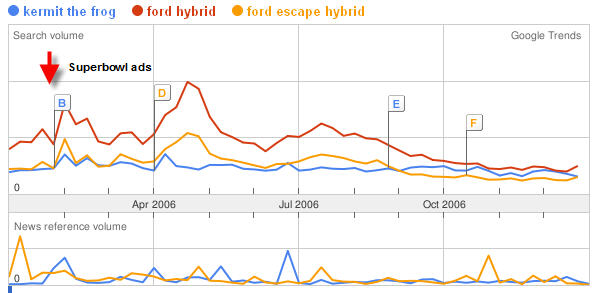
Huh? We’re now worried about search taking too much of the advertising budget away from TV, magazines and newspaper? Has Mr. Gatti seen how that particular pie is sliced up lately? If anything, we should flip this and tell all those advertisers dumping millions on television that they should back up those campaigns with a few bucks spent on relevant search terms. Here’s just one example. In 2006, Ford spent mega bucks to promote their new Green line of Hybrid Ford Escapes on the Super Bowl in television ads. They had Kermit the Frog as their spokesperson..er…spokesfrog. But what Ford didn’t remember is that all that media attention would probably drive a resulting spike in search activity. And sure enough, as we can see from the Google trends graph below, there was a spike:

ford campaign

Unfortunately, Ford forgot to bolster their keyword buy by including all related phrases, leaving the door open for General Motors to bid higher for a number of generic relevant phrases, including Ford’s own spokesperson, Kermit the Frog, and intercept search users with pinpointed messaging. The total cost for Ford to close the loop on this particular campaign? Probably less than the cost of Kermit’s personal assistant during the filming of the ad.

Google Home Page gets Skinned – and One Change of Note for SEOs

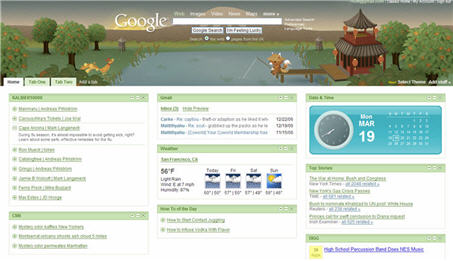
I just had the official walk-through of Google’s recent announcement for personalized home pages. In a nutshell, they are allowing users the opportunity to skin their home page with one of six different themes. The goal, and I quote, is to “delight users”. And they don’t just want to delight them in the short term. They want this to be a long-lasting love affair with the Google home page.

Actually, in the call, we got sidetracked a little bit with something that, to me, was far more interesting. I’ll get to that in a second but first of all let’s look at the noteworthy aspects of Google’s announcement. The theory here is that the more you can personalize your home page, the more likely you are to interact with it on an ongoing basis. And if there’s a certain amount of cool involved, it will hopefully keep you coming back. Of course, Google wants this implementation to be technically clean so they’ve approached it with their typical engineering anal-retentiveness.

googlephpex(1)

The application of the theme is restricted to the top of your personalized home page. Google was very careful to make sure that the graphics didn’t impair either the performance of the page or your ability to get to the information on the page. They’ve taken some fairly ingenious workarounds to this. The themes are launched with a CSS framework and the foreground images are transparent gifs, layered over a tiled background that allows resizing of the browser without impairing the look and functionality of the page.

Google also, and again I quote, wanted this to be about “art and personality”, not about a thinly “skinned” (if you’ll pardon the pun) advertising pitches. They’ve only released six themes in this first round because they wanted to set the bar high. They indicated that they would likely be releasing more over time. And they also indicated that they are considering opening up a skinning API in the future, but they would rather not have highly commercially oriented skins, i.e. promoting the launch of a new movie, suddenly intruding on the personalized home page user experience.

One feature that is pretty cool about the new themes is that they are location sensitive. When you load a new theme the first thing you’ll be asked to do is enter your zip code (right now this release is only aimed at the US, but a release for Google’s other localization areas should come in the near future. I did add one in Canada, but I’m not sure if it’s updating itself). After that, you’ll find your seeing updates itself reflect the time of day and, in some cases, the season and your local weather.

Here are some examples. In Bus Stop, the weather impacting the bystanders changes based on what you might be seeing your window.

busstopresized

In Beach, the time of day will change your view over the seascape. When the sun sets out side, it should also be setting on your monitor.

googlebeach

And, in the seasonal theme, you’ll not only see the theme change based time of day, you’ll also see the changes of the seasons.

googleseasonal(1)

Google also promises some Easter eggs, hidden in amongst the themes.

All in all, it’s a cool add-on to the Google personalized homepage. Of course the rationale behind this announcement is fairly transparent. Google is pushing hard to gain more face time with the average user, and this gives them a front to attack on. The more time you spend the Google home page, the more chance you will have to interact the other Google properties. Apparently, Google is seeing some very strong growth trends through 2006 with personalized homepage usage. They’re also seeing a huge ramp-up of content delivered for the home page through their Gadgets API.

The SEM Easter Egg

But what about the search marketing implications? There’s nothing about this particular announcement that should impact how the personalized home page could be used for personalized search, other than Google’s hope that the addition of a personalized theme would lead to more interaction with your homepage. But there was a functional roll out recently by Google that could have implications for the search marketing community. This is something that I wasn’t aware of and was lucky enough to get a quick walk-through.

Googleaddatab

When you sign in to your personalized homepage, you’ll now see a small “add a tab” link beside the tab at the top of your home page. When you click on this you’re asked to name your tab and if you leave the Feeling Lucky check box checked, Google will go out and find the content to put on your new page.

Addatabdialogue

For example, I added a tab called SEO and Google automatically populated it with the latest headlines from SEOmoz, SEO News, Search Engine Land, Search Engine Watch and a number of other SEO sites.

Googletabseo

I asked Google how it was determined what sites would be included in this set of default content. Apparently, it’s decided by the most common choices of other people who have added a similarly named tab. In other words, these represent the aggregate choices of an ad hoc community, defined by the people who are interested in SEO and have decided to add these sites as content to their home page. And the set of default choices will constantly be refined, based on the most popular choices of people who add that tab. However, once you’ve added the tab to your own home page, your default content set remains static.

Okay, that’s interesting. But let’s factor in Google’s other recent announcement, the fact that they now have an integrated personal suite that shares user data from search history and what you have on your personalized home page. It’s not clear right now how much of an impact the content you’ve chosen to include on your personalized home page has on your personalized search results, but Google has said they wouldn’t “preclude” the use of this information in the personalized results algorithm.

Let’s further explore the implications. In these areas of interest, what gets included in the default content set under a possible “add a tab” category might have a significant advantage for any searches that fall within that content area. The more people who leave the Feeling Lucky? check box checked, the more people that will have these default content providers represented on the homepage, which will in turn likely impact their personalized search results. As we start exploring personalized search more and more, we’re starting to see the possible tactics that are emerging for gaining visibility on a personalized search page.

So what’s the bottom line here? Google’s new themes are cute and will likely lead to a higher degree of usage, but they have little impact on the world of search marketing. However, the “Add a Tab” functionality could potentially have a lot more impact.

Debating with Myself about whether or not Google can Change Advertising

Ari Rosenberg, a media buying consultant, had an interesting column last week about Google’s plans to enter the cable TV market, just the same as they’ve made inroads in the radio and print markets. Google’s approach in all these markets is consistent. They will apply technology to open up the marketplace, removing the middleman and basically automating the purchase of media. Ari argues that while Google may understand technology, they have a lot to learn about how advertising works. This is a huge, complex question and there are a lot of different shades of gray to the argument. It’s not a simple yes or no argument. But there are some very interesting aspects, both pro and con, there he touches on in his column. So I’d like to present to differing viewpoints, both pro and con, about why or why not Google may actually change how advertising is done.

The Pro Side: Making the Marketplace More Efficient

There is no doubt that there’s a lot of room for efficiency in most media buying markets. There is a layer upon layer of friction in the marketplace, caused by entrenched consultants, reps and buyers and other “filler” between the ultimate buyer and seller. This is where Google can excel. Their theory is that they can remove the friction by using their technology to enable marketplaces where buyers and sellers can connect directly. More than this, they introduce the notion of relevancy. Ultimately, Google wants to achieve their end marketing goal of always showing the right ad to the right person at the right time. They would take the idea of keyword relevancy, pioneered so effectively on the Web, and apply it to other channels. Of course this depends on a more interactive version of print, radio, or cable than we currently see. But as all media converge, Google’s initial inroads into each of these channels will secure them a foothold at the time when relevancy starts to matter.

In this regard, Google is definitely dealing from two areas of strength. They understand technology and have been successful in developing clean, efficient interfaces to help streamline the flow of commerce. There is definitely a change that is needed in the media buying marketplace and Google has the engineering chops to clean it up dramatically. Also, they have a clear and deep understanding of consumer intent, expressed in the consumer’s own terms. And as it begins to matter more in advertising, Google is well-placed to make those consumer initiated connections happen.

The Con Side: Understanding Marketing

In last few years, I’ve had enough interaction with Google to understand that for them, marketing is considered a necessary evil. There’s a lot of “soft”, undefinable aspects to marketing, that can’t be distilled into a simple, clean algorithm. This is thinking that is largely foreign to the Google frame of mind. Google loves mathematical simplicity and definition. Two plus two should always equal four. The question shouldn’t be up for debate. But marketing is not that simple, not that clean, not that black-and-white. There’s a lot of gray in marketing.

Ari makes the point that Google doesn’t understand advertising. This is largely right. Google is an engineering company. It exists to apply technology to solve problems. If you look at the makeup of the Google organization, their own marketing department is a small, under resourced afterthought. Because they didn’t need to use advertising, the philosophy is that really is not necessary for anyone. As Google steps into advertising, think of them as Mr. Spock, reluctantly doing a stint as a Madison Avenue ad exec (now that’s an idea for a sitcom).

The Wild Card: the Consumer

Ultimately, it’s not Google or Madison Avenue that will have the last word in this debate. It’s you and me and 6 billion (and counting) other consumers. There is an old world and the new world in marketing. And the former is rapidly giving way to the latter. The wild card in all this is the changing game of marketing. Sure, Google may not understand the “warm fuzzies” of marketing, those undefinable aspects of brand engagement, but what Google does understand is connecting users with what they’re looking for. And do we really need advertising that hits us at a visceral and an emotional level, when it’s exactly the advertising we’re looking for anyway? It doesn’t have to hammer us over the head with its message, because we’re openly receptive to that message, we’re seeking it. As Google moves into print, cable, and radio it may not be that their lack of understanding of the current reality of marketing that will hold them back for making it successful. It may be the fact that those channels just don’t lend themselves very well to this new idea of consumer empowerment. Consumer empowerment is expressed much more easily over the interactive platform of the Internet. The Internet is the next evolution of marketing. The question will be more if Google can make a significant inroad into these more traditional channels before the channels become integrated within interactive, Web driven platform. Or will there be just too much friction to overcome?