The Psychology of Entertainment: Does Entertainment have an Evolutionary Purpose?

One of the interesting things we found about the 20th century was that humans are not really built to deal with abundance. Anytime we have too much of anything, our evolutionary guidance control systems seem to go awry. The human survival mechanisms were designed in an environment of scarcity. In the words of John Locke:

The life of man, solitary, poor, nasty, brutish and short.

We were built to rise above the odds, to survive in spite of adversity and hardship. In that scenario, the resiliency of humans is astonishing. But once the fight is over, we tend to languish and drift. History has repeated the story over and over again. The first well documented case was the fall of the Roman Empire:

“But the decline of Rome was the natural and inevitable effect of immoderate greatness. Prosperity ripened the principle of decay; the causes of destruction multiplied with the extent of conquest; and, as soon as time or accident had removed the artificial supports, the stupendous fabric yielded to the pressure of its own weight…. The victorious legions, who, in distant wars, acquired the vices of strangers and mercenaries, first oppressed the freedom of the republic, and afterwards violated the majesty of the purple. The emperors, anxious for their personal safety and the public peace, were reduced to the base expedient of corrupting the discipline which rendered them alike formidable to their sovereign and to the enemy; the vigour of the military government was relaxed, and finally dissolved, by the partial institutions of Constantine; and the Roman world was overwhelmed by a deluge of Barbarians.”
– Gibbon – Decline and Fall of the Roman Empire

Getting Soft Does Not Equal Survival

The Inevitable Effect of Immoderate Greatness….a cautionary tale if ever there was one. What does that have to do with the psychology of entertainment? Well, everything. With abundance comes leisure time. With leisure time comes a desire to seek entertainment. And when we seek entertainment to excess, we tend to get mired down as a society. As Edward Gibbon documented, the Roman Empire fell because of many factors – a wide spread empire that overcame its notion of centralized government, the rise of Christianity, economic reasons, but most of all, Rome fell because most Romans found themselves in the leisure class and didn’t know what to do with themselves. They got soft.

We’re A Modern Rome, and that’s not a Good Thing

8293_psychology_cartoon_DKMy personal feeling is that we’re currently following in Rome’s footsteps. The 20th Century was one of extreme excess. The richest parts of the world got fat and lazy. No, not everyone. But on the average, the facts speak for themselves. Over 70% of Americans are fat or obese. If we look at the last 50 years, the percentage of US adults who are obese or extremely obese has gone from under 15% (in 1960) to 41.3% (2006) according to the National Health Examination Survey. And the latest AC Neilsen numbers indicate that the average American spends over 5 hours a day watching TV. That’s 153 hours of TV every single month. Of course, TV’s not the only passive form of entertainment we consume, but it’s by far the most measurable and easiest to identify. Using the internet is rapidly catching up, with Forrester reporting we spend about 12 hours a week, or 50 hours a month, online. Of course, one of the challenges we’ll identify with online time is that it’s difficult to categorize it as entertainment. But let’s say that at least 25% of our time online is spent being entertained in some way (consumption of online video is a popular activity). That brings the grand total to about 165 hours a month being passively entertained, about the same time we spend at our jobs and almost as much time as we spend sleeping. We spend almost a third of our lives being entertained, in one way or the other. This is not active entertainment, this is not social entertainment, and in most cases, this is not intellectually stimulating entertainment. This is sitting in front of a screen consuming mindless entertainment. Humans were not built to do that.

If one were a Darwinist (which I am) one would have to ask – what is the evolutionary point of entertainment? With the single minded view of Richard Dawkin’s selfish gene, how does our creation of and need for entertainment increase the odds of our genes propagating? It’s not an unusual question. The same question has been asked about art, for example. Here, I think it’s important to explore the difference between a genotype and a phenotype, as the two often get confused when evolutionary questions arise.

Genotypes and Phenotypes

The genotype (courtesy of Professor John Blamire) is “the “internally coded, inheritable information” carried by all living organisms. This stored information is used as a “blueprint” or set of instructions for building and maintaining a living creature. These instructions are found within almost all cells (the “internal” part), they are written in a coded language (the genetic code), they are copied at the time of cell division or reproduction and are passed from one generation to the next (“inheritable”). These instructions are intimately involved with all aspects of the life of a cell or an organism. They control everything from the formation of protein macromolecules, to the regulation of metabolism and synthesis.”

The phenotype is “the “outward, physical manifestation” of the organism. These are the physical parts, the sum of the atoms, molecules, macromolecules, cells, structures, metabolism, energy utilization, tissues, organs, reflexes and behaviors; anything that is part of the observable structure, function or behavior of a living organism.”

The difference between a genotype and a phenotype is where many nature/nurture debates get hung up on the rocks. It might be helpful to use an analogy, going back to the concept of a “blueprint”

The Genetics of Urban Renewal

Imagine you’re the architect of a new building that is to be built in the downtown core. You design the building to be the best possible fit for the location where it’s to be built. You put together a highly detailed plan for the building, down to where each outlet is to be placed and the finish of each door knob. Then, you pass the plan over to the construction crew. This is the building’s “genome”.

The building gets built according to your plan, but then your influence over the building is finished. The building becomes a physical object within an environment, and as such, it has many interactions with that environment. These interactions can alter the nature of the building (especially if you’ve built flexibility into your initial design, which is certainly the case in the human genotype) and also, the building will alter the nature of the environment. For example, let’s say this new building was meant as a showpiece for renewal in an older and more run down part of the downtown core. If the building was successful in this goal, one might see it’s spark further development around it, literally changing the face of the environment.

Here’s another example. Let’s say the building was a 32 storey office tower that replaced a 2 storey run down apartment block. Obviously, that’s going to significantly increase the number of people who occupy the “footprint” of the building. In the old building, we might have had 20 lower income families. Suddenly, we have almost 5000 office workers who come to the building between the hours of 8 and 5, then go home. Any urban planner is going to see the dramatic impact that is going to have one the surrounding area. Parking, services, recreational areas, traffic routes…all these things will have to change to accommodate your design.

None of these environment changes were captured in your original blueprint, but they all resulted directly because of your plan. These changes, the interplay between the building and it’s environment, is a rough analogy for a phenotype. The phenotype is the “long shadow” of the genotype.

Evolution is a Harsh Critic of Phenotypes

Here’s another important fact to consider about phenotypes and genotypes. Evolution is relatively ambivalent about phenotypes. While they’re important to the organism, they serve a perfunctory role in natural adaption. Phenotypes are the acid test that determines whether or not genes get passed on. If the genotype leads to a phenotypical environment that results in higher reproductive success, it will get passed on. It if doesn’t, it dies out. This is the sole driver behind Dawkin’s selfish gene.

To go back to our building analogy, it’s as if the sole success of the building was determined by how much lease revenue it generated over a 50 year period. If it generated more than all the other buildings in a 5 block radius, your design would be used again and again. Using this one measure of success, all the phenotypical impact of the building – the rerouting of streets, the sparking of new construction, the addition of parking facilities, the very change in this section of the downtown core – only matter if these led to more lease revenue. If not, all these outcomes of your design are irrelevant.

If we talk about entertainment, I suspect we’re talking about phenotypes, not genotypes. In the next post, I’ll pick up this thought and explore further.

The Psychology of Entertainment: a Recap

psychThus far in this series, we’ve covered a lot of territory in looking at the psychology of entertainment. If you remember, when I initially started, my premise was that an audience had to stabilize before it provided a reliable market for advertisers. Unless you knew who you were talking to, you were relegated to conducting “drive-by” marketing, presenting your message to a transient set of eyeballs rather than a real live person you knew something about.

In looking for this loyalty online, we have to move beyond the “bright shiny object” syndrome that typifies much of our digital behavior. There seems to be a segment of our society that flits from trend to trend, creating enticing hockey stick growth curves that both VCs and marketers chase. But in the vast majority of cases, this attention deficit segment eventually moves on to the newest, greatest thing and the jilted online love implodes. For example, along the social network path there are any number of used and tossed aside past favourites. Remember Six Degrees, Friendster or Orkut? Even MySpace has largely given way to Facebook.

My original premise was that we have to find usefulness in an online destination before we’ll give it our loyalty. And we have to be loyal to a destination long enough for marketers to be able to identify a stable audience that they can know something about. Lance Loveday countered by saying that entertainment could also be a factor, along with utility, that leads to loyalty. That’s when I started to look at the psychological underpinnings of entertainment. Up to this point, I have spent much of the time looking at television, simply because it’s our most common form of entertainment. This week, I’ll be going back online to find entertainment, but before that, I should recap the basics of what we’ve learned, because we’ll be applying the same loyalty acid test to online entertainment.

We Love a Story

The most common and consistent element in the history of entertainment is the story. There is something inherently appealing about a narrative. In this post, we discovered that our brains respond well to stories. It’s easier for us to keep details in mind when they come wrapped in a story. Stories give us a rich context to project ourselves into, engaging the brain more fully. Stories are “software” that runs natively on our “hardware.” I gave memory champ Andi Bell and best selling author Malcolm Gladwell as examples.

Some of Us are Addicted to Entertainment

In most human characteristics determined by our genome (weight, height, intelligence, etc) the population plays out on a normal distribution curve, with the majority of us clustered around a central norm. Researchers Timothy Brock and Stephen Livingston found the same is true for our need for entertainment. In this case, they defined entertainment as passive entertainment, such as watching TV, rather than active entertainment like participating in sports. They found there is an unusually high need for entertainment amongst a significant segment of our population. While the norm seems to indicate that we’re very attached to our TV set, in extreme cases, researchers have found that TV consumption borders on true biological addiction.

Our Entertainment is Making Us More Passive

Researchers have found another troubling trend emerging through the 20th century. We appear to be turning into a nation of watchers. We sit back, waiting to be entertained. In many areas of our society, including education and politics, the tradition of Socratic debate has given way to passive consumption of information and, in the case of the later at least, propaganda. Neil Postman, for one, feels we’re “Amusing Ourselves to Death”. Robert Putnam found a strong correlation between TV watching and withdrawal from community participation.

How We Connect to TV

So, how did this strong (and in some cases, addictive) bonds to TV form? Our psychological bonds to TV shows parallel our need as social animals to connect with people, to identify our place in our social networks and to share common interests. Cristel Russell, Andrew Norman and Susan Heckler explored how we connected to TV shows and found 3 common bonds: viewer to program, viewer to viewer and viewer to character. The viewer to program bond comes from an aesthetic or artistic appreciation of the show. You applaud it’s production values, or the script. This is probably the most detached bond, and interestingly, is more common in men than women. The next bond is viewer to viewer. Here, a TV show becomes a social lubricant. If gives you something in common to talk about with your friends. The final bond is viewer to character. Here, the veil between reality and fantasy starts to slip a little. At it’s most benign, it’s just an identification with a character in a show. Like tends to bond with like. Grey’s Anatomy if a favourite amongst those that work in the medical profession, for example. And I know at least a few Democratic party faithful who are lifelong West Wing fans. Sometimes viewer-character bonds become less grounded in the real world and turn into delusional obsessions.

Because these bonds to TV are often grounded on social connections, whether real or imagined, it’s not surprising that they are nurtured in the same way face-to-face relationships are. These relationships grow over time, as we learn more about the characters we’re watching. They seem to grow strongest when there is a continuing storyline and character developments we can become engaged in. And finally, this ongoing narrative comes in a language our brains were built to process. We get stories. And we particularly like stories that play out the way we think they should. We like happy endings.

What Makes a Hit Show?

Now that we know the nature of our connections with a TV show, we should be able to predict what would make a successful TV show. What shows cause these bonds to flourish.

If we look at the hits over time, certain themes emerge. In Situation Comedies, characters are more important than the situation. While a novel situation is intriguing in the short term, it’s our connection with the characters that will build long term loyalty. It wasn’t the fact that M*A*S*H was set in the Korean War that made it interesting, it was that the complex environment provided so many opportunities for rich character developments within the show. There can be no situation less interesting than the premise behind Friends – 6 20 somethings living their lives in lower Manhattan. Friends hooked us because we cared about Ross, Rachel, Chandler, Monica, Joey and Phoebe.

The Thin Line Between Humor and Fear

What makes us laugh? At the most basic level, we laugh when we know something that appears threatening turns out to be harmless. Babies laugh when we make light of potentially stressful situations (a primary care giver momentarily disappearing during a game of peekaboo, an adult staging a mock “tickle” attack). This tendency sticks with us throughout our lives. It’s why we laugh at slapstick. Laughter shows that we’ve mastered some small part of our environment. In the case of a joke, it’s the “click” that happens when we solve an incongruity – we “get” the punchline. However, the satisfaction we get from this depend on our social context. Not all jokes are equally satisfying to everyone.

How We Process Humor

Men and women process humor differently. “Getting” humor appears to depend on a delicate balance between right brain and left brain processing. The left brain (the logical side) tends to assemble the required information, but it’s the right brain that comprehends the situation and, at a subconscious level, finds the humor in it. The “click” of getting a joke happens on the right side. That’s why jokes cease to be funny when we overanalyze them (which happens on the left side). It’s also why an academic paper on humor is probably the least funny thing you’ll ever read. As we start to look at the different types of humor, we start to see some divisions in what we find funny. Women, for example, are drawn to humor that involves social situations. Men tend to laugh more at jokes that involve sex and scatological references. And while slapstick can elicit belly laughs, wit tends to draw a smile. Slapstick taps into the fear/humor circuit, where wit is more of a social aspiration.

The Hooks of Our Favorite Shows

In this post, I took a look at some of the success factors of past TV hits.

Survivor – The situation of Survivor, the idea of competition, was the hook here. Unfortunately, by it’s very nature, Survivor found it difficult to carry loyalty from season to season. We had to get to know a whole new cast of characters each time.

West Wing – Witty dialogue and impossibly clever characters set up perhaps the most socially aspirational show in history (at least for Democratically inclined intellectual elitists) but it was overly dependent on creator Aaron Sorkin’s scripts. When Sorkin moved on, so did our interest.

American Idol – The mega talent show seems to be the exception to the continuing narrative rule. Why is this show not suffering the same fate of other season-by-season reality premises? It turns out that American Idol and other shows like it do tap into a narrative – our own. We have a built in need to admire talent, especially undiscovered talent. Where they go, so could we. It’s another cue that comes from our highly social evolutionary past.

Why We Love Violence 

Our taste for violent entertainment actually has a physiological basis. Violence taps into a basic good vs evil archetype, but this alone doesn’t explain it’s appeal. We love violence because it tweaks the danger detection circuits of our brain, releasing neuro-chemicals that give us a natural high. Our bodies become primed for action through the images and sounds we see, and this makes us feel more confident, ready for action and hyper-alert. Violent entertainment tricks our bodies into believing that we’re in danger, so the body responds appropriately. Not all people are alike in this regard. Some of us have a higher need for this type of sensation than others. This trait was quantified in the 70’s by Marvin Zuckerman and his sensation seeking scale. It has been found since that those with the greatest taste for sensation also tend to exhibit other addictive tendencies.

Are Video Games too Real?

If violent entertainment fools our brain into delivering an artificial high by getting us ready for a fight, how can we manage to stay in our seats through a 2 hour movie. As I explained in this post, the danger alert circuit is modulated by our cortex, which dampens down the impact of the alert. Essentially, our brain keeps telling itself that it’s not real, so just calm down. But the new technology being incorporated into video games is making it more and more difficult for our brains to determine what’s real. As games become more sophisticated, with photo-realistic graphics (even in 3d), more interactive and controlled by real body motions and not just a control pad, our brains could be forgiven for forgetting it’s all a game. We already know violent games are mildly addictive as we become dependent on the potent chemical cocktail that gets released as the brain is partially fooled into thinking the danger is real. So what happens, we have to wonder, when these games get even more realistic?

Why We Love being Entertained in Crowds

Why do we enjoy being entertained more when we’re in a crowd? The answer could come from our evolutionary past. The survival success of a herding animal comes from it’s ability to communicate potential danger quickly through the group. So, for humans, emotions are highly contagious. We pick up on the mood of the crowd around us and eventually synchronize our own mood to it. The loops the brain uses to do this are fascinating and are covered off in much more depth in this post.

The purpose of these 11 posts was to explore how we’re entertained. With that in mind, we can then look at our online alternatives and make some guesses about how entertaining we’ll find them. Remember, we’re looking for long term loyalty here, an audience that stays consistent enough that we can start to effectively target marketing messages to them with some understanding of who they are. So, here are the bullet points:

– We engage with narratives
– We connect with characters we care about
– Interactivity can’t get in the way of the narrative.
– Primitive humor and fear share the same basic roots
– Humor is in the eye of the beholder
– We love to admire talent, especially underdogs
– Violence and sensation deliver a natural high
– We are social animals and emotions are contagious

Tomorrow, we’ll start to explore how these foundations of entertainment translate to the online environment. And we’ll begin with an important question: Do we have too much entertainment?

The Psychology of Entertainment: Why We Love Watching in Crowds

3d-audienceWe laugh more at movies when we watch them with others. We get bigger thrills from action thrillers. We’re more likely to cry during a tear jerker. When we’re with a bunch of other people, it’s as if our emotions are turbocharged. Why?

One could say it’s our environment. Sitting in a darkened theater we focus more attention on whatever we’re watching. There are fewer distractions. We become more fully engaged with the experience. This provides part of the answer, but it’s certainly not the entire answer.

One could also say it’s the technology. It would be hard to argue that a billboard sized image that fills our entire field of vision (especially one that gives us a 3D experience) is more powerful than the typical home screen. Back that up with a full theater sound system and you have a powerfully engaging experience. Certainly that might explain the higher octane thrills we would get in an action movie, but it doesn’t seem as applicable in a tear jerker or a comedy. Is a 40 foot high Rachel McAdams more emotionally compelling than a 2 foot high one? Possibly, but the explanation still seems to fall short.

We know that we behave differently in groups than we do as individuals. At its most benign, it’s the shared experience of an entertainment event. At its most sinister, it’s the so called “mob mind,” a crowd induced mentality that through history is responsible for millions of lost lives. The power of synchronized emotion is immense.

The Psycho-Analytic Explanation

But where does this shared experience, this synchronization of emotions, come from? According to Carl Jung, we synchronize our emotions and thoughts when we come together in a group because we all share an identical “collective unconscious“, a universal framework of archetypes and motifs. It’s as if, when we get together, we all have the same subconscious script we’re reading from, written by our collective culture. Freud felt that we act differently towards people when we’re in a group than we do as individuals. The minds “merge” together into one way of thinking and enthusiasm for this view becomes increased as a result. And Le Bon believed it was the relative anonymity of the crowd that allows us to generate collective emotions that we might not have as individuals. All of these speak to a collective “meta” motivation, a common will that lives apart from the individuals who make up the group. Do mobs have a mind of their own? Most of the research done in this area has been around questions that have a much greater social implication than whether we laugh or not at the movie. But perhaps the answer comes from the same place. And perhaps it’s not as complex as Jung, Freud or Le Bon would have us believe. Is there a collective consciousness that takes over, or is it instead some fairly simple inherent mechanisms that come as standard equipment with we humans.

The Evolutionary Explanation

So, to go back to the question, are we more likely to laugh at Jennifer Aniston in a theater rather than at home because we have a shared collective archetype-driven subconscious script that indicates we should laugh at her? Do we laugh because we feel anonymous in a crowded theater and so let our inhibitions slip? Or do we laugh because we have given ourselves over to the collective thinking of the group? Maybe, just maybe, we laugh because the person beside us is laughing. Maybe it’s that simple.

We know that emotion is contagious. “Smile and the world smiles with you.” Cliche? Perhaps, but scientifically true. If we see someone smile, we’re more likely to smile ourselves. This is especially true if we like the person who is smiling. This is Bargh and Chartrand’s “Chameleon Effect.” We mimic others, especially those that we feel emotionally connected to. Emotional contagion is strongest between people who are close: family and best friends. In their book “Connected: The Surprising Power of Our Social Networks and How They Shape Our Lives“, Nicholas Christakis and James Fowler cite studies that show when a normal individual is paired with a mildly depressed roommate in college, soon the normal individual also becomes depressed.

Bio Feedback

The amazing thing about emotions are that they don’t always travel from the brain outwards. Our body feeds back signals to the brain that can change our mood. If you smile, you suddenly start feeling better. If you laugh, your outlook on life picks up. Telephone operators are told to smile when they’re on the phone, even though the person on the other end of the line can’t hear them. And there are documented cases of widespread contagious laughter. Dr. Madan and Madhuri Kataria have started Laughter Yoga, a “global movement for Health, Joy and World Peace” based simply on spontaneous laughing, practiced in laughing clubs around the world.

Why do these outward signals of our emotions spread through a group like wildfire, even as they change the very mood of the group? The answer, evolutionary biologists suspect, may lie in the fact that laughter and smiling almost certainly predate language amongst humans. Humans travelled in groups for their own protection. The reason groups are safer than traveling as an individual lies in the fact that groups have many sets of eyes and ears, where a lone human has only one set of each. Groups work as early warning systems. But these systems only work if the word spreads quickly. And that presents a problem. What happens before there were words? This is where our facial expressions and emotions come in.

Our Facial Recognition Hardware

The human brain has a dedicated mechanism solely for reading facial expressions, the fusiform gyrus, which then feeds these signals to the amygdala. The amygdala, as I’ve mentioned before, is the early warning detection system of the brain. And this mechanism makes a very important determination. It either switches on or off our defence mechanisms and it does so subconsciously, in about 1/10 of a second (the same timing, interestingly, that we use to recognize favored brands). So, a look of fear, terror or alarm can alert others around you in a fraction of a second. Language, which uses more recently evolved portions of our brain, can’t respond nearly as quickly. This alarm system alerts those around us by making our emotions their emotions. But it’s not just terror that spreads quickly. We are tuned to pick up any strong emotion and pass it along. Groups that feel the same way about things tend to be a better survival unit than those that don’t. When you think about this, it makes perfect evolutionary sense. It’s not enough to simply make people aware. If you want to survive, you have to ready them for action. And the fastest way to do this is to have the ability to quickly spread the same emotion through a crowd. The human brain is superbly tuned to pull this off. The fairly recent discovery of mirror neurons are responsible for our mimicry and seem to be an integral part of emotional contagion and synchronization. Below, VS Ramachandran provides some amazing examples of how humans lose core abilities when specific parts of the brain have been damaged.

But what happens as we leave the African savannah behind and start hanging out in movie theaters and community playhouses? The same mechanisms come with us, and we use them in the same way. We pick up emotions from those around us. And we do so because we’re wired to do so. It’s not a conscious decision. It’s just a very old part of our brain doing it’s job. And the entertainment industry is starting to incorporate this understanding of human nature into how it builds our entertainment experiences. At the recent TEDActive conference, sheer chance put me beside a psychologist and an amusement park owner during one lunch break. Soon, they were talking about the role of mirror neurons in the design of thrill rides – how closely do you have to sit together and what visual vantage point do you need to let the thrill of a roller coaster spread from one person to the next?

To Laugh, Or Not to Laugh

Perhaps the most interesting example was when Shakespeare’s Globe theater was rebuilt in London. In Shakespeare’s day, plays were performed in broad daylight, people stood together in crowds and they could easily see each other. The plays were raucous affairs filled with laughter, jeers, taunts and strongly expressed emotions. But over time, theaters became darkened and isolated cocoons that started to separate people from each other. When the Globe was resurrected, it was built to be historically accurate. This meant that for the first time in 400 years, people were seeing plays in the same environment they were originally performed in. The result? The crowds seemed to enjoy the plays more. They were noisier, stamped their feet, cheered louder and laughed more. They had more fun. Shakespeare, it appears, knew a thing or two about the power of a crowd.

This all brings up an interesting question for us to consider. In the last few posts I talked about how technology might be turning us into a nation of addicted watchers. Video games may significantly up the bar in false manipulation of the brains circuits. But increasingly, we’re also consuming those entertainment experiences by ourselves. If we’re built to enjoy things more when we’re in a group, what is the long term impact of being entertained alone, in the dark? Will technology start to simulate the effect of a crowd? Will we be put in virtual communities when we watch something? In fact, we’ve already started down this path. TV directors found out very early in the history of the new medium that audiences were much more likely to laugh if they were cued by a laugh track.

In the next posts, I’ll start to bring us back to the original question, which was does entertainment build loyalty online? We’ll look at what we find entertaining online. For example, is a social network useful or entertaining? Do we consume video differently online? Will we build the same loyal viewing habits now that we can timeshift our viewing schedule to our convenience, not the networks? How will an increasingly interactive experience impact our entertainment tastes?

The Psychology of Entertainment: Will Video Games Become Too Real for Us to Handle?

Man_Playing_A_Video_Game_1575481-310x416In yesterday’s post, I explored our psychological attraction to violent action thrillers. Today, let’s go one step further. What is the attraction of violent video games? And how might this attraction deepen and even become pathologically dangerous as the technology behind the games improves? It’s a question we’re speeding towards, so we should stop to consider it.

In TV and film, violent action triggers a chemical reaction in the brain that we find stimulating and pleasing. As cortisol and dopamine get released, we experience a natural high. Strong evidence points to a connection between sensation seeking (triggering the high) and addictive tendencies.

The Veil of Non Reality

There is a “veil of non-reality” that moderates this reaction however. The high we get from violent entertainment comes from the limbic structures of the brain, triggered by the amygdala and other sub-cortical neural modules. This is the primal part of the brain that ensures survival in threatening situations, which means that responses are fast but not deliberate. The higher, cortical parts of the brain ride overtop of these responses like a governor, toning down the responses and modulating the overactive danger response mechanisms. It our brains didn’t do this, we’d quickly burn ourselves out. Cortisol is a great stimulant when it’s needed, but a steady diet of it turns us into a quivering pile of anxiety-ridden stress.

When we watch entertainment, this modulating part of the brain quickly realizes that what we’re watching isn’t real and puts its foot on the brake of the brain’s natural desire to pump out Cortisol, dopamine and other neuro-chemicals. It’s the “voice of reason” that spoils the fun of the limbic brain. Despite the fact that there’s car’s exploding left and right and people are dropping like flies, the fact that we’re watching all this on a 2 dimensional screen helps us keep everything in perspective, preventing our brain from running away with itself. This is the veil of “non-reality” that keeps us from be fooled that this is all real.

The Imagined Reality of Entertainment

But let’s stop for a moment and think about how we’re consuming entertainment. In the past decade, screens have got bigger and bigger. It’s no coincidence that we get a bigger high from watching violence on the big screen than from watching it on a 20 inch home TV. The “veil of non-reality” starts to slip a little bit. It seems more real to us. Also, we feed off the responses of others in the theater. We are social animals and this is especially true in threatening situations, even if they are simulations in the name of entertainment. We pick up our social cues from the herd.

It’s not just the size of the screen that’s changing, however. Technology is continually trying to make our entertainment experiences more real. Recent advances in 3D technology have not only made James Cameron even wealthier, they also deliver a stronger sensory jolt. Watching Avatar in 3D is a sensory explosion. The veil of “non-reality” slips a little further.

But improvements in graphic technology can only go so far in fooling the brain. Much as our eyes might be deceived, we’re still sitting passively in a chair. Our interpretation of the world not only relies on input from the senses, it also relies on our own sense of “body” – Antonio Damasio’s somatic markers.

The Satisfaction of Control

This is where video games are quickly approaching a potential crisis point in sensory overload. Even the best Hollywood thriller requires us to sit passively and consume the experience. We have no control over plot, dialogue or the character actions. We can only engage in the experience to a certain level. In fact, much of the appeal of a Hollywood thriller comes from this gap between what’s happening on the screen and what’s happening in our own minds. We can imagine possible outcomes or perhaps the director gives us knowledge the protagonist doesn’t have. We experience suspense as we see if the protagonist takes the same actions we would. We silently scream “Get out of the house!” to the teenage babysitter when we know the psychopathic killer is upstairs.

But video games erase this limitation. With a video game, we’re suddenly in control. Control is a powerfully seductive condition for humans. We naturally try to control as many elements of our environment as possible. And when we can exert control over something, we’re rewarded by our brains and a natural hit of dopamine. That’s why completing a puzzle or solving a riddle is so inherently satisfying. These are tiny exertions of control. In a video game, we are the authors of the script. It is we who decide how we react to dangerous situations. Suddenly we are not a passive audience. we are the actors. This is cognitive engagement at a whole different level. Suddenly the appeal of sensory stimulation is combined with the rewards we get from exercising control over novel situations. That’s a powerful one-two punch for our brains. And the veil of “non-reality” slips a little further.

Virtual Reality

The negative impacts of video games have been studied, but again, like TV, studies have been largely centred around one question: does the playing of video games lead to increased aggression and violence in children? And, like TV, the answer seems to be a qualified yes. For those already prone to violence, the playing of video games seems to reinforce these attitudes. But it’s also been argued that the playing of video games provides a cathartic release for violent tendencies.

Less research has been conducted on the cognitive impact of video games, and it’s here where the bigger problem might lie. A few studies have shown the playing of video games could be addictive. A Japanese study found that excessive video game playing during adolescence seems to alter the way brains develop, impairing the ability to focus attention for long periods of time. In fact, a number of studies have shown links between exposure to excessive sensory stimulation through electronic media and the incidence of ADHD and other attention deficit disorders. It’s this longer term altering of how our brains work that may represent the bigger danger in video games.

Video games combined violent scenarios, which we know to provide sensory jolts to the brain, with the seduction of control. What has limited the addictive appeal of video games to this point are two things: how realistic the scenarios are perceived to be and the way we interact with the games. And, in both these areas, technology is moving forward very quickly.

Video game graphics have come a long way, but they still lack the photo realism of a typical Hollywood movie. However, the distance between the two is lessening every day. How far away are we from a video game experience that matches the realism of Hollywood? Huge advances in computer graphics and sheer processing power are bringing the two closer and closer together. The day is not far away where our experience in a video game will feel like we’ve been dropped in the middle of a movie. And, with 3D and virtual reality technology, even the physical separation of a screen will soon disappear. The imaginary world will surround us in a highly realistic way. What will that do for the “veil of non-reality?”

The other area where video games have improved dramatically is in the way we control them. The control pad with various triggers and buttons was a artificial way to interact with the video game world. A spin-jump-kick combination was triggered by pushing down a few buttons while we sat in a chair. This helped our brain maintain it’s distance from the imagined reality. But Nintendo’s Wii changed how we interact with video games. Sophisticated sensors now translate our own body motions into corresponding digital commands for the game. Even our bodies are fooled into believing we’re actually playing golf or participating in a boxing match. Interestingly, Nintendo made the choice to make the graphics on the Wii less realistic, perhaps trying to maintain a “veil of non-reality.”

The Wii opens the door to a much more realistic way of controlling video games. Now our own body movements control the virtual character. Suddenly, our body is providing reinforcing feedback to our brain that this might just be real. When you combine this with photo-realistic visual input and audio input, one could forgive our brains for not being able to determine what is real and what isn’t.

Entertainment Overload?

If technology continues down the path it’s own, the virtual reality of a video game may be indistinguishable from the true reality of our lives. If the “veil of non-reality” permanently slips, we have a huge potential problem: our lives pale in comparison to the sensory possibilities of a virtual world. That’s why our brains may not be equipped to handle the overload. We may get addicted to sensation as the brain is fooled into giving us stronger and stronger hits of cortisol, dopamine, adrenaline and other natural narcotics. When the “veil of non-reality” slips away forever, our brains may not be equipped to handle the new virtual reality.

The Psychology of Entertainment: Why We’re Hooked on Violent Action Thrillers

In previous posts, I explored what encourages long term loyalty to a TV show. All of this entertainment psychological navel gazing was prompted by the original question: how does entertainment “hook” us and how can marketers use that to effectively connect with potential customers, especially online?

The Intrigue of Violence

heath32201_468x312Before we move on from TV, there is one genre we have yet to explore: the action thriller. Why does violence intrigue us? If you think about it, there is nothing rational about this proclivity we have towards violence. In our society, our own bodies are considered taboo. The female breast, the source of sustenance for all of us when we’re born, cannot be seen on TV. Yet we regularly watch, even expect, primetime shows where humans lives are snuffed out without a second thought. If you stop to seriously contemplate this cultural paradox, there can be no logical answer. Why would we possibly be entertained by watching others of our species be subjected to harm? Yet the draw of violent action is undeniably human.

By the time the average American child is 18 they will have watched 200,000 acts of violence on TV. And we, as parents, rarely question this form of entertainment. On any given night, on one channel alone, you’re likely to see a least a dozen murders. In 8 seasons of 24, Jack Bauer has personally dispatched over 200 people (according to http://www.jackbauerkillcount.com). There are no fewer than 5 websites that keep tally of Bauer’s body count. Season 4 was the bloodiest, with Jack adding 44 souls to the death toll. Now, if you consider that each episode of 24 represents a single day in Bauer’s life, that means he’s a pretty busy killing machine. Even allowing for the fact that Bauer doesn’t seem to sleep (or urinate, for that matter), that’s still a murder every 32.7 minutes. Now..that’s entertainment!

But why is violence entertaining? It’s not as difficult to understand why sex sells. After all, it’s tied into our need to procreate, so the evolutionary linkages are pretty easy to understand. But our love of violence presents more of a mystery.

It’s More than Good vs Bad

As I wrote before in a previous post, we have pretty simply formulas for a successful narrative – the good guys are supposed to triumph and the bad guys are supposed to be defeated. Action thrillers wrap themselves around this central truth, with the good guys routinely dispatching the bad guys (The Bauer/Bad Guy Kill Ratio certainly reinforces this psychological truth). Every so often, just to keep things interesting, someone close to Bauer meets an untimely end. Those thinking Jack Bauer in romantic terms would do well to reconsider. Bauer’s wives and love interests also have a habit of dying. Losing a sympathetic character hieightens the dramatic impact of the narrative. But if we have this inherent connection with stories, why do we need violence? Would we be just as satisfied if Jack Bauer soundly trounced his enemies in a good game of backgammon? I suspect not.

So it’s not just the good against evil archetype that we look for in an action thriller – it’s the violence itself. And this comes from the same mental circuit that we explored when we looked at why we laugh, our danger detection circuit.

The Sensational High

The human body responds in a unique way to signals of danger. The brain readies the body for fleeing or fighting. And it does so by a sudden release of neuro-chemicals, including the hormone cortisol and both adrenaline and noradrenaline. These chemicals not only ready us for action, they also cause us to believe that we can overcome opposition. Confidence in threatening situations provides an evolutionary advantage, as long as it leave the door open to a rapid exit of the odds are too heavily stacked against us.  Fear, danger and violence all provide us with a natural high that makes us feel more powerful, more positive and more confident. Also, dopamine, the fuel of our reward center, is released as we encounter novel situations. These chemicals, acting together, create a feeling of satisfaction for us.

Psychologists call this need for stimulation sensation seeking. Like most human traits, it’s not universally present or consistent. We have a normal distribution curve of sensation seeking throughout the human population. Marvin Zuckerman created the sensation seeking scale in the 70s. Some of us have an addictive need for sensational stimulation. Some of us avoid it at all costs. Most of us lie somewhere in between. And, not surprisingly, males are more likely to seek sensation through aggressive physical activity and by watching on-screen violence. Televised sports, especially high contact sports like boxing, wrestling, football and hockey all cater to the male need for physical, often violent stimulation.

Studies have found strong links between sensation seeking and addictive personalities. Those that constantly seek sensation are most likely to become addicted to cocaine (which provides a similar high by fooling the same circuits of the brain), alcohol and even gambling. In one interesting twist, some Parkinson’s patients who receive L-dopa, a therapy to replace dopamine, typically lacking in Parkinson’s, suddenly developed a powerful appetite for gambling. By altering the brain chemistry to lessen the adverse affects of their patient’s condition, the doctors unwittingly upped their need to seek sensation.

Hollywood as the Pusher

If danger provides us with a natural high, Hollywood has learned to push this hardwired hot button repeatedly and often. The action thriller is a distillation of sensation. In 60 to 120 minutes, we are treated to a buffet of sensation, all signaling our brain that it should deliver another hit. In our normal lives, few of us are in situations that necessitate the release of these neuro-chemicals more than a few times each year. There is more danger packed into a half hour of primetime TV than most of us encounter in our entire lives.

Given the condensed nature of these threatening stimuli, the brain can’t respond as fully as it would in real life situations. Because our cortex is running governor on all this, continually letting us know that this is all make-believe, the hits are dramatically modulated, providing a minor buzz of stimulation. Still, those with a need for stimulation get what they’re looking for from the average thriller. At the end of the show they feel entertained.

There is increasing concern over the long term effects of this constant stimulation. Does the violence we see of TV lead to increased violence in real life? Academic opinion is divided on this, but the balance seems to be tilted to the “yes” side. If we take a normal distribution of violent, anti-social tendencies amongst the human population (typically, these studies look at the effect of televised violence amongst children) we would have the typical bell curve, with some decidedly anti-violent and pacific, some pathologically violent and the most of us somewhere in the middle. There is mounting evidence that the flood of violent stimuli delivered through the TV set and other entertainment mediums shifts this curve to the violent side. TV violence won’t make a peaceful child suddenly violent, but it can make the child prone to violence more apt to play out their tendencies. TV seems to shift the odds in favour of violence. There is also a self-reinforcing loop here. Violent people seek out violent entertainment. Peaceful people tend to avoid it. Our choice of entertainment reinforces our natural tendencies.

Pure Violence is Not Enough for Long Term Connections

Now, if the action thriller is literally delivering a chemical high to our brain, this would seem to indicate that they would be almost irresistible entertainment choices. Fortunately, it seems that humans have slightly more complex needs than just a never ending high. If we look at thrillers in terms of long term viewer loyalty, violence alone is not enough. While a action block buster might be enough to keep us enthralled for the short term, we need more from our shows to keep us coming back season after season. Mere sensory stimulation catches our attention, but deeper connections with characters are required for emotional bonding over longer periods of time.

The entertainment industry has a long and dubious history of gratifying our sensation seeking needs. But recently, an even more potent sensation “fix” has been discovered. In a violent TV action show, we can watch but we can’t participate. This helps the brain maintain it’s cognitive balance, understanding that this is all a show, that it doesn’t represent reality. This allows us to modify the release of natural hormones and neuro-transmitters. But what happens when we have the ability to interact with these violent, imaginary scenarios? Video games up the ante by adding the very powerful element of control. I’ll explore that in the next post.

The Psychology of Entertainment: How American Idol, Survivor and Dallas Hooked Us

In this series of posts, I’ve covered off at some length why we find some things inherently funny. We’ve also talked about the importance of connecting with characters in developing a long term loyalty to the show that separates the long running hits from the one season wonders. But obviously, there is more than just comedy on TV. There’s drama, Reality TV and Action Thrillers, all dealing with the same basic elements of characterization and narrative (even Reality TV, which is really unscripted drama). With this, let’s look at how some different shows have approached the challenge of long term loyalty.

What Made Some Show Hits?

Survivor

survivor logoSurvivor was the most successful summer replacement in history. It rocketed to popularity in 2000 and was responsible for the flood of reality TV we’re still saddled with. The popularity of Survivor, however, has dropped dramatically over the past few years. One possible reason is that Survivor forces you to reestablish connections every single season. The situation is more important than the characters in Survivor. Just as we start to care about a character, they get voted off the island. We watch Survivor like an anthropologist would, intrigued by the challenge and how the human cast reacts to it, but unable to form connections that endure from season to season. The producers realized this and started to bring back past favourites for an “All Star” survivor, hoping to re-establish past connections, but by then it was too late. Our interests had moved on. The connections had been discarded. Survivor had “jumped the shark.” Other reality shows, such as Big Brother and the Apprentice have faced this same inherent “shelf life” problem. In terms of gaining long term loyalty, characters we connect with will always trump intriguing situations, for reasons I explored a few posts back.

West Wing

WestwingMy personal favorite. But as I said in an earlier post, even my degree of connection with West Wing suffered after the third season. Writer Aaron Sorkin’s scripts demanded a high degree of investment on the part of the viewer. The byzantine tangle of situations, delivered through machine gun quick, impossibly clever dialogues, was more like intellectual gymnastics than a relaxing hour in front of the tube. Earlier this week, I talked about the psychological attraction of wit. We all wish we were wittier and the characters on West Wing, thanks to Sorkin, were impossibly clever and witty. It left you breathless just trying to keep up. However, Sorkin continually delivered huge returns on that investment. For me at least, West Wing hit highs I haven’t seen since. After four seasons, Sorkin moved on. Also, the inevitable cast churn started. Perhaps we were just worn out from trying to keep up, but in it’s last 3 seasons, West Wing continually lost steam.

Other long running dramas, including ER and Dallas (technically the most successful show in history, if you look at global syndication as a measure), relied on various formulas of social connectedness. ER wrapped in our preoccupation with health (another inherently wired hot button in humans) with rich characterizations. Dallas took the soap opera primetime, offering a shallower but undeniably fascinating tangle of greed, betrayal, sex, love and occasional redemption through the actions of more sympathetic characters. Dallas was like junk food for our brains, playing to our lowest psychological denominators. It’s a path many shows have followed.

American Idol

AmericanIdolSo, in the examples above, it appears we need an ongoing narrative to keep us engaged, right? Then how do I explain the success of American Idol? There is no narrative. And just like Survivor, the cast of characters changes each season. So why is American Idol the most popular TV show in recent memory? Well, it turns out that American Idol does rely on a narrative. It relies on our narrative.

If our connection with characters provides the glue that keeps us tuning in week after week, how would I explain the success of American Idol? While we might start identifying with one particular contestant, there is no real narrative that drives American Idol. It’s a talent show. And it’s not the only online success. America’s Got Talent, Dancing with the Stars, the Susan Boyle phenomenon. What is the mechanism at play here that entertains us? Again, it seems to come down to narrative, but in this case, it’s our narrative, not the characters, that proves to be the glue.

TV Provides a Reference Point for Ourselves

Our connectedness to characters seems to rely not so much on their situations, but on our own. Somewhere deep inside, we project their fantasy on our reality. The narrative of our favorite characters have to have some hooks or bearing points that we can anchor in on. There has to be some degree of affinity. We can relate to the situation (med students watching Grey’s Anatomy) or we can relate to a character’s qualities (I’d like to be Chandler Bing’s friend). We can fantasize about being in a character’s shoes (being Jack Bauer in 24) and we can care about a character’s well being (Will Schuester has to dump his wife and hook up with Emma Pillsbury). A TV show has to give us a reason to want to live our lives vicariously through it’s characters and situations. The formula for American Idol relies on the same hooks. We want to be on stage too. It’s the same hook that made Rock Band and Guitar Hero massive best sellers amongst video games.

What connection do we have with the contestants on these massively popular talent shows? Why are talent shows inherently appealing to us? Let’s return to Susan Boyle and Britain’s Got Talent. Why did we get a chill down our spine when this frumpy Scottish spinster suddenly opened her mouth and belted it out? Why was it so deliciously satisfying when the smirk was wiped from Simon Cowell’s face? Well, it’s because we humans travel in herds. Seriously.

Monkey See, Monkey Aspire to Do

Television Britain's Got TalentWe admired Susan Boyle. We admire talent when we see it. And we especially admire talent when it’s undiscovered. Why?

Joseph Henrich and Francisco Gil-White have a theory about that. They believe admiration is like a short cut to success. And unlike other species, where social prestige comes primarily through physical aggression, humans can take many paths up the social ladder. The examples of humans achieving social status through talent or intellectual ability far outnumber those succeed through physical domination. Our brain is our greatest asset and human society has evolved to recognize our unique advantage.

When we see someone suddenly winning a crowd over, we can’t help but feel chills of admiration going down our spine. (Here’s a link to the video on YouTube, just in case you’ve forgotten the sensation. It’s been viewed almost 90 million times) Their success could be our success. They provide a new potential path in our own personal narrative, a road to prestige that we to could go down. And the appeal of the talent show format is that these are undiscovered talents. Their current social status is not so different from our own. In fact, as in Susan Boyle’s case, based on appearance alone, we initially put ourselves several rungs up the social ladder. So, if Susan could suddenly soar up in social value, our odds must be even better (ignoring for the moment that we can’t sing like her). We measure our chances against the yardstick provided by Ms. Boyle. We can readily imagine ourselves in her no-nonsense leather shoes. It’s why we are predisposed to root for the underdog. And the more “under” the dog, the bigger the cheers.

What is the Darwinian logic to this behavior? It’s not so difficult to understand. The path to social success, and all the evolutionary advantages that accrue to one who attains it, is easier if you follow in someone else’s footsteps. We are a social animal and one of the advantages of that is that we can advance faster if we learn from other’s failures and triumphs. We are hardwired to both admire, criticize and topple fallen idols (a la Tiger Woods). Reality talent shows like American Idol and America’s Got Talent take full advantage of these behavioral traits.

So, we’ve covered the required elements of the drama, the comedy and Reality TV. But so far, I still haven’t touched one genre of TV entertainment, the action show. More on that next week.

The 150 Millisecond Gap: The Timing of Brand Love

A few weeks ago, I was sitting in a meeting room at Simon Fraser University, looking at two squiggly lines on a graph in a Powerpoint slide. In fact, five of us in the room were all looking at it intently. Among the five of us, there was a PhD and a handful of Masters degrees in Neurology and Psychology. I contributed nothing to this impressive collection of academic achievement. Still, there was something on the chart that fascinated me.

SI140gapimage

The chart was the result of a neuroscanning experiment we conducted with SFU and Isabel Taake and Dr. Mario Liotti last year.  We were exploring how the brain responded to brands we like, brands we don’t like and brands we could care less about. The study was an ERP (Event Related Brain Potential) study. The idea of the study was to divide up the groups, based on brands they buy and brands they don’t buy and measure their brain waves as they’re presented with pictures of the brands with an EEG scanner. After, these waves were averaged and the averages of each group were compared with each other. What we were looking for were differences between the waves. We were looking for gaps.

It turned out we found two gaps. The brain waves are measured based on time, in millisecond increments. When we initially did the study, we were looking for something called the DM effect. This effect has been shown to represent a difference in how we encode memories and how effective we are in retrieving them later. We wanted to see if well liked brands showed different levels of brain activity when it came to memory encoding than neutral or disliked brands. The answer, as it turned out, was a qualified yes. What was most interesting, however, was the difference in the brain waves we saw when people were presented pictures of  brands they love and brands they either dislike or  feel ambivalent about. There was something going on here, and it was happening in two places. The first was happening very quickly, literally in the blink of an eye. We found our first gap right around 150 milliseconds – in just over 1/10th of a second. The second gap was a little later, at about 450 milliseconds, or about half a second.

Brands = Faces?

Previous ERP work often used faces as the visual stimuli that subjects were presented with. Researchers like working with faces because the human brain is so well attuned to responding to faces. As a stimuli, they provide plenty of signal with little noise. What researchers found is that there were significant differences in how our brains processes well known faces and unknown faces. They also found differences in how we processed smiling faces and scowling faces. And the differences in processing showed up in two places, one in the 150 millisecond range and the second at about 300 – 500 milliseconds. The first gap is what neurologists call the Vertex Positive Potential. The second is called the P300. I’ll explain what each of these means in more depth in a second.

What was interesting with this study is that we were seeing the same  thing play out when we substituted familiar brands for familiar faces. Respondents were responding to brands they liked the same way they would respond to a friendly face they recognized. So, what’s the big deal about that? And why two gaps? What was the significance of the 300 milliseconds that separate the two? Well, it’s the difference between gut instinct and rational thought. What we might have been seeing, as we stared at the projector screen, was two very different parts of the brain processing the same thought, with the first setting up the second.

The Quick Loop and the Slow Loop

Neurologists, including Joseph LeDoux and Antonio Damasio, have found that as we live our lives, our brains can respond to certain people, things and situations in two different ways.

The first is the quick and dirty loop. This expressway in our brain literally rips through the ancient, more primal part of our brain – what has popularly been called the Lizard brain (neurologists and psychologists hate this term, by the way). Why? Because if we hesitate in dangerous situations, we’re dead. So, we have a hair trigger response mechanism that alerts us to danger in a blink of an eye. How quick is this response? Well, coincidentally, it’s usually measured in the 100 to 200 millisecond range. This is the VPP, the Vertex Positive Potential. It’s an emotional processing of a stimulus, an immediate assessment of threat or reward.

Previous research (Jeffreys Takumachi 1992) found that the VPP is common when we see faces but could also be found when we looked at some objects.  Some, but not all objects. What we (and by we, I mean Isabel and Dr. Liotti) did was substitute preferred and non-preferred brands for faces. And we saw the same VPP gap. Typically, this early processing is done by the amygdala (our danger detection module) and other areas of the brain including the orbitofrontal cortex.  If you look at the map of neural activity, you’ll find more frontal activity in the “Buy” group. The brain is responding emotionally to what it is seeing and it’s doing so almost instantaneously, in the blink of an eye.

Slide17

But then there’s a slower loop that feeds the signal up to our prefrontal cortex, where there’s a more deliberate processing of the signal. If the signal turns out to be non threatening, the brain damps down the alarms and returns the brain to it’s pre-alert status. Cooler heads prevail, quite literally. The time for this more circuitous path? About half a second, give or take a few milliseconds. This more deliberate evaluation represents the second gap, the P300 gap, we saw in our averaged brain waves. This is a more deliberate evaluation of the stimulus. It’s here where our reasoning brains kick in and either contradict or reinforce the early signals of the VPP gap. If it’s a smiling face, we go beyond instant recognition and start to retrieve (from memory) our concept of the person behind the face. The same is true, I suspect, for our favorite brands. The neural map here shows the difference in scalp potential activity between the “Buy” group and the “Non-Buy” group. The heat we see is the home of brand love.

Slide19

Where Brand Love Lives

In neurological research, different methods deliver different insights. The ERP methodology we used provides accurate timing, thus the discovery of the 150 and 450 ms gaps. But fMRI scanning provides accurate tracking of the exact locations of neural activity. Another study, conducted in 2004, starts to give us some clues as to exactly where brand love lives. Dr. Read Montague and a team at Baylor University staged a rather elaborate repeat of the Coke-Pepsi Challenge, but this time, people took the challenge while they were in a fMRI scanner. I’ve written before about the study if you’re interested in more detail about how they pulled it off.  Today, what I want to talk about is where in the brain brand love lives.

Coke is one of the most beloved brands in the world. It elicits strong loyalty amongst its fans, to the point where they swear it tastes much better than it’s rival – Pepsi. Well, as Montague found, if they didn’t know what they’re drinking, this isn’t really true. Even the most fervent Coke fan often choose Pepsi as their preferred drink when they didn’t know what they were drinking. But when they knew the brand they were tasting, something very interesting happened. Suddenly, other parts of the Coke fan’s brain started lighting up.

cokestudy

The hippocampus, the left parahippocampal cortex, the midbrain and the dorsolateral prefrontal cortex started lighting up. This is significant because it indicates that the brain was actually retrieving concepts and beliefs from memory (the hippocampal activity) and the retrieved concepts were being integrated into feelings of reward (the prefrontal cortical activity). The brain was enhancing the physical sensation of taste with the full strength of brand love.

So?

Perhaps we’re starting to see not only the home of brand love, but also the timing. This was why I fixated on that small gap between the squiggly lines at 150 milliseconds. It’s because this represented our immediate, visceral response to brands. Before the brain really kicks in at all, we are already passing judgement on brands. And this judgement will color everything that comes after it. It sets the stage for our subsequent brand evaluations, happening at the 450 ms gap. This is when the brain structures identified in the Baylor study start to kick in and reinforce that “blink of an eye” first impression. Brands appear to deliver a one-two punch.

We’re currently planning our follow up research for 2010. I’m not exactly sure what it will entail, but you can bet we’ll be looking much closer at those 150 and 450 ms gaps!

The Psychology of Entertainment: Why We Love Ross, Rachel, Chandler, Monica, Joey and Phoebe

friendsIn a post last week, I dove into the question: Why are some TV shows enduring hits, some flash-in-the-pans and some none starters?

What separates a M*A*S*H, Friends or Cheers from a Baby Bob, Mama’s Family or Veronica’s Closet (Huh..you say? Exactly my point).

The difference, according to researchers Cristel Russell, Andrew Norman, and Susan Heckler (“Chapter Fifteen People and “their” Television Shows: an Overview of Television Connectedness,” The Psychology of Entertainment Media:  Blurring the Lines between Entertainment and Persuasion, ed. L. J. Shrum. Lawrence Erlbaum Associates, 2004) is our degree of connectedness with the show. Do we take the characters and situations into our own lives? Do we build a bridge between our reality and their fantasy? The stronger the bridge, the more durable the connection will be.

Successful Sitcoms have to go beyond the “Sit”

Imagine you were in a pitch for a new sitcom. “We have 6 20-something friends in Greenwich Village who hang out at a coffee shop and talk a lot” or “we have a middle aged sports writer and his family who move across from his Italian mom and dad in Long Island.”  In a Hollywood pitch for a new sitcom, it will typically be the “sit” part that gets pitched – what’s the situation? This is where the concept tends to trump character in most premises. But situations are only of fleeting interest to us humans. Situations engage the mind in the same way a puzzle or brain teaser would. They can introduce a partial picture and our curiosity wants to resolve it to our satisfaction. We want to see how the situation turns out. By the way, this mastery of unresolved situations is the basis of the appeal of humor and drama as well. But situations don’t have “legs” when it comes to consistently engaging us. We have limited attention spans for situations. Once we resolve them, or feel that we’ve resolved them, our attention moves on. This is the way it works in the real world. Life will throw us situation after situation, often several in a day. If we lingered over each one longer than was necessary, we’d never move forward. We’d keep getting caught in situational “eddies”, separated from the main current of our lives.

It gets worse. If situations can’t be resolved in a timely manner, we grow frustrated and bored with them. Our brain starts telling us, through our emotions, that it’s time to move on. So, for a show to be successful, it has to introduce a parade of situations, just like real life would.

So, how does a show keep us engaged in between situations? What keeps us tuned in? The characters. Characters are what we connect to. Characters engage us at a completely different level than situations. Situations are an intellectual challenge. Characters create emotional bonds. We care what happens to them. And this caring, this connection, provides the emotional overtones that keep the situations consistently interesting.

Let’s look at the mother of all entertainment situations, the budding romantic relationship. This has universal appeal. We all (hopefully) experience love. And we all experience sexual attraction. This is something we can relate to. When it’s simmering between two characters we care about, it’s almost irresistible. Hollywood has tested this formula thousands of times in all different situations. They have mastered the ability to mercilessly tease us through the various stages of outright hostility but inner intrigue, unrequited love, flirtatious exploration, tentative connection, secretive romance, open declaration, romantic entanglement, betrayal, the inevitable break up, and then, the cycle can start all over again. It seems contrived because it is. But it works. I’ve just described 10 seasons of Friends. The truth is, however, that we would have never stuck it out if we didn’t care about Ross and Rachel, Chandler and Monica, Joey and Phoebe. The appeal of Friends was the appeal of the characters, not the situations.

Tomorrow, I’ll look at humor. What strikes us as funny, and why? Why is there a fine line between a baby’s laughter and tears? How can we find both Tyler Perry and Oscar Wilde funny? What part of the brain processes humor? Why is this different in men and women?

The Psychology of Entertainment: Our Connection with TV

TV viewing, like everything else, has changed drastically in the last few decades. America used to have fairly homogenous tastes in TV. Any given night, it was a safe bet that a significant portion of America was sitting down to watch Happy Days, or All in the Family or, in an early generation, I Love Lucy.

But, with the explosion of the multi-channel universe, our TV tastes have fragmented along several lines. The result? It’s difficult for an advertiser to gain critical mass with an audience by advertising on any one show. America now watches TV in thousands of small splinter segments. And, as we consume more video online, we can pick and choose not just from a broad swath of programming, we can also shift consumption to match out schedule.

This post, however, is not about the challenges of time shifting, market fragmentation or digital consumption. This posts asks a more basic question: what is it about TV that we find entertaining? Why are some shows hits for several seasons, some for a single season, and others complete misses out of the gate? Why do we love the boob tube?

Why We Love TV

Well, the answer, in part, explains the fragmentation of the TV universe. There doesn’t seem to be any universal answer. Humans are too unpredictable to allow Hollywood to forecast with any great accuracy the success of a TV show. There are several different levels on which we can connect with a TV show and the success of any show depends on it’s unique mix of factors that lead to it’s connectability.

TV shows somehow have to weave themselves into the fabric of our society. It becomes a resonating soundboard for our popular culture. This means that the popularly of TV has to not only successfully navigate the churning waters of the diversity of human behaviour but also has to do so against the ever changing snapshot of our cultural context. Obviously, in the 1960’s, the Beverly Hillbillies struck a chord with a significant number of people. It’s unlikely that it would survive today.

In The Psychology of Entertainment Media: Blurring the Lines between Entertainment and Persuasion. (Lawrence Erlbaum Associates. 2004. Page Number: 275) Cristel Russell, Andrew Norman and Susan Heckler explore the various dimensions of TV “connectedness” and identify just some of the variables at play here. I’ll touch on the more interesting ones.

There are some fundamental truths here when it comes to why we watch TV. At the highest possible levels, there is commonality across all of us. We watch TV to improve our moods, learn something, aspire to a higher place in our society and give us something in common to talk about with our friends and co-workers. But each of those things are much too general to give us much insight into why one show succeeds while another might fail. For example, most sitcoms are funny enough to lift our mood, but some last for 10 seasons and others die shortly after the pilot airs. Simple mood improvement is obviously not enough to explain TV success.

Connecting through the Tube

We start to gain more insight when we look at the level of connection people have with one particular show. The depth of that connection determines loyalty, the degree of social “grease” (how much you talk about a show within your social circle) and, ultimately, the longevity of a show. What is that distinct “something” that causes us to connect with a TV show? On the basis of connectedness, one could argue that, although it only lasted 10 short episodes, Star Trek might be one of the most successful TV shows of all time. It engendered a level of connectiveness that was almost obsessive (remember the backlash when William Shatner told a bunch of Trekkies on Saturday Night Live to “get a life?”). That connectedness created a franchise that spawned 11 movies, 6 TV series and a lifetime slate of speaking gigs (if they want them) for the original cast.

So, what is connectedness? It’s that quality of a TV show that goes beyond simple watching to directly influence the personal and social aspects of our lives. When we connect with a TV show, we seek to jump over the gap that separates us from the show. Russell, Norman and Heckler show that this can happen in three ways:

The Vertical Connection: Viewer to Program

The connection between a viewer and a program is very similar to a brand connection. We become fans of the “brand” of the show. We watch every episode, we feel anxious when we miss an episode, We admire the quality of the production (i.e. the writing) and we may extend our loyalty to the purchase of the show on DVD  or perhaps books, soundtracks or other spin offs from the show.

The Horizontal Connection: Viewer to Viewer

Here, shared appreciation for a TV show acts as sort of a “social lubricant.” It gives us common ground for discussion within our social circles. This level of connectedness leads to group watching of a TV show. Often, there are real or aspirational similarities between the cast of the show and these groups of fans. For example, med students love to watch Grey’s Anatomy (and ER before that, and St. Elsewhere before that).

The Vertizontal Connection: Viewer to Character

Here’s where the line between reality and fantasy starts to get disturbingly blurred. Often, fans begin to identify with the cast members in a show, seemingly forgetting that they’re fictional. This combines aspects of the two previous connections. The connection is between the viewer and the show, but it’s a social relationship that goes beyond simple brand-like loyalty. We want to be friends with Ross and Rachel. We want to have Ray Romano as our next door neighbour (preferably without his parents). We want to join the Glee Club at William McKinley High School. We begin to adjust our reality to incorporate the characters fictional reality. This level of connection leads fans to begin adopting gestures, facial expression and vocal characteristics. They want to wear the same clothes, eat the same food and experience the same things.

It’s these three levels of connectedness that account for loyalty to, and through that, the success of a TV show. What leads to these connections?

Growing a Relationship over Time

If you look at the great TV series that have endured over time, they often have one thing in common – few were hits right out of the gate. Cheers, All in the Family, M*A*S*H and many others all took some time to find their audience. And, if we look at our connection to a TV show as a type of relationship, this is not surprising. Relationships don’t suddenly blossom overnight. They take time to develop.

The most successful TV series rely heavily on strong characters. And the series with longevity seem to have characters with some depth and complexity. It takes time to get to know a Hawkeye Pierce, a Sam Malone or even an Archie Bunker. What at first seems to be a one dimensional character reveals more of themselves over time, in a multitude of situations. Strong writing drives this character development.  Just like in real life, our strongest TV relationships tend to be with people we’ve known for awhile. Their initial appeal first catches our interest, but there better be some depth there to maintain our interest.

A Continuing Storyline

Just like relationships, a narrative that bridges the gaps from episode to episode seems to lead to greater loyalty. The price of entry is higher (you need to invest in watching a few episodes to pick up the threads that carry from show to show) but once you make the investment, it’s much easier to get hooked.

A personal example shows how powerful this loyalty can be. One of my favorite shows on TV was West Wing. My level of connectedness was primarily between viewer and show – I was awestruck by Aaron Sorkin’s writing. But if ever a TV show required a substantial investment on the part of the viewer, West Wing was it. If you missed an episode or two, the rapid fire dialogue between Toby, C.J. and Josh might has well have been in Mandarin. You had no idea what the hell was going on. I managed to make this investment for the first 3 seasons of West Wing but then lost the storylines somewhere in season 4 and, despite trying a few times, never managed to pick them up again for the rest of the show’s primetime run. Last year, I bought the show in a box set and I’m now working my way through it. The advantage of watching on DVD is that you can always go back to listen to a particular piece of dialogue again.

The Human Connection to the Narrative

A continuing storyline gives us a narrative to follow. And we are huge fans of narratives. We tend to see the world, and even ourselves, through the narrative lens. As I said in a previous post, our brains have a inherent connection to stories. Our brain is built to process a story.

Narratives give us a self view that we use to make sense of the world and our place in it. It provides a frame of reference for the very tricky question of consciousness: Why do we exist? How do we exist? What causes us to act? What causes others to act? Good, evil, God, the Devil, nature, catastrophe, our place in the world – all these questions that we have relentlessly pondered since we were first able to, all have been woven into narratives that form our common mythology. “All the world’s a stage, and all the men and women merely actors.” Shakespeare was on to something, but he had it backwards. The stage is in our minds, a construct of our brain. The script is written by us, and we assign the roles as we see fit, including our own.

If we constantly participate in this ongoing narrative we write of our own lives, deciphering the motivations of others from our vantage point in our own life stories, is it any wonder that we find  continuing story lines particularly appealing in our favorite TV shows? This is, as we see it, life. And these story lines bring the characters alive (sometimes too alive) for us.

Why We Love Happy Endings

If we see life as a story, it makes sense that we’re suckers for a happy ending. Aristotle figured this out about humans 2000 years ago. ” A good man must not be seen passing from happiness to misery,” and “a bad man from misery to happiness.” Narratives have to make sense to us, based on our understanding of what is right or wrong. In other words, shit happens, but don’t let it happen in my favorite TV show. Of course, script writers use our inherent dislike of this moral unfairness to tweak us on a regular basis. But in doing so, they run the risk of losing us. After getting hooked on an entire season of 24, I was so upset at the resolution of season 1 that I never watched it again. I had the same reaction when Mark Green died in ER. There are consequences if you decide to break Aristotle’s laws of narrative.

Tomorrow, I’ll further explore how we connect with TV. For example, I’ll look at why women tend to accept fictional characters at face value, while men remain more detached, treating characters as a literary device to be manipulated by the author. Why teenagers in particular are susceptible to being influenced by characters in TV shows. Why some of us go “over the edge” in our degree of “fan-ship”. And why some of us love action packed shows and others like to relax with more sedate shows.

The Psychology of Entertainment: Our Need for Entertainment

Anytime we talk about human behavior thats triggered by the equipment we all ship with – namely our brains-we have to account for variations in how that equipment operates. We are not turned out by assembly line, with quality control measures insuring that all brains are identical. Each brain is distinct, formed both by our own genetic signature and by our environment. While variation across the human genome is remarkably minor, we are all products of bespoke design – handcrafted to make us uniquely us.

Distribution of Our Uniqueness

SnvThis variation typically plays out in a normal distribution curve, more commonly known as a bell curve. Most of us cluster towards the center – the norm. And as we move out from the center, venturing one or two standard deviations from the norm into outlier territory, our numbers drop dramatically.
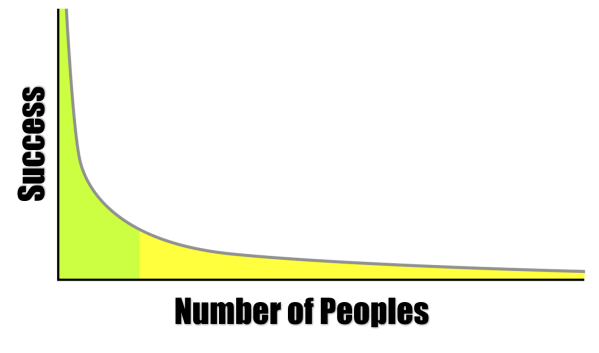
If we talk about the phenomenon of entertainment, we are definitely talking about how our brains operate. This means that we could expect to find a normal distribution in attitudes towards entertainment, with a peak in the middle and rapidly descending slopes on both sides. For example, one would expect such a distribution in the types of entertainment we prefer: the books we read, the shows we watch, the music we listen to. in fact, with a little statistical origami, we can do a quick check on this. Take a standard distribution curve and fold it in half along the “norm” line (shown as 0). The shape should look familiar. We have Chris Anderson’s Long Tail. The similarity of tastes close to the norm accounts for blockbusters and best sellers. These are the forms of entertainment that appeal to the greatest number of individuals. More esoteric entertainment tastes live well down the curve, in outlier territory.

Long_Tail

The Need for Entertainment Scale

I’ll come back to the types of entertainment we prefer and why in a later post. Today, I want to concentrate on another variable in the human psyche that also can impact our engagement with entertainment: how much do we need to be entertained? Why are some of us drawn more to fiction and others to non-fiction. Why do some of us like the escapism of a TV sitcom and others prefer to watch the news? Why do some of us have 5 TV’s in our house, with hundreds of digital channels, and others have none? What does the normal distribution curve of our need for entertainment look like. That was exactly the question that Timothy Brock and Stephen Livingston from Ohio State University tackled (The Psychology of Entertainment Media: Blurring the Lines between Entertainment and Persuasion. Publisher: Lawrence Erlbaum Associates. Place of Publication: Mahwah, NJ. Publication Year: 2004. p 255-268).

The need for entertainment seems to be almost addictive in some cases. In the study, Brock and Livingston restrict their definition of entertainment to passive consumption of some form of entertainment, either TV, radio, film, print, theatre or sport spectacles. Of these, television is the most common, so many of the measures revolved around our relationship with that specific entertainment medium. I’ve talked before about the impact of TV on society, but some of the empirical research on our reliance on the tube is astounding. In 2002, Robert Kubey and Mihaly Csikszentmihalyi found troubling evidence of a true biological addiction to TV:

“To track behavior and emotion in the normal course of life, as opposed to the artificial conditions of the lab, we have used the Experience Sampling Method (ESM). Participants carried a beeper, and we signaled them six to eight times a day, at random, over the period of a week; whenever they heard the beep, they wrote down what they were doing and how they were feeling using a standardized scorecard.

“As one might expect, people who were watching TV when we beeped them reported feeling relaxed and passive.

“What is more surprising is that the sense of relaxation ends when the set is turned off, but the feelings of passivity and lowered alertness continue. Survey participants commonly reflect that television has somehow absorbed or sucked out their energy, leaving them depleted. They say they have more difficulty concentrating after viewing than before. In contrast, they rarely indicate such difficulty after reading. After playing sports or engaging in hobbies, people report improvements in mood. After watching TV, people’s moods are about the same or worse than before.

“Thus, the irony of TV: people watch a great deal longer than they plan to, even though prolonged viewing is less rewarding. In our ESM studies the longer people sat in front of the set, the less satisfaction they said they derived from it. When signaled, heavy viewers (those who consistently watch more than four hours a day) tended to report on their ESM sheets that they enjoy TV less than light viewers did (less than two hours a day).

What value do we place on the ability to watch TV? Brock and Livingston gave 115 undergrads two scenarios. In the first, they could correct a hypothetical mix up in their official state citizenship in return for a one time cash gift. The undergrads were asked to put a value on changing their official allegiance from one state to another. 15% would do it for free and another 40% would do it for under $1000.

The next scenario asked the students what compensation they would require to give up TV for the rest of their lives. A permanent tracking implant in their ear would notify a monitoring service if they cheated and the entire gift would be forfeited. 8% were willing to do it for free, but over 60% would need at least a million dollars to give up TV forever.

Findings: Men Need More Entertainment & The More You Think , The Less You Need to Be Entertained

In their scale of the need for entertainment, Brock and Livingston assessed three factors: Drive (how actively do you pursue passive entertainment?), Utility (how useful is passive entertainment, both to you specifically and in general?) and Passivity (how active do you like your entertainment to be?).

So, how do we fare on our need to be entertained, based on Brock and Livingston’s scale? First of all, men seem to have a stronger drive to be entertained than women. Males scored higher on the amount they spend on entertainment, the daily need for entertainment and the inability to function without entertainment. One would assume that the “couch potato curve” would skew to the male side of the demographic split.

Also interestingly, Brock and Livingston found an inverse relationship between the need to be entertained and the “need for cognition” – a measure of how much people like active problem solving and critical thinking. Again, the more you think, the less reliant you are on TV.

In a follow up study, Brock and Livingston tried to draw a defining line between entertainment (in their definition, passive consumption) and sensation seeking. I’ll touch on this in tomorrow’s post.