The Marketing Classic Few Marketers Have Ever Read

First published August 22, 2013 in Mediapost’s Search Insider

It may be the best book you’ll ever read on marketing, but you won’t find it in the marketing section of Amazon.  They have it variously filed in three different categories: Politics and Social Sciences, Technology and Text Books. The book is Everett Rogers’ “Diffusion of Innovations,” and you should add it to your reading list.

The book is a comprehensive review of how new ideas spread and take hold in our society, and although it was first written in the 60s (it’s currently in its fifthedition), the findings are as fresh and relevant as ever. Its relevance to marketing is immediate and tangible. After all, what else is marketing but promoting the  adoption and diffusion of new things?

Rogers traces almost a century of diffusion research to see how everything from new high-yield corn varieties to birth control were adopted in various cultures. While there are not a lot of examples purely from the consumer marketplace, the generalized observations beg to be applied to marketing campaigns pushing new (and hopefully improved) products.

Consider these five innovation-specific variables that affect how quickly a new idea is adopted:

1)   Relative advantage – How much of a true advantage does the new innovation offer over what is currently being used? Rogers offers an important caveat here: “The receiver’s perceptions of the attributes of an innovation – not the attributes as classified by experts or change agents, affect its rate of adoption.”

2)   Compatibility – How well does the innovation fit into the framework of the customer’s current situation? Is it an incremental innovation, easily added, or a discontinuous innovation, requiring significant pain on the part of the user to adopt?

3)   Complexity – What is the learning curve that comes bundled with the innovation? The steeper the curve, the slower the rate of adoption.

4)   Trialability – Is it possible to try the product firsthand to determine the relative advantage (see #1)?

5)   Observability – Being the herders we are, adoption is sometimes a matter of “monkey see, monkey do.”

These factors may seem fundamental, but every day new “innovative” products are turned loose on the market, there to wither and die, simply because one or several of these check boxes remain unchecked.

Rogers also spend significant time looking at the social dynamics of diffusion and adoption, including the role of early adopters, change agents, influencers, mass communication channels and interpersonal persuasion. I found amazing close correlations to the findings of my own research into buying behaviors in the B2B world.

At the risk of oversimplifying this seminal work, Rogers found that adoption balances at the intersection of risk and reward. Risk stalls adoption, reward drives it forward, and clarity of communicating this risk/reward balance in a relevant way is either the catalyst or the inhibitor that determines how steep the adoption curve is.

This is a textbook, so expect a small investment of effort to wade through the rather academic delivery, but if you persevere (and to be fair, I’ve suffered through much worse in other books) you’ll come away with perhaps the clearest summation of marketplace dynamics ever put in print.

Maybe We Need More Skin in the Game

First published August 15, 2013 in Mediapost’s Search Insider

I think our world, — or, more specifically, our marketplace — is a little too abstract. We — and by we, I mean the marketers, the suppliers to the market — live too far removed from the market itself: the consumers of the supplied goods.

It’s a point touched on by Nassim Nicholas Taleb in his most recent book, “Antifragile.” Marketers and manufacturers, he suggests, don’t have enough skin in the game to keep them honest. They’re too far removed from accountability. There are too many protective buffers between them and the consequences of their actions.

The law is supposed to provide the accountability — but let’s face it, when it comes to enforcing accountability in the marketplace, we’re a long way from the Code of Hammurabi (one of the first legal codes known), where sloppy workmanship enacted a pretty definite penalty: If a builder has built a house for a man, and has not made his work sound, and the house he built has fallen, and caused the death of its owner, that builder shall be put to death.

Or, consider if the actions of the captain of the Exxon Valdez would have been different if he would have been answerable to a law like this: If a man has hired a boat and boatman, and loaded it with corn, wool, oil, or dates, or whatever it be, and the boatman has been careless, and sunk the boat, or lost what is in it, the boatman shall restore the boat which he sank, and whatever he lost that was in it.

The world was a smaller and more intimate place back then. You couldn’t hide behind corporate lawyers, malpractice insurance and legal loopholes. If you screwed up, chances are you’d lose an eye, a hand or even your life. If you built a bridge that collapsed, you might as well have been under the bridge, because your fate would be the same.

Now, I’m not sure we’re ready to return to the brutal simplicity of an “eye for an eye” legal code, but it does bring up a rather thorny issue: If there are little to no consequences for shoddy or unethical work, what keeps us honest? There’s nothing like skin in the game to provide some pretty compelling motivation for ethical business practices. And there’s nothing like a consequence-free pass to encourage fast and loose corporate behavior.

The good news, I suppose, is that technology is once again making the world a little more intimate. McLuhan’s Global Village is coming to pass, and the unethical of the world are increasingly being held accountable for their actions. In fact, the speed at which this is happening is confounding the legal systems of many a nation, as vigilantism and frontier justice are increasingly springing up, unchecked by due process and judicial oversight.

I avoid trying to predict the future, but fairness and accountability are hardwired into us, so I suspect that as technology allows us to identify those responsible in the most egregious cases, we will be moved to demand action. We will force the market to have more skin in the game, as our opinions and beliefs, in aggregate, will define that market.

Reengineering Hiring

First published August 9, 2013 in Mediapost’s Search Insider

In all my years in business, the one thing I found consistently difficult was hiring good people. We spent a lot of time honing our screening skills, but I sometimes suspect we would have been just as far ahead by flipping a coin.

Over time, we found we achieved pretty good success rates with our lower-level hires, but the one area where consistent success eluded me was in our management recruitment. It seemed that the more senior the position, the worse our track record was. We had a few outright disasters.

When it comes down to it, hiring someone is making a prediction. You examine the evidence and try to foresee if that person will perform at an acceptable level in the position you have vacant. And, as I said in my last column, we humans don’t tend to be very good at making predictions. The more there is at stake in the position to be filled, the worse the consequences if our predictions are faulty. In looking at our past management hires, I realize that it wasn’t that our predictive powers were any less effective, it’s just that the pain of being wrong was more acute.

So, it was with some reassurance and more than a dollop of schadenfreude that I learned that Google has had exactly the same problem. That’s right, Google — the same company that has a zillion brilliant engineers working on every problem known to mankind. But those engineers have to come from somewhere, right? Someone has to hire them. And there, ay, there’s the rub!

In a recent interview in the New York Times, Laszlo Bock, senior vice president for people operations at Google, confessed that Google has tweaked, and, in some cases, massively overhauled its recruitment process.  Take, for example, Google’s famous early predilection for college G.P.A.s. According to Bock, based on actual performance, “G.P.A.s are worthless as a criteria for hiring, and test scores are worthless — no correlation at all except for brand-new college grads, where there’s a slight correlation. Google famously used to ask everyone for a transcript and G.P.A.s and test scores, but we don’t anymore, unless you’re just a few years out of school. We found that they don’t predict anything.”

Google has also slowly backed away from its ironclad requirement that every hire have a degree. Bock revealed, “The proportion of people without any college education at Google has increased over time as well. So we have teams where you have 14% of the team made up of people who’ve never gone to college.”

Sometimes, interviewers fall into the trap of over-playing their own cleverness and “expertise.” We spend more time trying to stroke our own ego by staging an impromptu show of power during the interview than in really listening to what the interviewee is saying. Google found that tricks like brainteasers, while they may make the interviewer feel clever, are worthless in screening out duds. The much less flashy but tried-and-true list of standardized behavioral questions (“Give me an example of when you…”) is a far better predictive indicator.

Finally, Bock admits that screening for leadership positions is the most difficult challenge, because leadership is something that defies easy definitions. “We’ve found that leadership is a more ambiguous and amorphous set of characteristics than the work we did on the attributes of good management, which are more of a checklist and actionable.” So you can ask questions, probing for effective leadership, but because leading people tends to fall into the category of ill-defined problems, you often have to do the best job you can in the hiring process, and then track performance religiously. In this case, “slow to hire, quick to fire” is a good principle to follow.

I found Bock’s last words, on the role of Big Data in management decisions, including those involving people’s performance, revealing: “Big Data — when applied to leadership — has tremendous potential to uncover the 10 universal things we should all be doing. But there are also things that are specifically true only about your organization, and the people you have and the unique situation you’re in at that point in time. I think this will be a constraint to how big the data can get because it will always require an element of human insight.”

Marketing in the “Middle”

First published August 1, 2013 in Mediapost’s Search Insider

In case you haven’t heard, email is dead. In fact, it’s died several times. You could call it the cat of digital marketing, working it’s way through its nine lives. And it’s not alone. Search has died more than a few times. Display was DOA over a decade ago, and has resurrected itself, only to suffer several more untimely demises. In fact, for any digital channel you might care to mention, I can probably find an obituary.

For some reason, we love to declare things dead. We like clarity and finality, and there’s nothing like death for getting an unequivocal point across. Death, by its very nature, should be the final word – except that, in these cases, it almost never is. These channels, like Mark Twain, have had “the rumors of their deaths greatly exaggerated.”

It’s yet another example of how we hate ambiguity. We don’t like being in the middle, drifting between two far off anchor points. It feels uncertain and “mushy”. Humans don’t do well with “mushy”. We prefer predictability. We like to know where we stand, which requires knowing what’s under our feet. The middle represents “terra incognito” – undiscovered and unstable. We know, if we stand here, we have to be prepared to be nimble and fleet of foot.

This tendency comes down to an unfortunate human fragility – we like predictable outcomes, but we suck at making predictions. Not just some of us suck at it – we all suck at it. Philip Tetlock conducted a two-decade study looking at the success rate of “experts” in making predictions in a wide variety of subjects, especially politics. The outcome? Experts come out slightly ahead of coin tosses and chimps throwing darts. Tetlock’s long list of blundered predictions is staggering. Expertise does not lead to accuracy in divining the future. Yet, we still cling to this false hope. We crave a universe that unfolds as it should, or, at least, as we expect it to.

The messiness comes from the complexity of real life. There’s just too much “stuff” happening for us to make sense of it with our limited intellectual horsepower. Evolution, in its blind wisdom, has allowed for that by building in some natural defenses against complexity. We refer to them as instincts, emotions and beliefs. The nasty “gotch ya” in this is that the more we accumulate experience and knowledge, the more inflexible those beliefs and instincts become. We tend to adopt “big ideas” or “macro-beliefs” as guiding principles and philosophical anchors, which become the lens through which we see the world. We trade off open mindedness for expertise. Tetlock calls these “hedgehogs”, from Isiah Berlin’s essay. “Foxes”, on the other hand, draw on a wide variety of experiences to shape their views. They, by their nature, tend to live in the middle.  Tetlock found that foxes have much better track records when it comes to prediction. So, if you want to know what might happen, don’t ask an expert, especially one who is regularly seen on TV. Ask a dilettante – who is much more comfortable with “mushy.”

Ironically, Jim Collins, of Good to Great and Built to Last fame, also taps Berlin for the hedgehog and fox analogies, but he believed that “hedgehogs” are what makes great companies great, because they provide a single objective to focus on – the “hedgehog” concept.

So, who’s right – Tetlock or Collins? The answer, as you would expect in a column on this theme, is that they’re both right. The world is neither a place exclusively for foxes nor hedgehogs. The sweet spot is in the middle.

Nowhere is this truer than in marketing – which has to mirror all the irrationality of human behavior. There are no absolutes in marketing; there is just a lot of mushiness in the middle.  We need hedgehogs for the “big ideas” that make great marketing great. But we also need foxes to help us navigate through middle successfully.  In fact, the more time I’ve spent in marketing (trying assiduously to avoid becoming an “expert”) the more I’ve realized that the middle is where all the action is: between quantitative and qualitative, between strategy and big data, between creative branding and direct marketing, between science and art.

And here, in the middle, we hate to call anything “dead,” because you just never know what might happen.

The Problem with Corporate Org-charts

First published July 25, 2013 in Mediapost’s Search Insider

Last week, I talked about the chasm between marketing and sales in most organizations, with the customer left to perish in the middle. One of the responses to that column was that there’s an even bigger divide between marketing and IT (a subject my friend Scott Brinker has written extensively and eloquently about).  The systemic problem that underlies this is that organizational org charts aren’t built in consideration of a customer’s requirements. The structure of the vast majority of companies is decidedly un-customer-centric.

Typically, the dividing lines of a company are decided by competitive profit and loss requirements, arbitrary product categorizations or regional segments. Within these corporate fiefdoms, the hierarchy of management is dictated by corporate traditions that are at least three decades out of date.  They were designed to run a company where economies of scale and sheer mass were the goals. Corporate strategy was aimed at mass producing and distributing as much product as possible to as many markets as possible. The focus was internal, with management’s eyes focused on productivity and profitability. Marketing was largely unidirectional, from the marketer out to the market. There was little in the way of feedback loops.

The typical corporate quadrumvirate is the CEO, CFO, COO and CMO.  All of these traditionally focus their gaze inwards. The “outside-in” perspective is not explicitly outlined in any of these job descriptions. Theoretically, CMOs should be on top of their market, but in practice this view is largely provided through traditional market research, which is usually several degrees removed from the reality of the market.  Even if a truly honest view of a company is captured in a research report, by the time it is digested internally, it’s spun into a form that bears no resemblance to the original.  Alarming findings are ignored or downplayed. Positive findings are exaggerated to bolster reputations and protect pet initiatives.  Corporate BS is in full-flow. Management typically has no idea how an actual customer perceives the business and its products.

Lately, an alphabet soup of new corporate office titles has been trotted out, paying lip service to the idea of customer-centricity: CXO (X=Experience),  CRO (R=Relationship), CIO (I=Innovation), CCO (C=Customer) or CAO (A=Agility). I know of a company that recently appointed a CXO. She was given the title and office, but nothing more. She had no resources, no budget, no mandate and no authority. She was literally stapled on the side of the org chart, with no lines of connection to anyone else, save for a single line running from the CEO down to her.  She soon found out that this was a one-way line. None of her frustrated feedback was taken into consideration.

I suspect the same is true for the majority of these new “designer-labeled” executives. The lesson? You can’t put a Sierra Club bumper sticker on a ’88 Buick, hoping to end up with a Prius.

In response to last week’s column, one reader asked the excellent question, “How do we bridge the gap?” The answer, based on my experience, goes far beyond including it in this quarter’s list of strategic initiatives. This is a foundational problem, and you’re not going to truly fix it without ripping apart the structure of your organization and rebuilding from the ground up, ensuring that the customer’s requirements dictate the reconstruction blueprints.

Let’s face it, that’s just not going to happen in an organization that has several years invested in doing business the same old way. There are handfuls of new companies, however, who “get” the importance of understanding their customers right out of the starting gate. They are re-engineering the org chart away from the traditional practice of simply being “big & profitable” to becoming “intimate and responsive,” knowing that profitability will come from that. They are eschewing typical titles, and all the political baggage that comes with them, in favor of creating new customer-aware roles with real authority.

In the end, I don’t think this is a “problem” that can be “fixed.” It’s one species of corporation, which will eventually be supplanted by another, better adapted to a new market environment.

Marketplace Chasm: The Divide Between Marketing and Sales

First published July 18, 2013 in Mediapost’s Search Insider

Marketing people and salespeople don’t like each other very much. Oh sure, to be politically correct, they will pay lip service to the ideal that they’re all part of one big happy family, working for the common good of the company. But deep down, you know what I say to be true.  Salespeople don’t trust the sneaky and manipulative ways of marketing people. And marketing people think salespeople are a bunch of type A prima donnas. I know –I’ve heard the backstabbing begin when one or the other leave the room. These are two tribes that are uncomfortable sharing the same teepee.

I believe it’s because they don’t think alike. Marketers are long-range operators. They are more comfortable at a distance from their target – sort of like a bomber pilot in WWII. There, they can objectify the campaign, thinking in abstract strategies. They like the 30,000-foot view. Up there, you can see the big picture and plan accordingly. It’s also a lot less messy.

Salespeople like trench warfare. They prefer rolling up their sleeves and battling it out on the front lines, where rulebooks routinely get tossed in favor of whatever works. Ask any office administrator whom the worst culprits are when it comes to filling out forms and filing reports –an accusatory finger will be pointing directly at the sales department door.  The salesperson’s philosophy is that the rules don’t apply to them, as long as they get results.

Look at one common point of confrontation between the two: the lead-gen form. Marketing people want to gain as much information as possible to plug into the prospect database, so they can slice and dice the data to their heart’s content. They’re not completely happy until they can segment and profile based on height, weight, religious affiliation, shoe size, ethnic background, educational level, blood type, current mood, number of relevant sites visited in the past 72 hours, underwear worn, pets owned and brand of toothpaste preferred. All a salesperson wants is a name, some form of contact and a semi-regular pulse. They’ll take it from there.

So, what’s the big deal? Who cares if salespeople and marketers don’t play nice together?  Well, I care. And I say that as a customer. The problem here is that as the sales department and the marketing department have their little turf skirmish, I’m caught in the war zone. All I want is the smoothest possible path to my eventual purchase, on my terms, at my speed. Your job, Ms. Salesperson and Mr. Marketer, is to help me get there. I don’t really care who got blindingly drunk at the last corporate retreat, or who is consistently a pedantic ass at the weekly sales and marketing “huddle.” I just want to buy the best stuff at the best price — period.

What inevitably happens when marketers and salespeople feud is that the path to purchase gets dictated by them, rather than by the customer. Hand-offs from one department to the other can be unnecessarily bumpy, due to internal problems that have nothing to do with the customer. Sometimes, the lack of communication between the two sides requires customers to do all the heavy lifting to keep the sale on track — including supplying information multiple times, constantly explaining their requirements and having to sit through redundant sales pitches.

In the old days where a disconnected, asymmetrical market was the norm, the divide between marketing and sales was less noticeable. We didn’t really start interacting with a vendor until we were in front of a sales rep. Marketing just primed the pump, so to speak. But today, in a more interactive, symmetrical market, we expect a seamless journey from the world of the marketer to the world of the salesperson. We make no distinction between the two. Unfortunately, the same is not true within the walls of the vendor’s organization. As long as these departments continue to feud, the customer will be the ultimate loser.

The Ill Defined Problem of Attribution

First published July 11, 2013 in Mediapost’s Search Insider

For the past few years, I’ve sat on the board of a company that audits audience for various publications. One of the challenges the entire audience measurement industry has faced is the explosion of channels traditional publishers have been forced to use. It’s one thing to tally up the audience of a single newspaper, magazine or radio station. It’s quite another to try to get an aggregate view of an audience of publishers that, in addition to their magazines, have a website, several blogs, various email newsletters, a full slate of webinars, a YouTube channel, multiple Twitter accounts, Facebook pages, other social destinations, digital versions of magazines and an ever-growing collection of tablet and smartphone apps. Consider, for instance, how you would estimate the size of MediaPost’s total audience.

The problem, one quickly realizes, is how you find a common denominator across all these various points of audience engagement. It’s the classic “apples and oranges” challenge, multiplied several times over.

This is the opposite side of the attribution problem. How do you attribute value, whether it’s in terms of persuading a single prospect, or the degree of engagement across an entire audience, when there are so many variables at play?

Usually, when you talk about attribution, someone in the room volunteers that the answer to the problem can be found by coming up with the right algorithm, with the usual caveat something like this: “I don’t know how to do it, but I’m sure someone far smarter than I could figure it out.” The assumption is that if the data is there, there should be a solution hiding in there somewhere.

No disrespect to these hypothetical “smart” data-crunchers out there, but I believe there is a fundamental flaw in that assumption. The problem behind that assumption is that we’re accepting the problem as a “well defined” one – when in fact it’s an “ill-defined” problem.

We would like to believe that this is a solvable problem that could be reduced to a simplified and predictable model. This is especially true for media buyers (who use the audience measurement services) and marketers (who would like to find a usable attribution model). The right model, driven by the right algorithm, would make everyone’s job much easier. So, let’s quit complaining and just hire one of those really smart people to figure it out!

However, if we’re talking about an ill-defined problem, as I believe we are, then we have a significantly bigger challenge. Ill-defined problems defy clear solutions because of their complexity and unpredictability. They usually involve human elements impossible to account for. They are nuanced and “grey” as opposed to clear-cut “blacks and white.” If you try to capture an ill-defined problem in a model, you are forced to make heuristic assumptions that may be based on extraneous noise rather than true signals. This can lead to “overfitting.”

Let me give you an example. Let’s take that essential human goal: finding a life partner. Our task is to build an attribution model for successful courtship. Let us assume that we met our own livelong love in a bar. We would assume, then, that bars should have a relatively generous attribution of value in the partnership “conversion” funnel. But we’re ignoring all the “ill-defined” variables that went into that single conversion event: our current availability, the availability of the prospect, our moods, our level of intoxication, the friends we were with, the song that happened to be playing, the time of night, the necessity to get up early the next morning to go to work, etc.

In any human activity, the list of variables that must be considered to truly “define” the problem quickly becomes impossible. If we assume that bars are good places to find a partner, we must simplify to the point of “over-fitting.”  It may turn out that a grocery store, ATM or dentist’s waiting room would have served the purpose equally well.

Of course, you could take a purely statistical view, based on backwards-looking data. For example, we could say that of all couples, 23.7% of them met in bars. That may give us some very high level indications of “what” is happening, but it does little to help us understand the “why” of those numbers. Why do bars act as a good meeting ground?

In the end, audience measurement and attribution, being ill-defined problems, may end up as rough approximations at best. And that’s OK. It’s better than nothing. But I feel it’s only fair to warn those who believe there’s a “smarter” whiz out there who can figure all this out: Human nature is notoriously tough to predict.

Comparing and Contrasting the Classes of ’79 and ’13

First published July 2, 2013 in Mediapost’s Search Insider

My youngest daughter just graduated from high school. I graduated from my high school a third of a century ago. The things you read about every day here at MediaPost have made the world a much different place for her than it was for me.

Or have they?

I was actually struck these past few months with how her grad experience didn’t seem all that much different than mine. The biggest difference, it seemed, was in how she connected with her friends. But the “why” – the topics of those connections – seems very familiar.

She is graduating from a small school, with a grad class of just over 50. I graduated from a small-town high school in Alberta in a class of 70. Like me, she has gone to school with most of her class from kindergarten right through to grade 12 – so the social dynamics in both cases were fairly tightly woven.

Both classes, the class of ‘13 and the class of ’79, were under the temporary euphoria of youthful confidence. All things seem possible when you’re 18. The world is not a grinding gristmill of monthly mortgage payments, day-to-day job-related drudgery, vague yet persistent aches and pains and innumerable other nagging details that suck the life out of you. It’s a lion waiting to be tamed, a journey begging to be taken or an adventure still to be had. Is there any more optimistic time in your life than graduation? I wish that it could last forever, but I know better.

Both classes had their inevitable run-ins with authority that seemed unreasonable and inflexible. In both cases, said “run-ins” arose from social “traditions” that ran afoul of scheduled class time. Both times, the phrases “can’t condone” and “set a precedent” was used a lot by the school administration. Of course, such nuances don’t mean much to you when you’re 18. “Party” is a word with much more meaning.

Speaking of parties, both classes had their share. The biggest difference between ’79 and ’13 was in how word of these parties propagated through the grad social network. In 1979, “viral” meant hanging out at the main intersection of town (I told you I grew up in a small town) waiting for familiar trucks (I told you I grew up in Alberta) to go by, so you could ask where the party was. Today’s approach seems much more efficient.

Style also played a major role in both events. In many cases, it’s our first experience with formal wear, which means a lot of time is devoted to dress and/or suit shopping. My daughter has been wearing high heels in the house for the past week, hoping to master the trick of locomotion without severe injury. Of course, in my case it was a very stylish dark brown velvet tuxedo with matching bowtie. Hey, it was ’79, and my fashion influences were “The Love Boat” and Jack Tripper from “Three’s Company.” Cut me some slack! There were people who went in blue jeans (remember – rural Alberta).

Another major theme was, and is, “Who’s going with who (sic)” to graduation. For those of us who were less precocious in our experience with the opposite sex, a lot of pressure came with graduation. We had to get a date, or be labeled as “the guy who went stag.” This meant you had a lot of socially inept teenagers going through the trauma of a first date at the same time, in the same place. All the technology in the world can’t improve person-to-person communication in this scenario.

It seems to me that though the way the class of ’13 negotiated through their grad experience may have changed since 1979, the actual things that make up that experience seem remarkably familiar. It’s still about transition: whether it be in relationships, opportunities, routines or responsibility.  It’s that awesome experience of sitting on the cusp, when all things seem possible. It’s believing that you own the world – and that  the world is an essentially good place. Whether you express that on Facebook, Instagram or while leaning on the side of a Chevy pick-up at the “Four Corners” in Sundre, Alberta — the “how” may have changed, but the “why” has remained the same.

The Story of the Underwood Typewriter Company

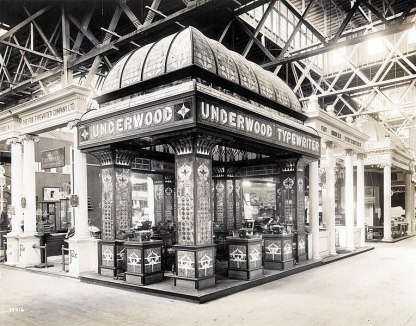
Underwood_Typewriter_Company_exhibit_in_the_Palace_of_Liberal_Arts_at_the_1904_World's_Fair

Underwood Typewriter Company exhibit in the Palace of Liberal Arts at the 1904 World’s Fair – Wikimedia Commons

First published June 20 in Mediapost’s Search Insider

A few weeks ago, I introduced you to my Underwood No. 5. Today, I’d like to tell you a little bit about the company that created the iconic No. 5. The story may be over a hundred years old, but that doesn’t mean that the businesses of today can’t learn from it.

The first designs for the typewriter started showing up in the 1870s. After some rather imaginative designs, including one that looked like a pincushion, the Sholes and Glidden Type Writer (1873) was the first writer to introduce the QWERTY keyboard (which I’m still using today). The QWERTY design was (supposedly) introduced to overcome the physical limitations of the machine, which tended to become jammed if frequently used keys were located next to each other. The reason we still use it? Well, suffice to say, habits are a tough thing to break.

The S&G design, and all the other variations that followed for the next two decades, tried various approaches, but all had one thing in common: They were all “understroke” or “blind” writers. The keys hit the paper on the bottom of the platen so users couldn’t see what they were typing.

In the mid-1890s, John T. Underwood was trying to figure what to do with his company, a fairly significant provider of ribbons and carbon paper to then-industry-dominant typewriter manufacturer Remington.  That company had spun off its typewriter division from the sewing machine division, which in turn had evolved from its main business, making guns. But Underwood had heard that Remington had plans to start making its own consumables. He countered by declaring, “All right, then, we’ll just build our own typewriter.” Fate upped the ante by bringing together Underwood and German-American inventor Franz X. Wagner.

Wagner had designed a better typewriter. Or, at least, he had reached an acceptable compromise by combining many of the best innovations of the competitors, together with a few twists of his own, and putting them together into a new package (Does this sound a little like a precursor to the iPhone?). The result was a design that would define what almost every typewriter would look like for the next six decades, until the electrified IBM Selectric.

Underwood quickly locked down Wagner’s design by purchasing his company – and then made Underwood the biggest manufacturer of typewriters in the world. To say Underwood dominated was an understatement. The No. 5 outsold all other competitors combined for the first two decades of the 20th century.

In 1927, Underwood merged with Elliot-Fischer to consolidate market share, with the goal of ensuring dominance. But the decline had begun. One of the problems was that Underwoods seemed to last forever, so replacement sometimes took decades. The other challenge came in the form of a minor distraction known as World War II. During the war, Underwood cranked out carbines for the troops.

By the ‘40s, at the end of the war, Underwood struggled to regain relevance and dominance. But it was saddled by technology that was almost half a century old – all the company knew how to build and sell. There was no “next big thing” to open up new markets. Underwood was also held back by inertia. It was hard for company strategists  to understand why the thing that made them so successful was no longer potent enough to enable survival (Microsoft?).

Eventually, Underwood was gobbled up by Olivetti (1959) and the Underwood name last appeared on a portable Olivetti built in Spain in the 1980s.

There are a few relevant lessons here.  The more dominant your technology, the more likely it is that your company will be limited by it. Dominant technologies, no matter how innovative they are when they first appear, tend to build inertia in organizations as they ride a long winning streak. Struggle is good for the corporate soul, and the simple fact is, competitors are forced to struggle, which makes them sharper, more nimble and more aggressive.

Secondly, along with inertia, successful companies also become complacent. They generally don’t start looking for the next big thing until the existing product line (or lines) begins to falter — and by then, it’s too late. The competition, which is hungrier and moves more quickly, has too much of a lead on them.

And thirdly, it seems that the more reliant companies are on a single product or business line, the more susceptible they are to the inertia and complacency that comes with dominance. They are restricted by a single product cycle, rather than spreading their chances for survival over multiple bets, each at different stages of market maturity.

Underwood is no more. But for four decades, it had a good run. It’s difficult to say whether this is a sad thing, or it’s just the inevitable life cycle of a company.

The Open and Shut Mind

First published June 13, 2013 in Mediapost’s Search Insider

A few years ago I was invited to a conference on advertising at a major university. The attendees were a fairly illustrious group of advertising professionals, including several senior executives from major agencies. There was also a healthy sprinkling of academics with impeccable credentials. I was in privileged company.

The organizer of the conference asked me to come up with a “dinner topic.” She explained that she wanted to generate a lively discussion at the various tables as we dug in and broke bread. It was okay if it was a “little” controversial. I must have ignored the qualifier, because my suggestion was, “Is advertising evil?” I have never been one for half measures.

As the ad illuminati settled at their tables, I set the stage by providing two opposing points of view:

First, the positive side of advertising. It can be a way to touch the very core of what makes us human, sometimes moving us to greatness. It can unify communities, create bonds and motivate us en masse. Not only can it be a social “lubricant” but, at its best, advertising can be a powerful change agent as well.

Now, the “evil” side: Does advertising take all this power and fritter it away to drive pure avarice?  Does it short-circuit our Darwinian behavioral wiring, chaining us to a hedonistic treadmill where we constantly want something we don’t have? Regular readers will detect a theme here.

It wasn’t difficult to read the mood of the room as I was wrapping up. My dad has a saying that, despite its off-color nature, sums up the atmosphere of this particular gathering better than anything else I can think of: “It went over like a fart in the house of worship.” I cautiously headed back to my table to take part in the planned “lively discussion.”

My tablemates didn’t know where to start. It seemed that it had never crossed their mind that advertising could be anything but the highest of callings. To have a debate, you need to at least have an abstract understanding of the opposing viewpoint, even if you don’t agree with it. At my table the most common question was, “What do you mean, ‘Is advertising evil?’” I had apparently introduced an entirely foreign concept.

I swallowed and forged ahead, sketching out the basis of my hypothesis. I tried to stay in the abstract, hoping to generate a philosophical debate and avoid getting caught in an emotional catfight. It seemed, though, that I had not only hit a hot button, but had taken a sledgehammer and smashed it to smithereens. Advertisers, at least based on this particular sample, seemed unwilling to discuss the philosophical pros and cons (or at least the cons) of their profession. I just wanted the whole evening to end as soon as possible.

My purpose here is not to reopen the debate. I use this story to illustrate an unfortunate human tendency. We live in a world of grays, but we like to think in black and white. I doubt that advertising is totally evil, but I also doubt that advertising is totally good. The truth lies between the two extremes; advertising is most likely a rather dirty gray.  If we’re willing to consider alternatives to our beliefs, perhaps it will move us a little closer to reality. I think advertising would do nothing but benefit from a deeper evaluation of its moral standing.

But we often forego a search for the truth, content to stick with our beliefs, which often bear little resemblance to reality. If those beliefs are attacked, we defend them vociferously, turning a deaf ear to counter-arguments. We don’t listen, because open minds require the burning of a lot of energy.

In a simpler evolutionary environment, beliefs were a heuristic shortcut for survival.  But today, they often polarize us at either end of a moral spectrum, with no middle ground left for discussion. Case in point, the current American political landscape.

I have spent most of my adult life trying to fight this natural tendency. I have tried to keep an open mind and not let my beliefs blind me to an opposing viewpoint — at least, not when it comes to those things I believe to be truly important. Morality, religion and politics are just three arenas where open minds are much harder to find than staunchly held beliefs.

And, apparently, you can add advertising to that list as well.