
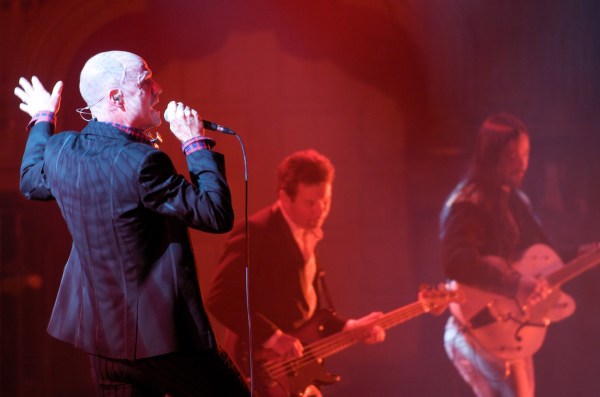
If one nation ever identified with one band, it would be Canada and The Tragically Hip. Up here in the Great White North, one can’t even mention the band without the word “iconic” spilling out. And, when iconic is defined as “a representative symbol or worthy of veneration” – well, as a Canadian, all I can say is – the label fits. I went on about why this was way back in 2016 when the Tragically Hip did their farewell concert in Kingston, Ontario. Just 14 months later, lead singer Gord Downie was gone, a victim at far-too-young an age of glioblastoma – a deadly form of brain cancer.
If you are at all curious about how a bond can build between a nation and a band, I would highly recommend diving into the new Prime Video docuseries, The Tragically Hip: No Dress Rehearsal. Directed by Gord’s brother, Mike Downie, it’s a 256-minute, 4 part love story to a band. A who’s who of famous Canadian Hip fans, including Dan Ackroyd, Jay Baruchel, Will Arnett and even our Prime Minister, Justin Trudeau, go on about the incredible connection between the band and our nation.
But, like all love stories, there is bitter and sweet here. Over their 32-year history as Canada’s favorite band, there were rough patches. Mike Downie interviews the remaining 4 band members and pulls no punches when it comes to talking about one particularly tense time – from 2009 to 2014 – when the band was barely communicating with each other.
Most Canadians had no idea there was “Trouble at the Henhouse” (the name of the Hip’s 6th album). As George Stromboulopoulos, a Canadian journalist who interviewed the band more than once, said, “”There are a couple of things that you can’t tell the truth about in this country, and one of the things you can’t tell the truth about in the country is that the guys in the Tragically Hip probably didn’t get along as often as everybody said they did.”
As I watched the series, I couldn’t help but think about the strange nature of band identities and how they play out, both internally and externally. How and why do we find part of our identities in a rock band, and what happens on the inside when the band breaks up? That didn’t happen to the Hip, but that’s possibly because Downie received his terminal diagnosis in 2015 and he wanted to do one last tour.
In the Panther, the campus newspaper of California’s Chapman University, reporter Megan Forrester explores why bands break up. She points to a psychological theory as the possible culprit: “Psychology professor Samantha Gardner told The Panther that friction and an ultimate dissolution of a group happens due to social identity theory. This theory suggests that any group that people associate themselves with, whether that is an extracurricular club, volunteer organization or a band, helps boost their self-esteem and reduce uncertainty in one’s identity.
“But once the values of the group change course, Gardner said that is when tensions rise.
‘The group members may have thought, ‘I don’t think this identity of being a member of this group is really who I am or it’s not what I envisioned,’ Gardner said.”
The issue with bands is that evolution of values and identities happens at different times to different members. We, as the public, find it hard to identify with 4 or 5 individuals equally. We naturally elevate one or – at the most – two members of the band to star status. This is typically the lead singer. That can be a tough pill to swallow for the rest of the band who play just beyond the reach of the spotlight. That is, in part, what happened to the Tragically Hip. When you have a mesmerizing front man, it’s hard not to focus on him. Gord Downie was moving at a different speed than the rest of the Hip.
But an equally interesting thing is what happens to the fans of the band. Not only do the members get their identify from the band. If we follow a band, we also get part of our identity from that band. And when that band breaks up, we lose a piece of ourselves. We still haven’t forgiven Yoko Ono for breaking up the Beatles, and that supposedly happened (we should blame social identity theory rather than Yoko) over 50 years ago.
I think the Tragically Hip also knew Canada would never forgive them if they broke up. We needed to believe in 5 guys who were happy to be famous in Canada, who more than once flipped US-based stardom the bird (including getting high before their SNL debut) and who banded together to create great music for the world – but especially Canada – to enjoy.
There’s nothing new about us common folks looking to the famous to help define ourselves. We’ve been doing that for centuries. But there is a difference when we look to get that identity from a group rather than an individual. Canada has lots of stars – singular – that we could identify with: Celine Dion, Drake, Justin Bieber. So why did 5 guys from Kingston, Ontario become the ones we chose as our identity badge? We did we resist the urge to look for an individual star and chose the Tragically Hip instead?
I think part of it was what I wrote before: the Tragically Hip appealed to Canadians because they stayed in Canada and gained a very Canadian type of stardom. But I also think Canadians liked the idea of identifying with a group rather than an individual. That was a good fit for our shared values.
Let’s do a little “napkin-back” testing of that hypothesis. If Canadians looked to a band for identity, would a more individualistic culture – like the U.S. – be more likely to look for that identify in individuals?
Given U.S. domination of pretty much every type of culture, you would expect it to also dominate a list of the greatest bands of all time. But a little research on Google will tell you that of a typical Top 10 list of the Greatest Bands, about two-thirds are British. There are a few that are American, but they are typically named with the same formula: Lead Singer + the Name of Band. For example: Prince and the Revolution, Joan Jett and the Blackhearts, Bruce Springsteen and the E Street Band. There are exceptions, but I was surprised how few really famous US based bands have names that are not tied to a person or persons in the band (Nirvana and The Eagles are two that come to mind).
Let’s try another angle: as our culture becomes more individualistic – as it undoubtedly has over the last 3 decades – would our search for identity follow a similar trend? There again, the proof seems to be in our playlists. If you look for the greatest hits of the last 20 years, you will find very few bands in there. Maroon 5 seems to be the only band that creeps into the top 20.
Be that as it may, I recommend taking 256 minutes to learn what Canadians already know: The Tragically Hip kicked ass!
 Out of My Gord