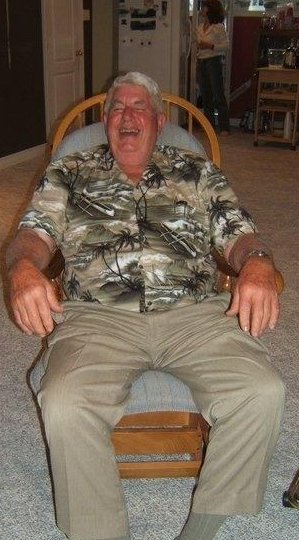
Uncle Jim: My Information Highway

105004556_10156866970385670_4530696031889839476_nFor my last post of 2010, I’d like to take a little detour from my usual subject matter and tell you about someone very special to me. I’d like to introduce you to my Uncle Jim, who passed away on Christmas day. He was, in many ways, a precursor to the connected world we write about constantly in this column.

Uncle Jim was a long-haul truck driver. For most of his life, he delivered bricks in Eastern Canada and the United States. Over the last several years of his career, he hauled specialty vehicles for the rich and famous (i.e. he transported Celine Dion’s car from Florida to Vegas). It was this last job that caused him to crisscross the continent. And it was during this time that many of us in the family got to know Uncle Jim.

Our family is pretty spread out. In Canada, we literally span the country, from Halifax to Vancouver. And we have members who also live south of the 49th parallel, primarily in Texas. Over the years, the bonds of our family have had to become pretty elastic to accommodate the intervening miles. But the bonds have never stretched to the breaking point, and one big reason for that was Uncle Jim.

Uncle Jim was our original information highway. Family was vitally important to Jim, and as he crossed the continent, he’d always set time aside to drop in on his various nieces, nephews and cousins. Jim kept a trucker’s timetable, which meant you wouldn’t get much warning. You’d get a call, which generally went like this; “Hey, it’s your Uncle Jim. I’m in town. Got time for a coffee? I’d like to see you.”

Jim didn’t care about how tidy your house was, or whether there was anything to feed him. He was a man who appreciated a hot cup of coffee and a good chat. You would bring him up to date with your life, and in return he’d share his treasure trove of family tidbits from across the country. Through Jim, you’d reacquaint yourself with your far-flung family: the cousins who were expecting, starting a new job, going to school or getting engaged. At the end of the visit, you were always very glad you took the time for a “coffee and a chat.” And Jim was always gracious and grateful for the time you took out of your day to share with him.

Uncle Jim made the life of a long-haul trucker tolerable by using it to become the glue of our family. He tied us together in ways that we’ve only now begun to appreciate with his passing. To a person, each of us have our “Uncle Jim” stories which have become so precious to us. We even had “Uncle Jim” alerts. My sister, who lives in Edmonton (about a 12-hour drive from our home) would give me a quick call to let me know Uncle Jim was on his way and I could be expecting a call soon. This gave us enough time to grab some cookies to have with coffee.

In the past few years, as Uncle Jim battled with cancer, I was able to return the favor. Whenever my travels took me anywhere in the vicinity of their home, I took an extra day to spend some time with my aunt and uncle. I didn’t think it was possible, but in the past three years (since his original diagnosis) family became even more precious to my Uncle Jim. Whether it was weddings, reunions or joint family vacations, he was never too ill to travel and spend time with family. Fortunately, my wife and I were able to host one of these reunions at our home a year and a half ago. It would become the last family reunion that Uncle Jim was able to make.

My last visit with Jim was a week before his passing. We didn’t have coffee, but we did talk about family and share some laughs. The burly truck driver was barely recognizable in a physical sense, weighing less than half what he once did, but the spirit was still there. He struggled to sit up so he could shake my hand. He was so grateful for the time I took out of my day to spend those last few minutes with him. I can’t express how much I’ll miss those visits.

On Christmas day, we all struggled with our loss. But somehow it was fitting that Jim’s far-flung nieces and nephews reached out online to share our grief. We posted little slivers of our sadness on Facebook — and from those slivers, a picture of Uncle Jim began to emerge. It seemed fitting to me that the portrait of a man who spent so much time on the road came from people separated by miles but united by memories.

I’d like to end 2010 with my own Facebook memorial to my Uncle Jim:

Uncle Jim… there’s a stop ahead where you can rest for the night. The food is good, the coffee hot, the traffic light and there are friends and family waiting for a visit. You’ve had a long haul with a tough load. It’s okay to let someone else take the wheel. You’ve more than earned a rest. Sleep well, Uncle Jim, sleep well. Your job is done! 

Search Breaks Out of the Box in Park City

First published December 9, 2010 in Mediapost’s Search Insider

Wow! The Search Insider Summit is in full swing in Park City, Utah and for the first time in six or seven Summits, I’m not there. I don’t mind saying, it’s feeling kinda weird.

Laurie Sullivan and the team, including your emcee Aaron Goldman, did a bang-up job putting the show together. I did have some limited involvement, looking on from the sidelines as they lined up the speakers and nailed down the agenda. They’re touching on all the hot topics: the convergence of display and search, social and search (pretty much everything and search); new platforms to allow for more effective targeting; the ongoing changes on the SERP; using data to make smarter marketing decisions; and yes, once again, how mobile will change everything (and this time, it’s really true!).

The agenda is a broad one, reaching into virtually every aspect of online activity. And really, that’s what any search agenda has to be. One of the ongoing challenges of programming the past several Summits has been where to draw the line. Despite the best efforts of many to define the search “box,” search is not a box, a channel, or a tactic. It’s what we do. And as such, it connects everything. We search in social networks. We search on mobile. And if we happen to see an ad that triggers our interest, the odds are very good that we will — you guessed it — launch a search. So a Search Summit has to be, by necessity, a Social/Mobile/Testing/Analytics/Display/Target and Segmentation Summit. You can’t keep search in a box.

I started writing this column way back in 2004. Since then (for almost 300 columns), I’ve been watching how search has seeped into every nook and cranny of online behavior. It’s become the gold standard for intercepting a consumer with intent. Search inventory forms the core of any performance marketing strategy worth its salt. Most of the things Goldman and Company will be talking about, nestled in the silver frosted peaks of Utah, revolve around extending the accountability and performance of search into other channels. Once you’ve tasted the search Kool-Aid, it’s hard to settle for any other flavor. The problem is, of course, with the keyword-restricted limits on search inventory, there’s only so much Kool-Aid to go around.

But another thing struck me while I ran down the Summit agenda: we’re talking about things we would have never talked about in 2004. We’re talking about the users on the other side of that search interface as real live people, not just volume numbers in a keyword discovery tool. Tony Fagan from Google will be talking about how constant testing helps hone your marketing skills against actual behaviors. Eli Goodman from comScore will share some tasty data about how Google Instant is changing behaviors on the results page. And, of course, you can’t dive into social media without understanding how people behave when they’re traveling with the herd.

If there’s one thing I’ve found lacking in search marketing, it’s the “marketing” part of the industry. More often than not, search plays out as a technical exercise, full of algorithms, rules and tools, rather than what marketing should be: a drive to forge relevant connections to people with needs, fears and dreams. When I programmed the Summit, I always tried to bring that perspective to the stage. I’m glad to see Laurie and her team have also kept the human part of search very much alive at this Summit.

Have fun, Search Summiters. I’ll miss you (and will see you in Captiva)!

A Tale From the Trenches: 14 Years in the Search Biz

First published October 28, 2010 in Mediapost’s Search Insider

Maybe you’ve heard the news. I’ve got a new gig. This week, the Yellow Pages Group in Canada acquired the company I co-founded. As I said to my partner, Bill, as we walked out of the office Monday, “Today is the last day we worked for Enquiro.” Although we’ve been ear-lobe deep in the deal for the past several months, for some reason that’s when it hit us. Tuesday, we came to work for a new company: Mediative.

The deal is interesting in a number of ways: a traditional publisher with a strong digital foothold in a market where the consumers are light years ahead of the marketers in Internet savvy, all set on a stage right next to the springboard of the digital revolution. It may not be “The Social Network” (and I’m certainly not Aaron Sorkin) but there are at least a couple good columns there. However, that’s for the future.

Today, it’s all about me.

But, as I pondered this, I realized my story is also the story of this industry. I’ve been doing this since 1996. No one was really doing it before that, so we made it up as we went along. Eventually this Internet thing gained enough critical mass that I had to find other people to do the same thing I was doing. Before I knew it, we had a company. And, because the Internet was growing like a runaway express train, our company became one of the fastest growing companies in Canada. We ran hard, just to keep from being run over.

Somewhere along the line, in addition to inventing an industry on the fly, helping clients who are desperately trying to figure out what the hell just happened to marketing and doing the cha-cha with Google’s algorithm, we also had to figure out how to run a company. As I soon found out, it’s one thing to do something yourself to earn a buck. It’s an entirely different thing to get a bunch of people doing the same thing and somehow transform that into a company — preferably a company that makes money. There are no guidebooks on how to build a search agency. And the headaches you have with a search agency of six people are entirely different than the headaches you’ll get with 13 people, or 23 people, or 34 people. I’ve had them all at various points in the last 14 years.

Just when you think you’re getting the hang of it, throw in a year like 2000 or 2008. It’s one thing to run an Internet company when everyone’s scrambling to throw money at you. It’s an entirely different thing when everyone goes into lockdown mode and companies are disappearing faster than free beers at a search conference.

Speaking of search conferences, those turned out to be our group therapy sessions, but you really had to read between the lines to get to the truth. I saw my friends and colleagues go from wild-eyed enthusiasm to world weary yet dogged determination. We kept hearing stories of people getting rich in search, but it was tough to nail down the facts. By and large, we all just kept plugging away, making enough money to keep the lights on and knowing that working anywhere else, while undoubtedly more lucrative, just wouldn’t be the same thing.

It’s been a 14-year gauntlet and I’ve got the collection of bruises to show for it. Somewhere on this decade-and-a-half ride I got old. I went from being an “upstart” to being a “village elder” (yes, I’ve actually been called that on more than one occasion). I went from being “bright” to being “wise.” I suppose there are worse things to be called.

I don’t mean to make this sound like a swan song. I’ll still be very much part of the search biz in my new gig. But, as I found out when I walked out the doors of Enquiro on Monday night and in the doors of Mediative Tuesday morning, this is a new chapter for me. Indulge me as I thumb through the ones that preceded it.

But you know what? In hindsight, I wouldn’t change a thing. All things considered, it’s been a hell of a ride!

Hello Yellow: Enquiro Now Part of YPG

Okay..it’s been a long time since my last blog post. I’ve been busy. In addition to everything else I’ve been doing over the last several months, we sold our company. Something had to give. And blogging drew the short straw. Sorry. I’ll be better in the future. I promise.

For anyone who’s done this, you know that this can be like strapping yourself into a roller coaster that appears to have no tracks. My wife said: “Oh my God, it’s like giving birth!” I’ll have to take her word for it.

But, by and large, it’s been pretty cool. I add the “pretty” qualifier because as lovely as lawyers and tax accountants can be, I’ve spent far too much time with them this summer. Sorry, “pretty cool” is the best I can do.

So, you ask breathlessly, “What’s the scoop?” Well, we were bought by a public company, YPG in Canada, and I’m told I have to be careful about what I say. One more thing I’ll have to get used to.

Yes, Enquiro was bought by a Canadian Yellow Page publisher..THE Canadian Yellow Page publisher. And I’m pretty pumped about that. Let me explain why.

These are not your Father’s Yellow Pages…

When they laid out their vision of the potential of the Canadian online landscape, I realized early on that these are smart people. They’ve been buying up online properties at surprisingly brisk pace. Today, they sit with one of the largest online networks in the country, and the largest Canadian owned one. What’s more, the properties they own all share one common trait, they’re all there to deliver on intent. So if you define this by intercepting people who are ready to buy something, this is one powerful network.

Here’s the nasty little secret about Canada. Canadian people are heavily wired. We spend more time on line than our US cousins. It must be those long winters. But Canadian advertisers are 4 to 5 years behind the digital curve. I don’t know why. They just are. That creates a huge opportunity gap, and YPG realized that. So they wanted to do more than just wire together a network of intent driven properties. They wanted to introduce a brand new digital offering that ties together platforms, publishers and people. They called it Mediative. That’s what’s now on my business card.

This doesn’t mean the US clients we’ve grown up with will be replaced by new Canadian upstarts. We’re going to continue aggressively growing our US footprint. It’s hard to keep digital marketing within borders. This move actually helps us do that, with new bases of operations closer to our markets on the East Coast and in the Midwest.

I like to think that Enquiro has been a strong contributor to the search marketing landscape over the past 14 years (yes, I optimized my first site in 1996). This is, in some ways, a step in a new direction, but the reason I was interested in this partnership in the first place is that it allows us to ramp up many of our plans.

Ode to an iPad

First published October 21, 2010 in Mediapost’s Search Insider

I really had no idea how much I’d love my iPad. I have to say that it’s now my preferred connection to the online world. Somehow, whether by design or coincidence, Apple has tapped into something primal and intuitive in myself. Judging from other iPad owners I’ve talked to, I suspect I’m not alone. There is a magical thing happening between me and this sleek little device. And whatever it is, it’s important, even prescient. This, I suspect, is our future sitting in our laps.

What’s the Big Deal?

I’ve spent a good part of my life pondering various technology interfaces. Based on this, I really didn’t think the iPad was that big a deal. The reason I got one was because I needed an ebook reader and I felt that the iPad offered me more functionality than a Kindle. But other than the inevitable coolness (or, at least, perceived coolness) that comes with any Apple device, I didn’t see what all the buzz was about. After all, it was just a big iPhone… without the phone. I still had to deal with an all-too-touchy digital keyboard and a rather anemic processor.

But then I got my hands on one. And something rather strange happened. I suspect that Apple may have found the perfect form factor. When you combine the larger screen with multitouch technology, it completely changes how I interacted with my device. It wasn’t something I could have predicted. But everything I did on the iPad just seemed more natural, more enjoyable, more — dare I say it — sensual. This was one sexy little piece of technology.

Love of the Limbic Kind

What happened? There is no new technology here. We’re even using an obsolete OS, for heaven’s sake. There may be no rational reasoning — but I’ll tell you, my irrational mind has fallen in love. Then again, perhaps it has nothing to do with ration. Maybe Apple is just making interactions with technology more primitive, in a good way.

Keyboards are stupid in pretty much every way imaginable. I’ve dedicated several hours of my life to understanding the QWERTY layout so I’m a reasonably proficient touch typist, but the layout still makes no sense — and yes, I’m aware of the history of it vs. the Dvorak keyboard.. The mouse was a step in the right direction, but there was still some rewiring of our brains required to understand that the cursor was really our proxy for our hand movements.  I find track pads a rather poor compromise.

But, to be able to grab something right in front of our eyes and manipulate it, ah — that is touching something hardwired deep in our limbic brain.  To flick, to stroke, to pinch — that is what it means to be human. Up ’til now, our user experiences have had to be jammed in the arbitrary constraints of outdated and illogical interfaces. But the iPad, perhaps more than any other device before it, is letting us be human again. And the experience is intoxicating.

The Human Part of HCI

I felt something of the same rush when I first picked up the iPhone, but the extra real estate of the iPad delivers a compounding effect on the level of the user experience. Perhaps you think I’m making a big deal out of nothing, but I suspect that the very humanness of the iPad’s interface could be a game-changer. I’m not the first to say so. This was much of the buzz I discounted when the iPad first came out. But now I’ve had the chance to see what might be behind the game-changing aspects of this device. And ironically, it’s nothing to do with new technology. In fact, it’s wrapping existing technology in a package that nailed the “human” part of the human-computer-interaction equation.

The question that comes to mind is, how might this change the nature of our online experiences? If our entire online history has been built on the paradigm of a keyboard/mouse/monitor interaction, how might that change with a multitouch, interactive screen? And that’s not even including geographically savvy devices, cameras or voice commands. That’s a substantially different paradigm, which will inevitably lead to a substantially different experience. Imagine, interacting with a virtual world where you can picture your surroundings, know where you are, touch the things you’re interacting with and express your intent verbally.  Finally, technology will start to catch up with what it means to be a human.

Warning: Bitchy Columnist Ahead

First published September 30, 2010 in Mediapost’s Search Insider

It’s been a weird week on the road. I’ve been bouncing around like a pinball along the East Coast and Midwest. I miss my kids. I miss my wife. I miss my bed. I have to blow off a little steam and you’re in the line of fire. So be it.

First of all, why the hell do they call it the Midwest anyway? If you draw a line down the middle of the continental United States dividing east and west, it bisects North Dakota, South Dakota, Nebraska, Oklahoma and Texas. Everything west of that should be west, and everything east of that should be east. The Midwest, according to my reckoning, would be somewhere around Idaho and possibly Arizona. It sure as hell ain’t Chicago. That would actually be the Mideast, or Middle East if you prefer. Confused? Me, too.

Secondly, where do hotels get off charging exorbitant rates for WiFi access and then give you a thin dribble of bandwidth that shuts on and off like a bad neon light? Multiply 13 bucks a night by 200 or 300 rooms for an average-sized hotel. That’s about $3,000 every day, or a million dollars a year. This isn’t rocket science, people. For that money, I should have a data pipe the size of a Volvo plugged into my laptop. And don’t even get me started on the connectivity you find at most digital conferences.

Perhaps you could take some of that windfall WiFi revenue and put it toward something extravagant, like an extra power receptacle in a hotel room that doesn’t already have fourteen lamps, a TV set, a coffee maker and a radio plugged into it. Did the designers of the average hotel room not think that electricity might fall into the category of a “nice to have?”

While I’m on the travel theme, why can’t seats be reclined when you take off or land? Does it throw the delicate aerodynamic balance of the plane off, sending it doing cartwheels down the runway? Is there some drastic physiological effect on your body if you’re not at a 90-degree angle, like your eyelids inverting or your nasal passages spontaneously combusting? Just wondering.

And what, exactly, will happen if I don’t power my electronic device “all the way down”? Does some residual power leakage cause the plane’s navigation system to think east is west or up is down? If so, that’s something we should crack down even harder on — perhaps if we just connected a simple cell activity detector to an ejection seat system. It would save the flight attendants a lot of time and grief.

By the way Mr/Ms Airline CFO, if I spend $600 on a ticket to fly from Toronto to Chicago, will giving me a full can of pop, rather that a 2-ounce thimble already jammed with ice, really send you into bankruptcy? If the edge of profitability is really that narrow, perhaps a better place to save money would be the hundreds of pounds of fuel you burn circling O’Hare for 45 minutes before you get the OK to land. It’s worth checking out, anyway.

One last thing. On behalf of all the office workers who work in high-rises across North America, please remember that as you prance around your hotel room in various states of undress, you can see in those windows as well as see out of them. That’s not one-way glass separating your room from the office across the street. There may be occasions where the view is agreeable, but I suspect they’re few and far between, based on the people I usually share a hotel elevator with.

OK, I feel better. Thanks for the therapy. Feel free to go back to your work now.

Zappos and the SNAFU Syndrome

First published September 23, 2010 in Mediapost’s Search Insider

Who can say no to MediaPost Publisher Ken Fadner? Certainly not me. And so, next Monday, I’ll be joining all you OMMA-ites (OMMAhanians?) in New York City for the big show. Ken wanted me to set the stage by spending a little more time talking about a subject I raised a few columns back, entitled “SNAFU: the New Normal.” In that column, I mentioned that a lot of companies going through huge transitions ask if there are any examples of other companies that have done it right. I said then the simple answer is no. We’re all figuring this stuff out as we go. But today, I wanted to share a further thought from one of the people that asked that question:

Enough Zappos Already!

“Tell me, are any companies doing this right. And don’t give me examples like Amazon or Zappos. I’m sick of hearing about these dotcom poster children. We’re not them. We can’t do the same things!”

Coincidentally, I’ve just finished reading Tony Hsieh’s book, “Delivering Happiness,” where he gives his perspective of what worked and what didn’t at Zappos.  One passage, in particular, shows that Zappos is not immune to the SNAFU Syndrome:

“It may seem sometimes like we don’t know what we’re doing. And it’s true: we don’t. That’s a bit scary, but you can take comfort in knowing that nobody else knows how to do what we’re doing either. If they did, they’d be the Web’s most popular shoe store. Sure, people have done parts of what we do before, but what we’ve learned over the years at Zapoos is that the devil is in the details. And that’s where we’re breaking new ground.”

It’s More than Foosball

Here’s the thing: Survival in the SNAFU storm is not about pizza lunches, foosball tables or wacky staff parties. It’s not about gourmet cafeterias, Segways or even culture handbooks. Hsieh didn’t do anything with Zappos that hadn’t been documented long before the dot-com era. He (like me) is a big fan of Jim Collins (“Good to Great”) and  Dave Logan  (“Tribal Leadership”). The foundations laid out in both those books have been field-tested across many different types of companies, from hospitals to hotels, grocery stores to banks, manufacturers to consulting firms. In fact, in both books there is a notable lack of high-flying dot-coms, as that wasn’t the flavor du jour when these books were researched.

These books look at the very foundations of organizational effectiveness and found that it wasn’t about cultural perks; it was about believing in something. Success comes from the feeling that you’re part of a bigger whole. It was about rising above profit statements and shareholder reports by creating a mission that makes people want to come to work in the morning.

Zappos isn’t about selling shoes. In the big scheme of what’s truly important, footwear doesn’t factor very highly. Zappos is about spontaneously creating smiles through exceptional experiences.  And that, my friends, is something any company can aspire to.

North Star

Here’s why these organizational foundations are so important in the new world. It’s very easy to lose your bearings in a sea of SNAFU. As I said, there are no maps or blueprints to follow. Strategies and five-year plans can get torn to shreds in a matter of seconds. When that happens, you’re going to need something to set your bearings by. Inspiring mission statements and real, living, breathing core values will always be there. They rise above strategy. They’re a North Star that’s always in sight.

If you do this right, everyone knows why they come to work in the morning. And, when the world goes to hell on you, it will give you a bearing point against which you can correct your course and head in the right direction.

Want to give yourself a chance to survive the SNAFU Syndrome? You don’t have to be Zappos or Amazon (and even they don’t have any guarantees). You just have to make up your mind to do it. Start by reading these two books.

If you’re not inspired, consider a new career. If you don’t now, you’ll probably be forced to later.

Will Canada Get Some Google Respect?

First published September 16, 2010 in Mediapost’s Search Insider

Just in case our friends to the south haven’t driven it home to us repeatedly, Canada is inconsequential. We’re a rounding error in revenue projections. We’re a few scattered bodies somewhere north of the 49th, a far-flung geographic extension of Montana, Minnesota and other assorted northern states. We’re an inconvenient expanse of land separating the mainland from Alaska, bad news for air commuting but good news for the cruise business. In general, we often get the feeling that life would be easier for the rest of you if we just went away.

A Really Soft Launch

But haven’t you heard? Google is investing in the Canadian market! The company is ramping up its sales team here. Well, you can be forgiven if you haven’t heard, because the news was barely a drop in the PR bucket next to the roar that was the launch of Google Instant.

And that, in a nutshell, is the story of our lives up here in the Great White North. You really don’t care. I remember being in Oklahoma once the morning after the Canadian federal election. Naturally, I was somewhat curious who won. I picked up the copy of USA Today that was dropped outside my hotel room and thumbed through the entire paper to find out who the leader of Canada might be. That, by the way, would be your single largest trading partner, not to mention your primary source of oil, wood, grain and several other essential natural resources. But somehow, the vast editorial resources of USA Today couldn’t be bothered to devote even one column inch to the future of your neighbor to the north.

Canada’s Coming-Out Party

Google has had a sales office in Canada since 2002, but it hasn’t been an easy task selling to Canadians. I myself have gone on record in the past saying Canadian marketers may have a somewhat obtuse view of digital marketing, due to their contorted vantage point. We’re a Canadian company that does 85% of its business with U.S. companies because of this lag in our native marketplace.

But Google apparently believes we’re worth further attention. Maybe it’s because Google’s CFO, Patrick Pichette, is Canadian. He boasts of having a picture of a Tim Horton’s sign on his Nexus One. I haven’t had a chance to connect yet with the Canadian ex-pat, Chris O’Neill, who’s currently in transit from Mountain View to Hogtown (that would be Toronto, for you non-Canucks) to unfurl the Google banner. According to his bio, O’Neill is as Canadian as they come. He grew up working in his parent’s Canadian Tire store, for heaven’s sake. I look forward to having a polite chat and a frosty Molson’s to welcome him home. Perhaps we’ll even strike up a game of street hockey and celebrate with some poutine after. A word of advice though, Chris: Don’t forget your toque — it’s getting a little nippy up here in the evenings.

Full Speed Ahead… Maybe

Seriously though, I suspect Google’s timing might be bang-on. I think Canadian business is ready to get serious about digital. I know Canadian consumers made that decision long ago. And once Canadians get over their natural fear of just about anything involving any degree of risk, they do tend to make up for lost time. When you combine these factors, I suspect the Canadian marketplace is ripe for some serious digital revolution. But, to be on the safe side, maybe we should strike a Royal Commission on the subject and wait two or three years for their report.

In any case, it will be great to have a few more voices preaching the digital gospel in the Canadian wilderness. When you have this much room and this few people, it can get mighty lonely up here.

SNAFU: The New Normal

First published September 2, 2010 in Mediapost’s Search Insider

Last week I heard this in a meeting:”We’re in the middle of tremendous change. The organization is going through the biggest transition in its history.”

The line is usually delivered with a mix of desperation, a touch of helplessness and an apologetic tone. The admission comes, with the predictability of a carefully timed script, as I’m trying to assess where companies are in terms of their digital marketing maturity.

Just a few years ago there was a lot of brash boasting about how cutting-edge companies were, but it’s been a long time since I’ve heard that confidence. Even former dot-com rock stars are realizing that they have a lot to learn. They know things are messed up and they think it’s their fault. Somehow things have gotten fouled up in the execution machinery of their company. They’re not smart enough, nimble enough or gutsy enough.

Hello, My Name is Gord, and My Company is Struggling to Keep Up…

Here’s the secret that most of these companies don’t know. As gut-wrenching the changes they’re going through — as messed-up as everything seems to be — they’re not alone. I hear that same apologetic admission from almost every company I meet with. I say it myself with a regularity in our internal company meetings that has lead to the formation of a betting pool with our more cynical team members. The next line that follows in the script is a desperate question: “Can you give us an example of a company that’s doing this right?”

The answer, though disappointing, is at least succinct:”No.”

We’re all learning — and we’re all screwing up. Get used to it, because it’s the new normal. This is the environment in which we have to learn to exist. There are no blueprints or case studies of perfect execution, because we’re heading into virgin territory.

If You Don’t Laugh, You Cry

World War II gave birth to my favorite acronym: SNAFU. It stands for “Situation Normal: All F*&%ed Up.” As a born cynic, I love the tang of acrid yet amused resignation in the face of an impossible situation that the term carries. It sums up the one attitude that ensures that we will eventually triumph: Look, we all know the world is a big ball of crap. Suck it up and get the job done. And while you’re at it, stop your whining.

There are two things that have shoved the world into massive disruption. First, we have the tidal wave of change unleashed by digital technology. It was like strapping a rocket pack on the back of our society and lighting it up. The only problem was that we didn’t know where we were going. At first, it didn’t matter, as long as we were moving fast. We were just exhilarated by the speed at which we were moving.

That led to the second factor, the crumbling of the economy. Suddenly, fast wasn’t good enough anymore. We had to be fast and focused. The stuff we did had to make sense. We — and by we I mean everybody — were being held accountable.

There’s Actually a Name for This…

These twin factors are ushering us through a period economists call a Long Wave Transition. Venezuelan economist Carlota Perez, in particular, has spent a lot of time thinking about this.

Here’s a quote from one of her papers:

“The problem is that, in such periods, institutions face a chaotic and unaccustomed situation, which requires much deeper changes than the great majority of their leaders and members had ever experienced. The difficulty is increased by the fact that there are no proven recipes and change has to take place by trial and error experimentation under the pressure of the very high social costs of the techno-economic transformation.”

Or, in other words: SNAFU. Get used to it, because you’re not alone.

Thoughts from a Few Miles Above Tintern Abbey

First published August 12, 2010 in Mediapost’s Search Insider

Funny, how our brains make us hang on to things that make little sense in the new scheme of things. For as plastic as the brain is, there are worn grooves that cannot be denied. We are creatures of habit and those habits comfort us, making us feel in control of our environment. Even when there is no rationale for our recurring behaviors, habits keep things plowing along, giving us a sense of equilibrium.

Every time I cross the Atlantic, where history is the natural state of things, I gain a new appreciation for this clash of the new and the old. It creates a fascinating juxtaposition of digital efficiency and deeply carved human habits. Europe is steeped in this paradox, but somehow it seems to keep wobbling along. Traditions don’t die here; they just lift one foot and plant them on the speeding express train that is technology, hoping to maintain a tentative balance as the other foot drags along the accumulated baggage of the centuries.

Hotchkisses in the ‘Hood

Today my family and I returned to my ancestral homeland, in the shadow of the Wye Valley, a picturesque vale that separates Wales from England. This area could quite justifiably be called the cradle of tourism. When the industrial revolution created a leisure class in England, they started getting cabin fever and itchy feet. Their leisure travels started fairly close to home and the picturesque Wye Valley was an early destination. Writers, poets and painters including William Wordsworth, Robert Bloomfield, Thomas Gray, William Thackeray, Alexander Pope, Samuel Coleridge, and J.M. Turner visited the area and effectively created the very first tourism ads.

The day is come when I again repose
Here, under this dark sycamore, and view
These plots of cottage-ground, these orchard-tufts,
Which, at this season, with their unripe fruits,
Among the woods and copses lose themselves,
Nor, with their green and simple hue, disturb
The wild green landscape.

From “Lines Written a Few Miles Above Tintern Abbey,” by William Wordsworth

The Jury-Rigging of a Continent

Fast forward to today. I sit in a 200-year-old cottage a mere stone’s throw from the Abbey that inspired Wordsworth’s idyllic reverie. In fact, the cottage was probably built during Wordsworth’s lifetime. I like to think that his carriage could have passed it by on the way to his vantage point above the Abbey the day he wrote his poem. Today, the cottage has been retrofitted to keep up with the times, with a satellite dish tacked onto the front and a digital lifeline from British Telecom snaking up the outside of the white plastered walls.

This cottage isn’t the only thing that’s been jury-rigged for the future here. The Welsh Tourism Board is no stranger to the benefits of technology. They were early adopters of the Web, putting together one of the better online tourism resources and being early believers in the power of search marketing. It’s appropriate that the originators of the modern tourism industry should be one of the first to recognize the rational beauty of digital information. No wasteful resources required, global accessibility and the ability for the user to find and interact with specific information. Even a Luddite (a movement, interestingly enough, that started not too far from here about the same time Wordsworth was penning his poem) would have to grudgingly concede the benefits of virtual tourism brochures.

Old Habits Die Hard

Yet today, in the shadow of Chepstow Castle (close to the Abbey and the oldest surviving stone fortification in Britain, dating from William the Conqueror) I went to the visitor information office and left toting at least two pounds of anachronistic, impractical, highly irrational literature. Somehow, even though my family travels with a digital inventory rivaling that of the average Apple store, I felt more comfortable with a good old printed piece of paper, or rather, several hundred pieces of paper. I, of all people, should realize how stupidly wasteful this is, but I couldn’t help myself. It just felt right. And somehow, it felt even more right with the accumulated weight of the ages pressing down on me.

But all is not lost. Tomorrow night, I’ll be taking my family to see an outdoor production of “Romeo and Juliet,” which will be held at the Abbey under the stars (the Abbey has been roofless for centuries). And I’ll be booking my tickets online. As I said, clashes between old and new abound here.