The Bleeding Obvious File: Advertising Leads to Increased Search Volumes

Holy crap, it’s official! There is a link between advertising and the volume of searches. We now have research to prove it. A recent analysis for the Retail Advertising and Marketing Association found a direct link between consumers exposure to advertising and their likelihood to begin an online search.

Consumers said they were most motivated to begin an online search after viewing:

  • Advertising in magazines (47.2%)
  • Newspapers (42.3%)
  • Ads on TV (42.8%)
  • From reading articles (43.7%)

In a particularly insightful quote, Mike Gatti, Executive Director of RAMA, said, “… while search engine marketing continues to be a popular strategy, retailers should not lose sight of traditional advertising channels to promote products and services.”

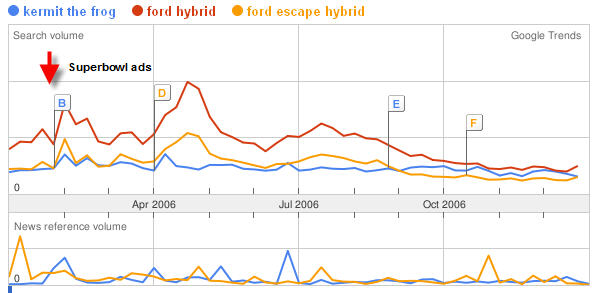
Huh? We’re now worried about search taking too much of the advertising budget away from TV, magazines and newspaper? Has Mr. Gatti seen how that particular pie is sliced up lately? If anything, we should flip this and tell all those advertisers dumping millions on television that they should back up those campaigns with a few bucks spent on relevant search terms. Here’s just one example. In 2006, Ford spent mega bucks to promote their new Green line of Hybrid Ford Escapes on the Super Bowl in television ads. They had Kermit the Frog as their spokesperson..er…spokesfrog. But what Ford didn’t remember is that all that media attention would probably drive a resulting spike in search activity. And sure enough, as we can see from the Google trends graph below, there was a spike:

ford campaign

Unfortunately, Ford forgot to bolster their keyword buy by including all related phrases, leaving the door open for General Motors to bid higher for a number of generic relevant phrases, including Ford’s own spokesperson, Kermit the Frog, and intercept search users with pinpointed messaging. The total cost for Ford to close the loop on this particular campaign? Probably less than the cost of Kermit’s personal assistant during the filming of the ad.

Wise Words about Branding from the Usability Sage

First published June 29, 2006 in Mediapost’s Search Insider

Jakob Nielsen knows a lot about usability. He’s perhaps the world’s foremost expert on how people use Web sites. I finally had the chance to meet Jakob face to face last week (we’ve been trading e-mails for some time) in San Francisco at his Usability Week Summit. I was down there to sit in on his one-day session on eyetracking.

No Graphics for Nielsen

Jakob takes a pretty austere view of the user experience. One can tell this from his own website, useit.com. Perhaps his most famous quote is “Flash: 99% bad.” He takes a similarly dim view of animations and large graphics, which lead to “banner blindness,” he says. In fact, other than the obligatory head and shoulder shot on his bio page and a small arrow glyph used to indicate hierarchy in his breadcrumb navigation bar, there are no graphics on useit.com. He goes on at some length about this. Why no graphics? He’s pretty adamant that they add nothing to the user experience. We’re not in complete agreement about this, but I get his point.

Jakob’s Nielsen Norman group has recently added eyetracking to its usability arsenal. If ever you’re looking for justification for not using large graphics on a site, look (sorry, no pun intended) no further than eyetracking heatmaps. In session after session, users skirt around large graphic blocks, focusing their interaction on text and navigation. It can be a rude slap in the face for most graphic designers (there’s a rather amusing anecdote about one such encounter that happened at the session, and an example of the phenomenon I’m talking about, on my blog).

Experience, Not Exposure

In the session, Jakob tossed out a line, the import of which I’m not sure was fully appreciated by the audience. When responding to a question from the audience about the seeming contradiction between the need for building of brand exposure and best practices for usability, Jakob said that online, brand value is built through experience, not exposure.

Whoa! There’s a world of wisdom in those eight little words! Beneath them lies a whole different way of looking at online engagement. It sums up something I’ve been hammering away at for years now. A successful user experience builds brand equity in a way that hammering visitors over the head with Flash or streaming video never could. Every single thing on a Web site should have one purpose, to make that user experience more successful. If it’s there solely for the gratification of the designer, or the CEO, or the CMO, it’s there for the wrong reason. And before you dismiss this thought, saying it doesn’t apply to you, take a look at your home page and ask yourself, why are the elements that are on the page actually there? Think through the decision process that placed each element on the page. How present were users in the process? Who was asking them for their opinion?

User Success In Search

This is a best practice in any Web site’s design, but it becomes particularly true when looking at search-generated leads. Search visitors reek with intent. They are incredibly single-minded in their purpose. They’re looking for a clear path ahead to their intent, and they’ve cast the first few steps down that path through their search query. They’ve come to the site not because they’re engaged with your brand, although that may have helped sway them in your direction, but because they’re engaged with a task. Get between them and the successful completion of that task at your peril. Every time you throw something at them that’s not aligned to that intent, you decrease their chances for success, eroding the value of your brand in their eyes. If you make them wait 20 seconds for a Flash file to load, that’s 20 seconds of ticking on a time bomb that could blow your brand to smithereens. If you throw in a large stock photo with the typical generic smiling face that takes up 70 percent of your home page, you’re wasting prime real estate. But don’t feel bad, it happens to the best of us. At least Jakob practices what he preaches on his site. What would you see if you went to the home page of Enquiro? A generic smiling face. But I’m working on it!

Lights! Camera! Google!

Google will be rolling out user initiated video advertising across it’s AdSense network.

Broken record time. I applaud Google’s decision to keep engagement with the video in the hands of the user.

But on a more fundamental level, I have to question the whole level of engagement with display advertising on sites. It seems like the harder advertiser’s scream, the more determined we are to ignore them. On a recent eye tracking study we did for MarketingSherpa, we were absolutely amazed with the small amount of scanning done in the typical ad positions on a page. Less than 10% of visitors even looked at these sections (top banner, right and left rail) of the page. Now, the purpose of the study wasn’t to look at this aspect specifically, but the scan patterns were undeniably clear. Interestly, text based ads that appeared within the flow of the main content had higher scanning levels, even when they appeared well below the fold.

Of course, these numbers are probably not terribly surprising, given the fact that visitors aren’t there to look at ads, but it makes you question the whole idea of paying by impression. If you’re buying based on a CPM model, realize that for every 1000 impressions, only 60 or 70 people are actually seeing the ad, even for a split second. Suddenly, those low clickthrough rates start to make sense.

Search Supercharges Ad Platforms but What’s In It for the User?

Seems like all the innovation lately with the search engines has been in rolling out sophisticated ad targeting platforms. Yahoo’s the latest to blow their horn about their own back end (and I realize that paints an ugly picture).

I’m a search marketer, and I love the advances that are being made in being able to target geographically, demographically and behaviorally, but I can’t help but think, “Who are we targeting?”. While the engines try to woo advertisers with better tools, what good is it doing if their market share is dwindling because they’re not giving the user a reason to use the engine?

I have not seen a significant improvement to the every day search user experience from any of the big 3 in years. One may argue that if you take advantage of search history or other enhancements that have debuted in beta, it offers more value to the searcher. But that does nothing for the vast majority of searches that happen every day on Google, Yahoo and MSN. Nobody has upped the ante. Ask is the only engine I’ve seen that made some significant changes on the interface (more about that later today).

As a search marketer, it’s all about market share. It takes time to target and strategically plan a campaign, and while the new platforms offer some impressive capabilities, they also add time required to manage them. Am I going to use that time to target 11% of the search market, 23%  or 50%? It just makes sense to use your time where it gets you the biggest return.

A word of advice. Worry about getting the users first, then worry about the tools to target them.